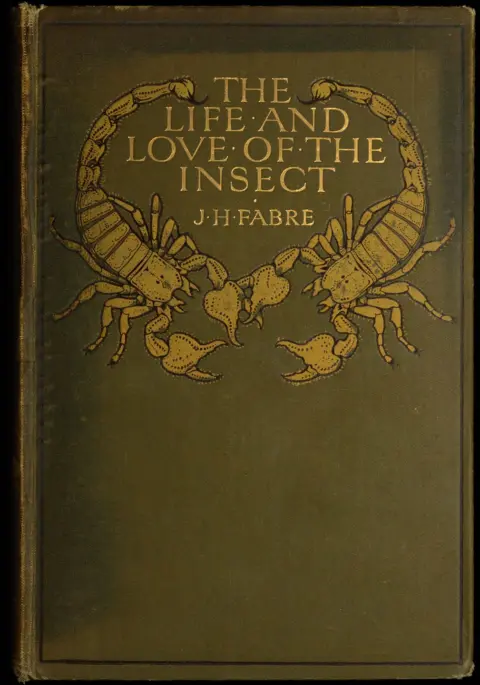
The Life and Love of the Insect
Jean-Henri Fabre
THE CLASSIC COLLECTION · 1919
"The Glow-Worm and Other Beetles" by Jean-Henri Fabre is a scientific publication written in the early 20th century. This work primarily explores the life and behavior of various insects, specifically focusing on beetles and their unique characteristics, with an emphasis on the glow-worm. Fabre’s writing reflects a meticulous approach to entomology, blending detailed observations with poetic descriptions of the insects’ lives and habitats. The opening of the text introduces the glow-worm, notable for its bioluminescent tail, which is celebrated in popular culture and science alike. Fabre details its physical characteristics and fascinating predatory behavior, particularly highlighting the glow-worm's method of incapacitating its prey, the snail, using an anaesthetic bite. With vivid imagery and scientific inquiry, the introduction sets the stage for a deeper exploration of the glow-worm’s life cycle, its evolutionary traits, and the intricate dynamics of its ecological niche. The narrative is rich with observations that blend scientific rigor with a narrative flair, inviting readers into the enchanting world of insects.
Introduction adapted from the source catalogue; source summaries may be automatically generated.
Free to read · English · 100,114 words · No account needed
MAKE TIME FOR A GOOD BOOK
On by default. Untick to stop anonymous reading totals. Each page counts after 10 seconds in view. How this works.
Anonymous counting is on unless you have switched it off.
Not a fortnight has elapsed before a strip, built up on the rim, has doubled the length of the Long-legged Clythra's shell, in order to maintain the capacity of the earthenware jar in proportion to the size of the grub, which has been growing from day to day. The recent portion, the work of the larva, is very plainly distinguishable from the original shell, the product of the mother; it is smooth over its whole extent, whereas the rest is ornamented with tiny holes arranged in spiral rows.
Planed away inside as it becomes too tight, the jar grows wider and at the same time longer. The dust taken from it, once more kneaded into mortar, is reapplied outside, more or less everywhere, and forms a rubble under which the original beauties end by disappearing. The neatly-pitted masterpiece is swamped by a layer of brown plasterwork; not always entirely, however, even when the structure reaches its final dimensions. If we pass an attentive lens between the two humps at the lower end, we very often see, encrusted in the earthy mass, the remains of the shell of the egg. This is the potter's mark. The arrangement of the spiral ridges, the number and the shape of the pits enable us almost to read the name of the maker, Clythra or Cryptocephalus.
From the very first I could not imagine the worker in ceramic paste designing its own pottery by drafting the first outlines. My doubts were justified. The grubs of the Clythra and the Cryptocephalus possess a maternal legacy in the shape of a shell, a garment which they have only to enlarge. They are born the owners of a layette which becomes the groundwork of their trousseau. They increase it, without, however, imitating its artistic elegance. A more vigorous age discards the laces in which the mother delights to clothe the new-born child.
Acarus, 33, 44
Adder, 294, 296
AEgosomus scabricornis, 317
Ammophila hirsuta (Hairy Ammophila), 96, 304
Andrena, 55, 85
Anoxia, 266
Ant, 294
Anthaxia nitidula, 216
Anthidium (see also the varieties below), 180, 236, 280
Anthidium bellicosum, 180
Anthidium scapulare, 179
Anthophora (see also the varieties below), 28, 30-34, 37, 39-41, 43-45, 53-61, 63-71, 73-75, 77-82, 84, 88, 90, 93, 97, 100, 103-105, 107-110, 114, 126, 128, 131, 139, 151, 163, 176, 179
Anthophora parietina, 28, 86, 90
Anthophora personata (see Masked Anthophora), 86
Anthophora pilipes (see Hairy-footed Anthophora), 29, 64, 84, 86,
106
Anthophora retusa, 86
Anthrax (see A. sinuata), 30, 37, 158, 199
Anthrax sinuata, 30, 35
Anthrenus (see also A. musaeorum), 33, 44
Anthrenus musaeorum, 33
Ant-lion, 13, 366, 368
Asparagus-beetle, Asparagus-grub (see also Field Crioceris, Twelve-spotted Crioceris), 436, 439
Audubon, John James, 348, 350
Azure Hoplia, 274
Bacon-beetle (see Dermestes), 294
Banded Epeira, 284
Bear (see also Cave-bear), 359-360, 400, 447
Beauregard, Dr., 161-162
Bee (see also Bumble-bee, Hive-bee, Mason-bee and the varieties), 28-30, 34, 45, 53-54, 56-57, 59, 60-65, 67, 70-71, 77, 79, 82, 85, 86, 88-90, 92, 97, 99, 101, 105, 106-108, 110, 128, 141-142, 144, 154, 163, 176, 178, 278, 298
Bee-louse, 85
Beetle, passim, 7, 28, 31
Beetle's Gamasus, 314
Belle (see Spurge Hawk-moth), 283
Bernardin de Saint-Pierre, Jacques Henri, 235
Bison Onitis, 245, 262
Blackbeetle, 388
Blackbeetle of the Sun (see Sacred Beetle)
Your reading position is saved on this browser. Take it to another device with a library code. Reading pages adapt to text, rather than matching a printed edition.
Jean-Henri Fabre
Jean-Henri Fabre
Jean-Henri Fabre
Jean-Henri Fabre
BEHIND THE BOOK
This eBook is for the use of anyone anywhere in the United States and most other parts of the world at no cost and with almost no restrictions whatsoever. You may copy it, give it away or re-use it under the terms of the Project Gutenberg License included with this eBook or online at www.gutenberg.org. If you are not located in the United States, you will have to check the laws of the country where you are located before using this eBook. Read the source licence.
The original source file, including credits and licence, is retained by this library. Request an original-format copy at no charge. Please include the book title and Project Gutenberg identifier #27868.
KEEP YOUR CURIOSITY GOING

John Muir

Asa Gray
Asa Gray

Florence Nightingale
Elizabeth Robins Pennell
Denison Olmsted