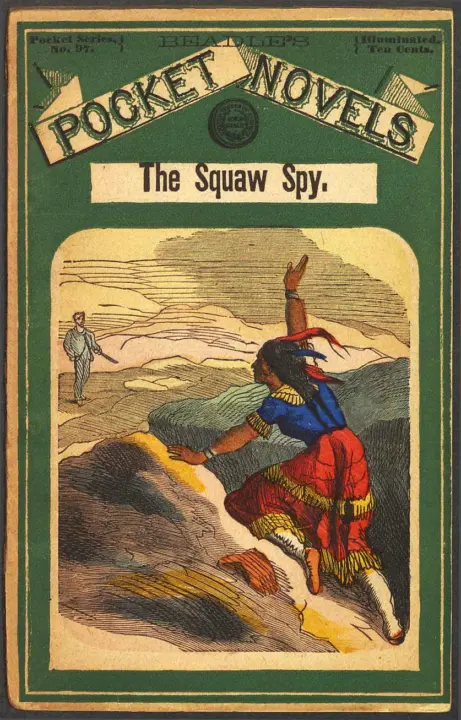
The squaw spy; or the rangers of the lava-beds
T. C. (Thomas Chalmers) Harbaugh
THE CLASSIC COLLECTION · 1884
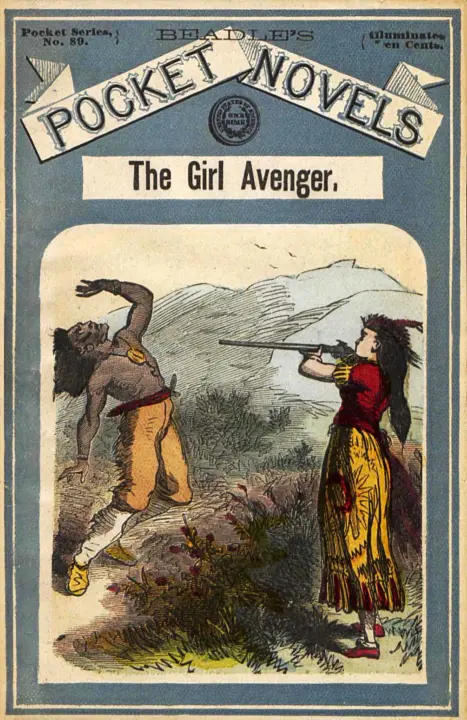
"The Girl Avenger; or, The Beautiful Terror of the Maumee" by T. C. Harbaugh is a historical novel written in the late 19th century. The story revolves around a young girl named Nanette Froisart, who embodies the role of an avenger against the Native American tribes that have wronged her. The opening chapters set a dramatic tone, depicting her fierce and skilled nature as she battles against formidable foes, particularly Joe Girty, a renegade who poses a significant threat to her and those she cares about. The opening of the novel introduces a tense scene along the Maumee River in 1794, where an Indian hunter, having just killed a stag, falls victim to a young girl’s decisive shot, revealing her as a formidable avenger. We learn about her pride in hunting and her quest for vengeance against Native Americans as she collects scalps as trophies. This intense moment unfolds with the emergence of Joe Girty, who captures her after she has successfully taken down another foe. The narrative weaves themes of vengeance, survival, and the complexities of identity amid the turbulent interactions between different cultures. As the story progresses, it hints at past traumas and a web of revenge that invites readers into a world shaped by conflict and resilience.
Introduction adapted from the source catalogue; source summaries may be automatically generated.
Free to read · English · 33,784 words · No account needed
MAKE TIME FOR A GOOD BOOK
On by default. Untick to stop anonymous reading totals. Each page counts after 10 seconds in view. How this works.
Anonymous counting is on unless you have switched it off.
Effie usually accompanied him on his fire hunts, and bore the torch. But now and then he would take it, while she dropped the noble prey.
“Let wife carry fire,” said the woman, burning with a desire to follow
her lord.
“That ’ud be a pretty caper,” responded old Mitre, “fur all of us to go away and let the red thieves steal every thing we’ve got. Not another word out of ye, woman; I’m goin’ alone, an’ if I see your eyes in the woods, I’ll put a bloody spot atween them.”
Cowed by this threat the dusky wife relapsed into silence, and the
trader walked from the Post.
“I’m goin’ to see the endin’ o’ this love-talk,” he muttered, as he hurried toward the river. “I’ve never listened to them yit; but I can’t resist the temptation to listen now, for I tell ye somethin’s in the wind, when a young gal goes out with a pistol to meet her lover.”
The twilight had faded now, the goddess of night had crept up from the horizon, bathing the trysting-spot and adjacent stream in crystalline light.
Mitre St. Pierre crept down the river-bank, toward the giant cottonwood. The shadows that the great trees threw shielded him from observation. The cottonwood stood some distance from its neighbors.
“So you are here at last, mon ami. I feared that you would not obey
my request.”
There was an unwonted tone to the British major’s voice, and his face wore a deathly pallor in the moonlight.
Effie St. Pierre noted all this before she spoke.
“Pardon me for mistrusting, as I did, the authenticity of Omatla’s message,” she said. “You spoke of being in trouble, which I could not credit, as you left me so good-spirited this afternoon.”
“Ah, Effie, the clouds come sometimes when one thinks them far away--when the sky is one blue field from horizon to horizon. Trouble is oftentimes an unexpected as it is always an unwelcome guest.”
“You really are in trouble, then?”
“Yes,” and the major looked around to see if the dismissed messenger
lingered near.
But Omatla was speeding toward his village.
“To-day, girl--scarce two hours since--I had an altercation with Firman Campbell. You know him--the commandant’s son. In the midst of his cups--inflamed with liquor--he drank a disrespectful toast to you, and I struck him.”
Effie St. Pierre was silent--divining what was coming.
“He staggered under the blow,” continued the Briton, “delivered with my open hand, and when he recovered he came at me with a pistol. It was self-defense, then, girl. I drew my weapon, and, to save my own life, took his.”
Your reading position is saved on this browser. Take it to another device with a library code. Reading pages adapt to text, rather than matching a printed edition.
T. C. (Thomas Chalmers) Harbaugh
T. C. (Thomas Chalmers) Harbaugh
T. C. (Thomas Chalmers) Harbaugh
BEHIND THE BOOK
This eBook is for the use of anyone anywhere in the United States and most other parts of the world at no cost and with almost no restrictions whatsoever. You may copy it, give it away or re-use it under the terms of the Project Gutenberg License included with this eBook or online at www.gutenberg.org. If you are not located in the United States, you will have to check the laws of the country where you are located before using this eBook. Read the source licence.
The original source file, including credits and licence, is retained by this library. Request an original-format copy at no charge. Please include the book title and Project Gutenberg identifier #68016.
KEEP YOUR CURIOSITY GOING
Cécile Tormay

Moritz Busch
Coulson Kernahan
John L. Ransom

Maurice Baring
Frances Wright