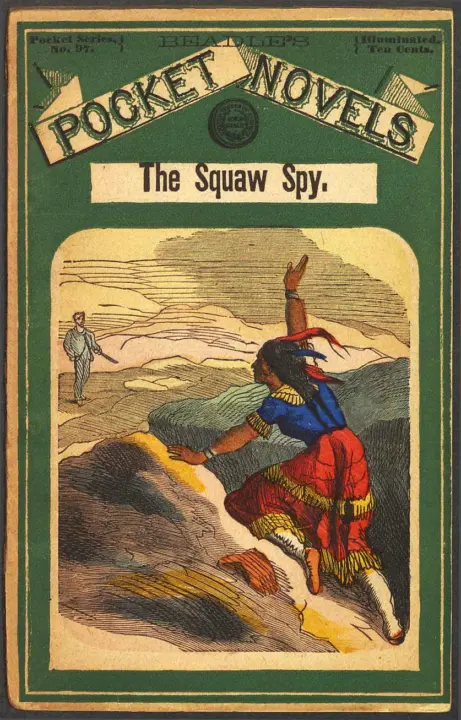
The squaw spy; or the rangers of the lava-beds
T. C. (Thomas Chalmers) Harbaugh
THE CLASSIC COLLECTION · 1884
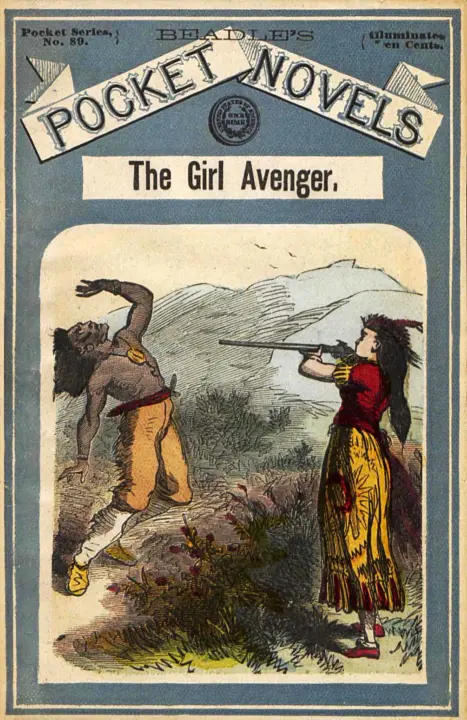
"The Girl Avenger; or, The Beautiful Terror of the Maumee" by T. C. Harbaugh is a historical novel written in the late 19th century. The story revolves around a young girl named Nanette Froisart, who embodies the role of an avenger against the Native American tribes that have wronged her. The opening chapters set a dramatic tone, depicting her fierce and skilled nature as she battles against formidable foes, particularly Joe Girty, a renegade who poses a significant threat to her and those she cares about. The opening of the novel introduces a tense scene along the Maumee River in 1794, where an Indian hunter, having just killed a stag, falls victim to a young girl’s decisive shot, revealing her as a formidable avenger. We learn about her pride in hunting and her quest for vengeance against Native Americans as she collects scalps as trophies. This intense moment unfolds with the emergence of Joe Girty, who captures her after she has successfully taken down another foe. The narrative weaves themes of vengeance, survival, and the complexities of identity amid the turbulent interactions between different cultures. As the story progresses, it hints at past traumas and a web of revenge that invites readers into a world shaped by conflict and resilience.
Introduction adapted from the source catalogue; source summaries may be automatically generated.
Free to read · English · 33,784 words · No account needed
MAKE TIME FOR A GOOD BOOK
On by default. Untick to stop anonymous reading totals. Each page counts after 10 seconds in view. How this works.
Anonymous counting is on unless you have switched it off.
“Now must Omatla’s lips close,” was the unexpected reply, “and he must go to the soldier and say that the Angel of the Maumee turns from him when the dark clouds gather.”
“No! no!” cried Effie, springing forward and detaining the Indian, with the magic touch of her tapering fingers; “I will not desert him in his trouble, Omatla. He is the dearest friend I have in yonder fort, and he shall not call on me in vain. Tarry here until I run into the Post.”
Nodding assent, the Indian remained stationary, and Effie hurried into
the structure.
The secret of her interviews with the British major beneath the cottonwood, she had long since confided to her adopted parents, causing them the more to yearn for the match to which they thought the eclaircissements were leading.
“I’m going down to the cottonwood,” she said, glancing at the old couple, as she threw a rich shawl over her head. “I won’t be gone long, and you need not bar the gate till I return.”
Then she stepped across the room, and drew from beneath the pillow of her couch a delicate silver-mounted pistol, lately received as a present from the major’s hands. This she thrust into her bosom, drew the shawl tighter around her head, for the wind was blowing quite briskly without, and left the room.
Mitre St. Pierre and his half-breed wife exchanged mystified glances.
“What can the girl mean in taking the pistol?” questioned the trader, in his native tongue. “She never took it to her love-meetings before.”
“Don’t know,” grunted the pale squaw; “must be going to shoot mark.”
“Shoot at mark in the dark?” said St. Pierre. “If it were light, I’d think you right, old woman; but now something’s up. Mebbe she’s goin’ to shoot the major? You know gals--at least they do in our country--take moighty strange notions sometimes.”
The half-breed wife broke into a loud laugh, which she continued until Mitre’s cheek assumed a scarlet hue, the sure precursor of a whirlwind of passion.
“Gal not shoot scarlet soldier,” she said. “Gal love him; not shoot man she loves; Indian gal don’t.”
Old St. Pierre dropped the conversation, rose to his feet and deliberately took his rifle from the wall.
“Where goin’?” asked his wife.
“Fire-huntin’,” was the response, and the speaker picked up a bundle of resinous sticks, prepared for the purpose, from one corner of the apartment.
“Who carry fire?” asked the half-breed, who seemed to divine the motives that prompted her husband’s sudden activity.
“I’ll carry it myself,” gruffly responded St. Pierre.
Your reading position is saved on this browser. Take it to another device with a library code. Reading pages adapt to text, rather than matching a printed edition.
T. C. (Thomas Chalmers) Harbaugh
T. C. (Thomas Chalmers) Harbaugh
T. C. (Thomas Chalmers) Harbaugh
BEHIND THE BOOK
This eBook is for the use of anyone anywhere in the United States and most other parts of the world at no cost and with almost no restrictions whatsoever. You may copy it, give it away or re-use it under the terms of the Project Gutenberg License included with this eBook or online at www.gutenberg.org. If you are not located in the United States, you will have to check the laws of the country where you are located before using this eBook. Read the source licence.
The original source file, including credits and licence, is retained by this library. Request an original-format copy at no charge. Please include the book title and Project Gutenberg identifier #68016.
KEEP YOUR CURIOSITY GOING
Cécile Tormay

Moritz Busch
Coulson Kernahan
John L. Ransom

Maurice Baring
Frances Wright