THE CLASSIC COLLECTION✦An outlaw’s diary: the CommuneCLASSIC FREE BOOKS
An outlaw’s diary: the Commune
Cécile Tormay
THE CLASSIC COLLECTION · 1917
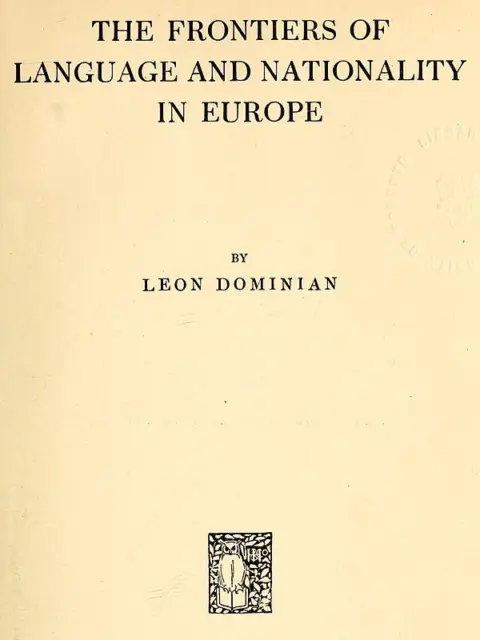
"The Frontiers of Language and Nationality in Europe" by Leon Dominian is a scientific publication written in the early 20th century. The book explores the intricate relationships between language distribution and national borders in Europe, emphasizing how geography has influenced the formation of linguistic and national identities. It offers insights into how language acts as a unifying factor within nationalities, while also addressing the impact of historical migrations and territorial disputes. At the start of the book, Dominian sets the stage by articulating the connection between language and territory. He discusses the historical evolution of human settlement and how different languages arise from specific geographical contexts, influencing human identity and culture. This opening section highlights the duality of language as both a marker of national and racial identity, presenting the idea that contemporary European boundaries have been shaped by a multitude of factors, including physical landscape and demographic changes. The preface and introduction establish the context for the subsequent analysis of linguistic frontiers, setting a scholarly tone and indicating the relevance of these themes in ongoing discussions about nationality and geopolitics in post-World War I Europe.
Introduction adapted from the source catalogue; source summaries may be automatically generated.
Free to read · English · 123,180 words · No account needed
MAKE TIME FOR A GOOD BOOK
On by default. Untick to stop anonymous reading totals. Each page counts after 10 seconds in view. How this works.
Anonymous counting is on unless you have switched it off.
Furthermore the land is none too fertile. Uncertainty therefore is today the common lot of many of the descendants of the old German settlers. Many prefer to engage in trade rather than in agriculture. The natural increase of the population has brought a certain amount of congestion which has resulted in emigration. Effort is made by German missionary societies to induce these Russian Germans to return to the land of their fathers. The Russian government on the other hand provides them with ample facilities and inducements to settle in Siberia. The region around Tomsk contains a number of villages built up by this emigration. Many however prefer to emigrate to the United States where they find a happier lot. Settlements composed entirely of Volga Germans exist in Wisconsin.
The old German settlers had held steadfastly to their religion. Their descendants have also clung to the faith of their fathers, thus creating a totally separate community in the midst of Orthodox Russia. Their earliest schools had been founded as annexes of their churches and education had been a great factor in the maintenance of language and religion. In 1891 the use of Russian was rendered obligatory in all educational institutions of the Empire. Nevertheless this measure cannot be said to have contributed to weaken the German character of the communities. From Germany itself manifestations of interest towards these faraway centers of German custom have always been keen. Neither has support been lacking.
According to recent statistics the Germans inhabiting the banks of the Volga number close to half a million, distributed equally on both banks of the great inland river. The ethnic type of these Germans has been maintained with remarkable purity and their language contains obsolete forms dating from the eighteenth century. The names of the largest communities and the number of their inhabitants are as follows:
Saratoff 12,500 Norka 13,416 Frank 11,700 Grimm or Lesnoi Karamish 10,761 Baltzer Katharinenstadt or Baronsk 10,134
[279] P. Clerget: Les Colonies Allemandes de la Volga, La Géogr.,
Feb. 1909.
[280] H. Pokorny: Die Deutschen an der Volga, Deutsche Erde,
1908, No. 4, pp. 138-144.
AREAS (in square miles)
Percentage of Former New Increase or State area area Decrease Montenegro 3,506 5,600 + 60% Albania -- 10,900 -- Serbia 18,650 33,600 + 80% Rumania 50,720 54,300 + 7% Bulgaria 37,201 43,300 + 16% Greece 24,966 46,600 + 87% Turkey in Europe 65,370 9,700 - 85%
Prior to After the State War War Montenegro 285,000 500,000 Albania -- 900,000 Serbia 2,960,000 4,300,000 Rumania 7,250,000 7,400,000 Bulgaria 4,340,000 4,800,000 Greece 2,670,000 4,600,000 Turkey in Europe 6,130,000 1,600,000
[281] Joerg, W. L. G.: The New Boundaries of the Balkan States and
their Significance, Bull. of Amer. Geogr. Soc., Vol. 45, 1913, p.
819.
Group Branches Languages
A. CELTIC 1. Gaelic a. Irish b. Highland Scotch c. Manx 2. Cymric a. Welsh b. Low Breton
Your reading position is saved on this browser. Take it to another device with a library code. Reading pages adapt to text, rather than matching a printed edition.
BEHIND THE BOOK
This eBook is for the use of anyone anywhere in the United States and most other parts of the world at no cost and with almost no restrictions whatsoever. You may copy it, give it away or re-use it under the terms of the Project Gutenberg License included with this eBook or online at www.gutenberg.org. If you are not located in the United States, you will have to check the laws of the country where you are located before using this eBook. Read the source licence.
The original source file, including credits and licence, is retained by this library. Request an original-format copy at no charge. Please include the book title and Project Gutenberg identifier #58205.
KEEP YOUR CURIOSITY GOING
Cécile Tormay

Moritz Busch
John L. Ransom
Frances Wright
Cécile Tormay

Mabel Potter Daggett