THE CLASSIC COLLECTION✦An outlaw’s diary: the CommuneCLASSIC FREE BOOKS
An outlaw’s diary: the Commune
Cécile Tormay
THE CLASSIC COLLECTION · 1917
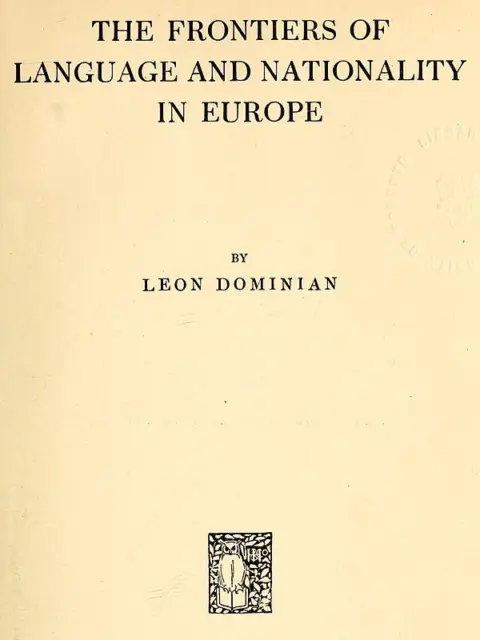
"The Frontiers of Language and Nationality in Europe" by Leon Dominian is a scientific publication written in the early 20th century. The book explores the intricate relationships between language distribution and national borders in Europe, emphasizing how geography has influenced the formation of linguistic and national identities. It offers insights into how language acts as a unifying factor within nationalities, while also addressing the impact of historical migrations and territorial disputes. At the start of the book, Dominian sets the stage by articulating the connection between language and territory. He discusses the historical evolution of human settlement and how different languages arise from specific geographical contexts, influencing human identity and culture. This opening section highlights the duality of language as both a marker of national and racial identity, presenting the idea that contemporary European boundaries have been shaped by a multitude of factors, including physical landscape and demographic changes. The preface and introduction establish the context for the subsequent analysis of linguistic frontiers, setting a scholarly tone and indicating the relevance of these themes in ongoing discussions about nationality and geopolitics in post-World War I Europe.
Introduction adapted from the source catalogue; source summaries may be automatically generated.
Free to read · English · 123,180 words · No account needed
MAKE TIME FOR A GOOD BOOK
On by default. Untick to stop anonymous reading totals. Each page counts after 10 seconds in view. How this works.
Anonymous counting is on unless you have switched it off.
The progress of French, in the Flemish-speaking districts of France, may be followed through the growing invasion of French words in the local vernaculars. The Flemish spoken in Dunkirk or Hazebrouck is an archaic dialect which is growing further and further away from the Flemish of Belgium, as this language tends to identify itself with Dutch in order to acquire literary form. As a rule, French is gradually replacing the Germanic idiom throughout the line of linguistic contact. The Frenchifying of the communes between the Aa and Dunkirk has taken place within the last fifty years. In the same period, Flemish has almost entirely disappeared from the suburbs of St. Omer, and the progress of French towards Cassel and Hazebrouck becomes yearly more apparent. The bilingual aptitude of the inhabitants in all of these localities is on the increase in the sense that many of the Flemings are acquiring proficiency in French. Business requirements in a large degree account for the change.
The only opposition to the advance of French is found in the Flemish immigration which brings fresh linguistic energy in its train. Fortunately for the Romance language, the tide of this immigration is weak and the newcomers are easily assimilated by the French-speaking element. A locality in which the decline of French is noticeable is found in the vicinity of Menin on the Lys river. The number of Flemish immigrants is particularly heavy in this region. Communes which have been French since immemorial times are fast becoming Flemish. Everywhere else, however, French is steadily encroaching upon the domain of Germanic speech.
Brussels typifies the bilingual character of the country of which it is the capital. French and Flemish are spoken both in its precincts and suburbs. The distribution of inhabitants, according to communes or wards, showed French predominance on December 31, 1910, as follows:
Speaking COMMUNES Number of French- Flemish- French and (wards) inhabitants speaking speaking Flemish Bruxelles 177,078 47,385 29,081 85,414 Anderlecht 64,157 11,211 24,320 23,486 Etterbeck 33,227 11,107 6,596 13,166 Forest 24,228 7,975 5,247 8,756 Ixelles 72,991 39,473 6,733 19,799 Jette 14,782 1,811 7,775 4,191 Koekelberg 12,750 1,770 5,702 4,378 Laeken 35,024 4,720 12,702 15,230 Molenbeek-St. Jean 72,783 11,663 24,910 31,331 Saint-Gilles 63,140 24,376 5,928 27,497 Saint-Josseten-Noode 31,865 10,547 3,349 14,859 Schaerbeek 82,480 20,975 13,677 40,525 Uccle 26,979 5,818 9,074 10,169 Woluwe--St.-Lambert 8,883 2,035 3,839 2,262 ------- ------- ------- ------- Totals 720,367 200,866 158,933 301,063
Your reading position is saved on this browser. Take it to another device with a library code. Reading pages adapt to text, rather than matching a printed edition.
BEHIND THE BOOK
This eBook is for the use of anyone anywhere in the United States and most other parts of the world at no cost and with almost no restrictions whatsoever. You may copy it, give it away or re-use it under the terms of the Project Gutenberg License included with this eBook or online at www.gutenberg.org. If you are not located in the United States, you will have to check the laws of the country where you are located before using this eBook. Read the source licence.
The original source file, including credits and licence, is retained by this library. Request an original-format copy at no charge. Please include the book title and Project Gutenberg identifier #58205.
KEEP YOUR CURIOSITY GOING
Cécile Tormay

Moritz Busch
John L. Ransom
Frances Wright
Cécile Tormay

Mabel Potter Daggett