THE CLASSIC COLLECTION✦An outlaw’s diary: the CommuneCLASSIC FREE BOOKS
An outlaw’s diary: the Commune
Cécile Tormay
THE CLASSIC COLLECTION · 1917
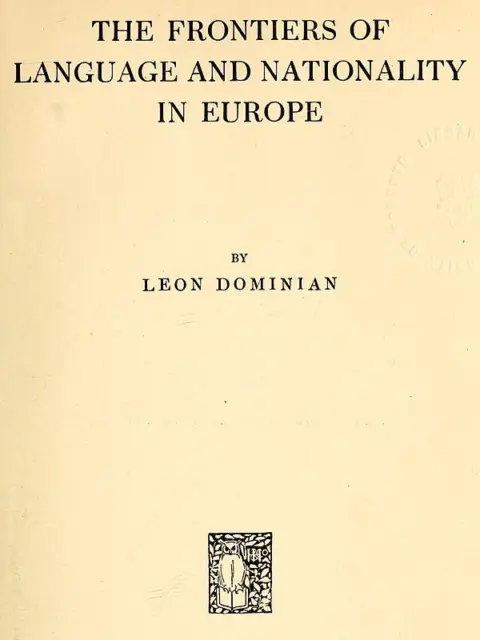
"The Frontiers of Language and Nationality in Europe" by Leon Dominian is a scientific publication written in the early 20th century. The book explores the intricate relationships between language distribution and national borders in Europe, emphasizing how geography has influenced the formation of linguistic and national identities. It offers insights into how language acts as a unifying factor within nationalities, while also addressing the impact of historical migrations and territorial disputes. At the start of the book, Dominian sets the stage by articulating the connection between language and territory. He discusses the historical evolution of human settlement and how different languages arise from specific geographical contexts, influencing human identity and culture. This opening section highlights the duality of language as both a marker of national and racial identity, presenting the idea that contemporary European boundaries have been shaped by a multitude of factors, including physical landscape and demographic changes. The preface and introduction establish the context for the subsequent analysis of linguistic frontiers, setting a scholarly tone and indicating the relevance of these themes in ongoing discussions about nationality and geopolitics in post-World War I Europe.
Introduction adapted from the source catalogue; source summaries may be automatically generated.
Free to read · English · 123,180 words · No account needed
MAKE TIME FOR A GOOD BOOK
On by default. Untick to stop anonymous reading totals. Each page counts after 10 seconds in view. How this works.
Anonymous counting is on unless you have switched it off.
[158] F. Teutsch: Die Art der Ansiedelung der Siebenbürger Sachsen, Forsch. z. deut. Landes- u. Volksk., Vol. 9, 1896, pp. 1-22. Cf. also O. Wittstock: Volkstümliches der Siebenbürger Sachsen, in the same volume. The name “Saxon” appears to have been applied indiscriminately in the Middle Ages to settlers of German speech in the Balkan peninsula. “Saxon” miners and “Saxon” bodyguards were also known in Serbian countries in that period.
[159] Luxemburg and the regions comprised between Trèves, Düsseldorf and Aix-la-Chapelle furnished German colonists during the middle of the twelfth century.
[160] Hungarian statistics show 2,470,000 in 1870; 2,403,000 in
1880 and 2,589,000 in 1890.
[161] Cf. V. Merutiŭ: Romîniĭ între Tisa şi Carpaţĭ, raporturī
etnografice, Rev. Stiintifică Vasile Adamachi, Vol. 6, No. 2,
1915.
[162] N. Mazere: Harta etnografica a Transilvanei, 1:340,000, Inst. Geogr. al Armatei, Iasi, 1909.
[163] G. Weigand: Linguistischer Atlas des dacorumänischen
Sprachgebietes, Leipzig, 1909.
[164] Their number is given at 750,000 by G. Murgocè and P.
Papahagi in “Turcia cu privire speciala auspra Macedoniei,”
Bucarest, 1911.
[165] The total number of Rumanians in the Balkan peninsula is estimated at about 10,300,000, distributed as follows: Rumania, 5,489,296 or 92.5 per cent of the population; Russia, 1,121,669, of whom 920,919 are in Bessarabia; Austria-Hungary, 3,224,147, of whom 2,949,032 are in Transylvania; Greece, 373,520; Serbia, 90,000.
[166] A. D. Xénopol: Les Roumains au Moyen-Âge, Paris, 1885.
[167] W. R. Shepherd: Historical Atlas, New York, 1911, pp. 34, 35,
39.
[168] Typical examples of seasonal migration are found in Switzerland, where conditions prevailing in the higher and the lower valleys of the Alps have induced the inhabitants to shift their residence with the seasons.
[169] A similar nomadism is observable among the Rumanians of the Pindus mountains. Cf. A. J. B. Wade and M. S. Thompson: The Nomads of the Balkans: An Account of Life and Customs among the Vlachs of Northern Pindus, London, 1914.
[170] About one-third of the words in Albanian are of Romanic
origin.
[171] Bull. pour l’étude de l’Europe Sud-Orientale, June, 1915,
p. 112.
[172] A. A. C. Stourdza: L’Héroïsme des Roumains au Moyen-Âge et le caractère de leurs anciennes institutions, Paris, 1911.
[173] Divided according to religion, the census of 1910 shows the
following figures:
Roman Catholics 98,565
Greek Catholics 26,182
Armenian Catholics 657
Orthodox Greeks 547,603
Gregorian Armenians 341
Lipps 3,232
Protestant sects 20,518
Jews 102,919
Unaccounted 86
-------
Total 800,103
[174] Czernowitz, Storozynetz, Sereth, Suczava, Radautz, Gurahumora, Kimpolung were among the cities most often selected.
[175] Their colonies are found at Rosh, Molodia, Tereblestie, Hliboka, St. Onufri, Altfratanz, Milleschoutz, Arbora, Itzkani, Ilischestie, Unterstanestie, Storozynetz, Neuzadowa.
[176] Their settlements are found at Jakobeny, Kirlibaba,
Luisenthal, Pozoritta, Eisenau, Freudenthal, Bukschoja and
Stulpikani.
[177] Today the predominance of Ruthenians in Bukovina is contested
by Rumanians who claim that Austrian statistics are deliberately
padded.
[178] I. Nistor: Românú si Rutenií in Bucovina, studiu istoric si statistu, Bucarest, 1915, p. 72.
Your reading position is saved on this browser. Take it to another device with a library code. Reading pages adapt to text, rather than matching a printed edition.
BEHIND THE BOOK
This eBook is for the use of anyone anywhere in the United States and most other parts of the world at no cost and with almost no restrictions whatsoever. You may copy it, give it away or re-use it under the terms of the Project Gutenberg License included with this eBook or online at www.gutenberg.org. If you are not located in the United States, you will have to check the laws of the country where you are located before using this eBook. Read the source licence.
The original source file, including credits and licence, is retained by this library. Request an original-format copy at no charge. Please include the book title and Project Gutenberg identifier #58205.
KEEP YOUR CURIOSITY GOING
Cécile Tormay

Moritz Busch
John L. Ransom
Frances Wright
Cécile Tormay

Mabel Potter Daggett