THE CLASSIC COLLECTION✦An outlaw’s diary: the CommuneCLASSIC FREE BOOKS
An outlaw’s diary: the Commune
Cécile Tormay
THE CLASSIC COLLECTION · 1917
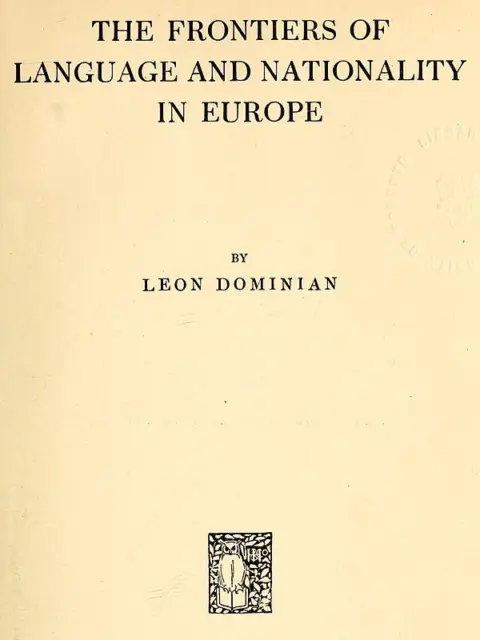
"The Frontiers of Language and Nationality in Europe" by Leon Dominian is a scientific publication written in the early 20th century. The book explores the intricate relationships between language distribution and national borders in Europe, emphasizing how geography has influenced the formation of linguistic and national identities. It offers insights into how language acts as a unifying factor within nationalities, while also addressing the impact of historical migrations and territorial disputes. At the start of the book, Dominian sets the stage by articulating the connection between language and territory. He discusses the historical evolution of human settlement and how different languages arise from specific geographical contexts, influencing human identity and culture. This opening section highlights the duality of language as both a marker of national and racial identity, presenting the idea that contemporary European boundaries have been shaped by a multitude of factors, including physical landscape and demographic changes. The preface and introduction establish the context for the subsequent analysis of linguistic frontiers, setting a scholarly tone and indicating the relevance of these themes in ongoing discussions about nationality and geopolitics in post-World War I Europe.
Introduction adapted from the source catalogue; source summaries may be automatically generated.
Free to read · English · 123,180 words · No account needed
MAKE TIME FOR A GOOD BOOK
On by default. Untick to stop anonymous reading totals. Each page counts after 10 seconds in view. How this works.
Anonymous counting is on unless you have switched it off.
[104] Limite des civilisations dans les Beskides occidentaux, Ann. de Géogr., Vol. 17, 1908, Feb. 15, pp. 130-132. Cf. also E. Hanslik: Kulturgrenze und Kulturzyklus in den polnischen Westbeskiden, Pet. Mitt., Ergänzungsheft No. 158, 1907.
[105] P. Langhans: Nationalitätenkarte der Provinz Schlesien, 1:500,000. Sonderkarte No. 1 in Deutsche Erde, 1906; id.: Nationalitätenkarte der Provinz Ostpreussen, 1:500,000. Sonderkarte No. 1 in Deutsche Erde, 1907.
[106] L. Niederle: op. cit., p. 73; but cf. H. Praesent: Russisch Polen, etc., Pet. Mitt., Vol. 60, Dec. 1914, p. 257.
[107] A. C. Haddon: The Wanderings of Peoples, Cambridge, 1912, p.
48.
[108] F. Curschmann: Die deutsche Ortsnamen in nordostdeutschen Kolonialgebiet, Forsch. z. deut. Landes- u. Volksk., Vol. 19, No. 2, 1910, pp. 91-183.
[109] Marquis de Noailles: Les frontières de la Pologne, Paris,
1915, p. 21.
[110] K. Closterhalfen: Die Polen in niederrheinisch-westfälisch
Industriebezirk 1905, 1:200,000. Pl. 16 in Deutsche Erde, Vol.
10, 1911.
[111] A. Raahe: Die Abwanderungsbewegung in den östlichen Provinzen
Preussens. Einleitung und Teil I. Die Provinz Ost-Preussen. Berlin,
1910.
[112] N. Troïnitsky: Premier recensement général de la population de l’empire de la Russie, 1897. Vols. 1 and 2, Petrograd, 1905.
[113] The Jews cluster especially in the eastern governments of Warsaw, Lomsha and Siedlez, where their percentage varies between 15.6 and 16.4. This ratio is lower in the southern and western administrative divisions. In Kalish it reaches only 7.2 per cent and is reduced to 6.3 per cent in Petrokow. In the cities the Jews constitute on an average slightly over a third of the population, although here again they are more numerous in the east. Cf. D. Aïtoff: Peuples et langues de la Russie, Ann. de Géogr., Vol. 15, May 1909, pp. 9-25.
[114] G. Bienaimé: La Pologne économique, Bull. Soc. de Géogr. Comm. de Paris, Vol. 37, Nos. 4-6, April-June, 1915, pp. 128-164.
[115] G. Bienaimé: op. cit., p. 139.
[116] A law passed in 1908 authorizes the State to acquire land in the administrative circles in which German interests require development of colonization. B. Auerbach: La germanisation de la Pologne Prussienne. La loi d’expropriation, Rev. Polit. et Parlem., Vol. 57, July 1908, pp. 109-125.
[117] P. Langhans: Nationalitätenkarte der Provinz Schlesien, 1:500,000. Sonderkarte No. 1 in Deutsche Erde, 1906. P. Langhans: Nationalitätenkarte der Provinz Ostpreussen, 1:500,000. Sonderkarte No. 2 in Deutsche Erde, 1907. Die Provinzen Posen und Westpreussen unter besonderer Berücksichtigung der Ansiedlungsgüter und Ansiedlung, Staatsdomänen und Staatsforsten nach dem Stande von 1 Januar 1911, Deutsche Erde, Vol. 10, Taf. 1, 1911.
[118] M. Loesener: Besitzfestigung in der Preussischen Ostmark. Deutsche Erde, Vol. 10, 1911, pp. 3-8.
[119] Dalchow: Die Städte des Warthelandes, I. Teil, Ein Beitrag
zur Siedlungskunde und zur Landeskunde der Provinz Posen. Leipzig,
1910.
[120] After having been entirely banished from secondary schools, Polish was excluded from elementary schools by a ministerial decree, dated Sept. 7, 1887. Religious instruction alone could be imparted in this language and even this privilege was removed in 1905.
[121] G. Bienaimé: loc. cit.
[122] B. Sands: The Ukraine, London, 1914, p. 8.
[123] H. Rosen: Pet. Mitt., Vol. 61, Sept. 1915, pp. 329-333.
Your reading position is saved on this browser. Take it to another device with a library code. Reading pages adapt to text, rather than matching a printed edition.
BEHIND THE BOOK
This eBook is for the use of anyone anywhere in the United States and most other parts of the world at no cost and with almost no restrictions whatsoever. You may copy it, give it away or re-use it under the terms of the Project Gutenberg License included with this eBook or online at www.gutenberg.org. If you are not located in the United States, you will have to check the laws of the country where you are located before using this eBook. Read the source licence.
The original source file, including credits and licence, is retained by this library. Request an original-format copy at no charge. Please include the book title and Project Gutenberg identifier #58205.
KEEP YOUR CURIOSITY GOING
Cécile Tormay

Moritz Busch
John L. Ransom
Frances Wright
Cécile Tormay

Mabel Potter Daggett