
Two Women, 1862; a Poem
Constance Fenimore Woolson
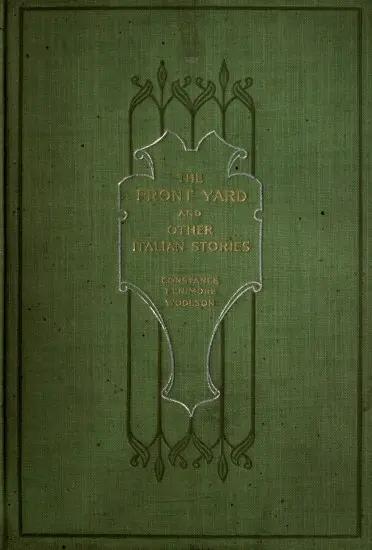
THE CLASSIC COLLECTION · 1895
"The Front Yard and Other Italian Stories" by Constance Fenimore Woolson is a collection of short stories written in the late 19th century. The narratives focus on various characters navigating life and personal aspirations in the context of Italian settings, exploring themes of love, sacrifice, and cultural identity. The leading character in the opening story, Prudence Wilkin, is a New England woman who struggles to adapt to her new life in Italy while yearning for the comfort and respectability symbolized by the ideal of a front yard. At the start of the book, Prudence is introduced as a hardworking widow living in Assisi, burdened by her demanding household that includes her elderly mother-in-law and several children, all while fantasizing about creating a front yard free from the stench and chaos of a neighboring cow-shed. Her thoughts reveal a deeper longing for a sense of self and beauty cultivated through hard work and dreams. The scene is set with Prudence’s reflections on her challenging domestic life, her ambitions for improvement, and the dynamics with her family members, foreshadowing the struggle for fulfillment amid her harsh realities.
Introduction adapted from the source catalogue; source summaries may be automatically generated.
Free to read · English · 77,221 words · No account needed
MAKE TIME FOR A GOOD BOOK
On by default. Untick to stop anonymous reading totals. Each page counts after 10 seconds in view. How this works.
Anonymous counting is on unless you have switched it off.
The end of the week had been appointed for Pierre's excursion.
The morning opened fair and warm, with the veiled blue that belongs to the Bay of Naples, the soft hazy blue which is so different from the dry glittering clearness of the Riviera.
Fanny was mounted on a donkey; Eva preferred to walk, and Mademoiselle accompanied her. Pierre had included in his invitation the usual afternoon assemblage at the villa--Dallas, Mark Ferguson, Bartholomew, Gordon-Gray, and David Rod.
For Fanny had, as Dallas expressed it, "taken up" Rod; she had invited him twice to dinner. The superfluous courtesy had annoyed Dallas, for of course, as Rod himself was nothing, less than nothing, the explanation must lie in the fact that Horace Bartholomew had suggested it. "Bartholomew was always wrong-headed; always picking up some perfectly impossible creature, and ramming him down people's throats," he thought, with vexation.
Bartholomew was walking now beside Fanny's donkey.
Mark Ferguson led the party, as it moved slowly along the narrow paved road that winds in zigzags up the mountain; Eva, Mademoiselle, Pierre, Dallas, and Rod came next. Fanny and Bartholomew were behind; and behind still, walking alone and meditatively, came Gordon-Gray, who looked at life (save for the hunting) from the standpoint of the Italian Renaissance. Gordon-Gray knew a great deal about the Malatesta family; he had made a collection of Renaissance cloak clasps; he had written an essay on the colors of the long hose worn in the battling, leg-displaying days which had aroused his admiration, aroused it rather singularly, since he himself was as far as possible from having been qualified by nature to shine in such vigorous society.
Pierre went back to give some directions to one of the men in the rear of their small procession.
When he returned, "So the bears sometimes get among the canes?" Eva was
saying.
"But then, how very convenient," said Pierre; "for they can take the canes and chastise them punctually." He spoke in his careful English.
"They're sugar-canes," said Rod.
"It's his plantation we are talking about," said Eva. "Once it was a military post, he says. Perhaps like Ehrenbreitstein."
"Exactly," said Dallas, from behind; "the same massive frowning stone
walls."
"There were four one-story wooden barracks once," said Rod; "whitewashed; flag-pole in the centre. There's nothing now but a chimney; we've taken the boards for our mill."
"See the cyclamen, good folk," called out Gordon-Gray.
On a small plateau near by a thousand cyclamen, white and pink, had
lifted their wings as if to fly away. Off went Pierre to get them for
Eva.
"Have you ever seen the bears in the canes yourself?" pursued Eva.
Your reading position is saved on this browser. Take it to another device with a library code. Reading pages adapt to text, rather than matching a printed edition.
Constance Fenimore Woolson

Constance Fenimore Woolson

Constance Fenimore Woolson
Constance Fenimore Woolson
BEHIND THE BOOK
This eBook is for the use of anyone anywhere in the United States and most other parts of the world at no cost and with almost no restrictions whatsoever. You may copy it, give it away or re-use it under the terms of the Project Gutenberg License included with this eBook or online at www.gutenberg.org. If you are not located in the United States, you will have to check the laws of the country where you are located before using this eBook. Read the source licence.
The original source file, including credits and licence, is retained by this library. Request an original-format copy at no charge. Please include the book title and Project Gutenberg identifier #38517.
KEEP YOUR CURIOSITY GOING
Coulson Kernahan

Maurice Baring
Frances Wright
Cécile Tormay

Frederic Jesup Stimson

W. H. P. (William Henry Pope) Jarvis