
Two Women, 1862; a Poem
Constance Fenimore Woolson
THE CLASSIC COLLECTION · 1895
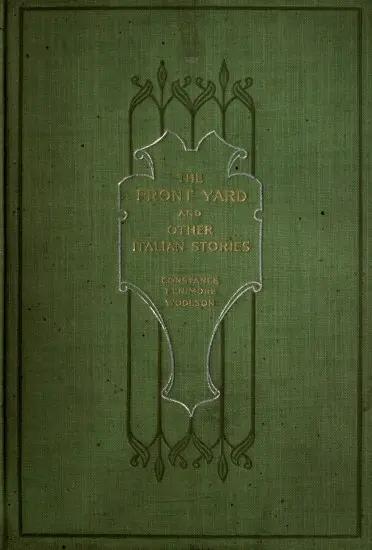
"The Front Yard and Other Italian Stories" by Constance Fenimore Woolson is a collection of short stories written in the late 19th century. The narratives focus on various characters navigating life and personal aspirations in the context of Italian settings, exploring themes of love, sacrifice, and cultural identity. The leading character in the opening story, Prudence Wilkin, is a New England woman who struggles to adapt to her new life in Italy while yearning for the comfort and respectability symbolized by the ideal of a front yard. At the start of the book, Prudence is introduced as a hardworking widow living in Assisi, burdened by her demanding household that includes her elderly mother-in-law and several children, all while fantasizing about creating a front yard free from the stench and chaos of a neighboring cow-shed. Her thoughts reveal a deeper longing for a sense of self and beauty cultivated through hard work and dreams. The scene is set with Prudence’s reflections on her challenging domestic life, her ambitions for improvement, and the dynamics with her family members, foreshadowing the struggle for fulfillment amid her harsh realities.
Introduction adapted from the source catalogue; source summaries may be automatically generated.
Free to read · English · 77,221 words · No account needed
MAKE TIME FOR A GOOD BOOK
On by default. Untick to stop anonymous reading totals. Each page counts after 10 seconds in view. How this works.
Anonymous counting is on unless you have switched it off.
"Are you English?" said the old woman. "I'm an American myself; but I ain't deef. The sack warn't too heavy; it's only that I ain't so strong as I used to be--it's perfectly redeculous!"
"You're not strong at all," responded the stranger, still indignantly, looking at the wasted old face and trembling hands.
A week later Prudence was in bed, and an American nurse was in charge.
This nurse, whose name was Baily, was a calm woman with long strong arms, monotonous voice, and distinct New England pronunciation; her Italian (which was grammatically correct) was delivered in the vowels of Vermont.
One day, soon after her arrival, she remarked to Granmar, "That yell of yours, now--that yam--is a very unusual thing."
"My sufferings draw it from me," answered Granmar, flattered by the adjective used. "I'm a very pious woman; I don't want to swear."
"I think I have never heard it equalled, except possibly in lunatic asylums," Marilla Baily went on. "I have had a great deal to do with lunatic asylums; I am what is called an expert; that is, I find out people who are troublesome, and send them there; I never say much about it, but just make my observations; then, when I've got the papers out, whiff!--off they go."
Granmar put her hand over her mouth apprehensively, and surveyed her in silence. From that time the atmosphere of the kitchen was remarkably quiet.
Marilla Baily had come from Florence at the bidding of the American who had helped to carry the potatoes. This American was staying at the Albergo del Subasio with her friends who were sketching Giotto; but she spent most of her time with Prudence Wilkin.
"You see, I minded it because it was him," Prudence explained to her one day, at the close of a long conversation. "For I'd always been so fond of the boy; I had him first when he warn't but two years old--just a baby--and so purty and cunning! He always called me mamma--the only one of the children, 'cept poor Nounce there, that really seemed to care for me. And I cared everything for him. I went straight down to town and hunted all over. But he warn't to be found. I tried it the next day, and the next, not saying what I wanted, of course; but nobody knew where he was, and at last I made up my mind that he'd gone away. For three weeks I waited; I was almost dead; I couldn't do nothing; I felt as if I was broke in two, and only the skin held me together. Every morning I'd say to myself, 'There'll certainly come a letter to-day, and he'll tell me all about it.' But the letter didn't come, and didn't come. From the beginning, of course, I knew it was him--I couldn't help but know; Jo Vanny was the only person in the whole world that knew where it was. For I'd showed it to him one day--the work-box, I mean--and let him put it back in the hole behind the hay--'twas the time I took the money out for Patro. At last I did get a letter, and he said as how he'd meant to put it back the very next morning, sure. But something had happened, so he couldn't, and so he'd gone away. And now he was working just as hard as he could, he said, so as to be able to pay it back soon; he hardly played on his mandolin at all now, he said, he was working so hard. You see, he wasn't bad himself, poor little fellow, but he was led away by bad men; gambling's an awful thing, once you get started in it, and he was sort of drove to take that money, meaning all the while to pay it back. Well, of course I felt ever so much better just as soon as I got that letter. And I began to work again. But I didn't get on as well as I'd oughter; I can't understand why. That day, now, when I first saw you--when you ran in to help me--I hadn't been feeling sick at all; there warn't no sense in my tumbling down that way all of a sudden."
Your reading position is saved on this browser. Take it to another device with a library code. Reading pages adapt to text, rather than matching a printed edition.
Constance Fenimore Woolson

Constance Fenimore Woolson

Constance Fenimore Woolson
Constance Fenimore Woolson
BEHIND THE BOOK
This eBook is for the use of anyone anywhere in the United States and most other parts of the world at no cost and with almost no restrictions whatsoever. You may copy it, give it away or re-use it under the terms of the Project Gutenberg License included with this eBook or online at www.gutenberg.org. If you are not located in the United States, you will have to check the laws of the country where you are located before using this eBook. Read the source licence.
The original source file, including credits and licence, is retained by this library. Request an original-format copy at no charge. Please include the book title and Project Gutenberg identifier #38517.
KEEP YOUR CURIOSITY GOING
Coulson Kernahan

Maurice Baring
Frances Wright
Cécile Tormay

Frederic Jesup Stimson

W. H. P. (William Henry Pope) Jarvis