THE CLASSIC COLLECTION✦Pierre and LuceCLASSIC FREE BOOKS
Pierre and Luce
Romain Rolland
THE CLASSIC COLLECTION · 1918
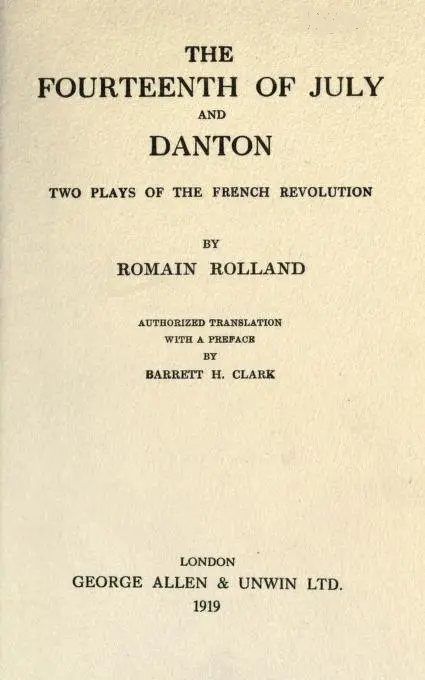
"The Fourteenth of July and Danton: Two Plays of the French Revolution" by Romain Rolland is a collection of historical plays written during the early 20th century. The work dramatizes significant events from the French Revolution, focusing on the interplay between individual heroes and the collective will of the people. The plays emphasize themes of liberty, social justice, and the moral truths behind revolutionary movements. The opening of "The Fourteenth of July" introduces the tense atmosphere in Paris leading up to the storming of the Bastille on July 14th, 1789. It captures the excitement and anxiety among various social classes as they react to the perceived threats from the monarchy. The dialogue features characters such as Camille Desmoulins and members of the crowd who discuss strategies and fears while urging each other to unite against the oppressive forces. The scene is laden with rich dialogue that reveals the characters' passions and the weight of societal expectations, setting the stage for the ensuing revolution. The focus on the "People" as a collective character emphasizes Rolland's aim to portray the revolution as a movement driven by the masses rather than just a few historical figures.
Introduction adapted from the source catalogue; source summaries may be automatically generated.
Free to read · English · 52,400 words · No account needed
MAKE TIME FOR A GOOD BOOK
On by default. Untick to stop anonymous reading totals. Each page counts after 10 seconds in view. How this works.
Anonymous counting is on unless you have switched it off.
VADIER [noticing SAINT-JUST]. Saint-Just! Good! We shall now make up for lost time. [BILLAUD-VARENNE and VADIER seat themselves unceremoniously. SAINT-JUST walks about. ROBESPIERRE remains standing, and leans against the window-sill. After a pause.]
BILLAUD-VARENNE. The guillotine! You have waited too long, Robespierre: we are in immediate danger. If Danton is still alive tomorrow, the cause of liberty is lost.
ROBESPIERRE. What news?
BILLAUD-VARENNE [with papers in his hand]. Look. The traitor
is at it again.
ROBESPIERRE. Who?
VADIER. Your friend, Maximilien: Camille, dear Camille.
ROBESPIERRE. Has he been writing again?
BILLAUD-VARENNE. These proofs have just been seized. Read.
VADIER [rubbing his hands]. The seventh Vieux Cordelier. The continuation of the good apostle's Credo.
ROBESPIERRE. The idiot! Will he not learn to hold his tongue?
BILLAUD-VARENNE [like a monomaniac]. The guillotine!
SAINT-JUST [reading the proofs with ROBESPIERRE]. Like a prostitute, who cannot but bring dishonor upon herself.
ROBESPIERRE. And Danton?
BILLAUD-VARENNE. Danton is at it again; he is speaking at the Palais-Royal. He insults Vadier, and me, and all the patriots. Desmoulins is with him. They're all together with the women and Westermann, too. They make obscene allusions to the Committee. The people are gathering about them, and laughing.
SAINT-JUST. You hear, Robespierre?
ROBESPIERRE [disdainfully]. No danger. We shall have time to deliberate in peace before Danton is through drinking. [Looking again at the proofs.] Why, this is suicide!
VADIER. He's gone too far this time!
BILLAUD-VARENNE. His head should follow!
SAINT-JUST [reading]. He compares the members of the
Convention to Nero and Tiberius.
BILLAUD-VARENNE [reading]. He dares to say that we went after Custine on Pitt's orders, and not because Custine was a traitor, but because he was not a worse one.
VADIER [reading]. "The Committee will reduce the Assembly to the servile condition of a parlement the rebellious members of which are to be thrown into prison."
ROBESPIERRE [correcting them]. He puts "would reduce," and not
"will reduce."
VADIER. The same thing.
BILLAUD-VARENNE [reading]. "See how near is the Committee to ruining the Republic, when it sends two of its Deputies which it cannot bribe to the Luxembourg?"
ROBESPIERRE. He says "it can send," and not "it sends."
BILLAUD-VARENNE [pettishly]. Don't be so particular!
SAINT-JUST [reading]. He has the effrontery to maintain that "the War-office appointed as heads of the armies the brothers of actresses with whom they had been intimate."
VADIER. Disorganizing the defense, reviling the nation in the eyes of foreigners! Can nothing stop his vile tongue!
BILLAUD-VARENNE. And the whole thing bristling with demands for clemency, and talk about humanity!
VADIER. And his hypocritical tears! Bah!
Your reading position is saved on this browser. Take it to another device with a library code. Reading pages adapt to text, rather than matching a printed edition.
BEHIND THE BOOK
This eBook is for the use of anyone anywhere in the United States and most other parts of the world at no cost and with almost no restrictions whatsoever. You may copy it, give it away or re-use it under the terms of the Project Gutenberg License included with this eBook or online at www.gutenberg.org. If you are not located in the United States, you will have to check the laws of the country where you are located before using this eBook. Read the source licence.
The original source file, including credits and licence, is retained by this library. Request an original-format copy at no charge. Please include the book title and Project Gutenberg identifier #49438.
KEEP YOUR CURIOSITY GOING
Cécile Tormay

Moritz Busch
John L. Ransom
Frances Wright
Cécile Tormay

Mabel Potter Daggett