THE CLASSIC COLLECTION✦Pierre and LuceCLASSIC FREE BOOKS
Pierre and Luce
Romain Rolland
THE CLASSIC COLLECTION · 1918
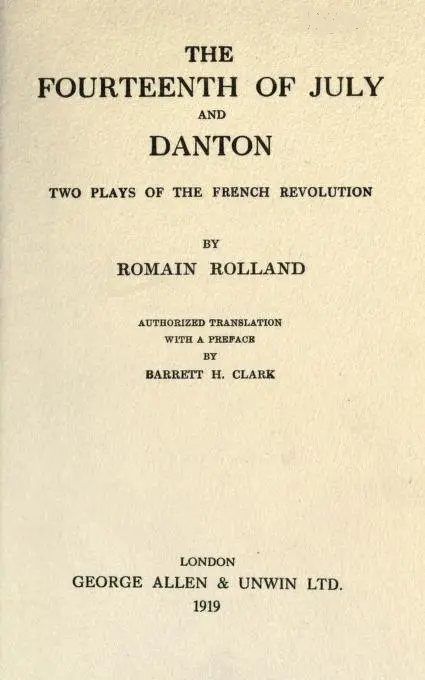
"The Fourteenth of July and Danton: Two Plays of the French Revolution" by Romain Rolland is a collection of historical plays written during the early 20th century. The work dramatizes significant events from the French Revolution, focusing on the interplay between individual heroes and the collective will of the people. The plays emphasize themes of liberty, social justice, and the moral truths behind revolutionary movements. The opening of "The Fourteenth of July" introduces the tense atmosphere in Paris leading up to the storming of the Bastille on July 14th, 1789. It captures the excitement and anxiety among various social classes as they react to the perceived threats from the monarchy. The dialogue features characters such as Camille Desmoulins and members of the crowd who discuss strategies and fears while urging each other to unite against the oppressive forces. The scene is laden with rich dialogue that reveals the characters' passions and the weight of societal expectations, setting the stage for the ensuing revolution. The focus on the "People" as a collective character emphasizes Rolland's aim to portray the revolution as a movement driven by the masses rather than just a few historical figures.
Introduction adapted from the source catalogue; source summaries may be automatically generated.
Free to read · English · 52,400 words · No account needed
MAKE TIME FOR A GOOD BOOK
On by default. Untick to stop anonymous reading totals. Each page counts after 10 seconds in view. How this works.
Anonymous counting is on unless you have switched it off.
HÉRAULT. You are a good, dear, lovable child, and yet you are
cruel--like a child.
CAMILLE [excitedly]. You really think me cruel?
LUCILE. See, he's crying this moment!
CAMILLE [deeply stirred]. True, he suffered. When I think of his agony, his terror, waiting for the end--It must have been atrocious! No matter how vile he was, he suffered like an honest man--perhaps even more. Poor Hebert!
LUCILE [her arms about CAMILLE'S neck]. My poor Bouli-Boula, you're not going to feel so sorry for a villain who wanted to send you to the guillotine?
CAMILLE [angrily]. Yes. Now, why are you attacking me this way? Si quis atra dente me petiverit, inultus ut flebo puer!
LUCILE [to HÉRAULT]. And you dare say my Camille is cruel!
HÉRAULT. I do, of course. Dear fellow! He is perhaps the
cruellest of us all.
CAMILLE. Don't say that, Hérault; I may end by believing you.
LUCILE [to HÉRAULT, shaking her finger at him]. Say it's not
true: you are the cruellest.
HÉRAULT. Well, no, it is not true: you are the cruellest.
LUCILE. Very well. I don't mind that.
CAMILLE. What you say troubles me, Hérault. It is true, I have done great evil, but I am not bad by nature. I have constituted myself the prosecuting attorney for the lamp-post. I have no idea what damnable impish instinct urges me on. It was due to me that the Girondins are now rotting in the fields. My Brissot dévoilé led to the decapitating of thirty young, lovable, generous men. They clung to life, as I do; they were made in order to enjoy life, and be happy. They, too, had their dear Luciles. Oh, Lucile, let us go away, far from this butchery that is so terrible to others, and perhaps to ourselves! What if we--you--our little Horace--? Oh, why can't I be a stranger once more to all men? Where can I hide myself from the sight of the world, with my wife and child and my books! Ubi campi Guisiaque!
PHILIPPEAUX. You're in the cyclone, and you cannot escape.
HÉRAULT. Don't force him to remain in a struggle which he was
not intended for.
PHILIPPEAUX. But as he himself just said, we must do our duty.
HÉRAULT [pointing to CAMILLE, who kisses LUCILE]. Look at him: does not Camille's duty seem to be the pursuit of happiness?
CAMILLE. True, I have a wonderful vocation for happiness. Some
people are made for suffering, but suffering disgusts me: I want
none of it.
LUCILE. Did I spoil your vocation?
Your reading position is saved on this browser. Take it to another device with a library code. Reading pages adapt to text, rather than matching a printed edition.
BEHIND THE BOOK
This eBook is for the use of anyone anywhere in the United States and most other parts of the world at no cost and with almost no restrictions whatsoever. You may copy it, give it away or re-use it under the terms of the Project Gutenberg License included with this eBook or online at www.gutenberg.org. If you are not located in the United States, you will have to check the laws of the country where you are located before using this eBook. Read the source licence.
The original source file, including credits and licence, is retained by this library. Request an original-format copy at no charge. Please include the book title and Project Gutenberg identifier #49438.
KEEP YOUR CURIOSITY GOING
Cécile Tormay

Moritz Busch
John L. Ransom
Frances Wright
Cécile Tormay

Mabel Potter Daggett