THE CLASSIC COLLECTION✦Pierre and LuceCLASSIC FREE BOOKS
Pierre and Luce
Romain Rolland
THE CLASSIC COLLECTION · 1918
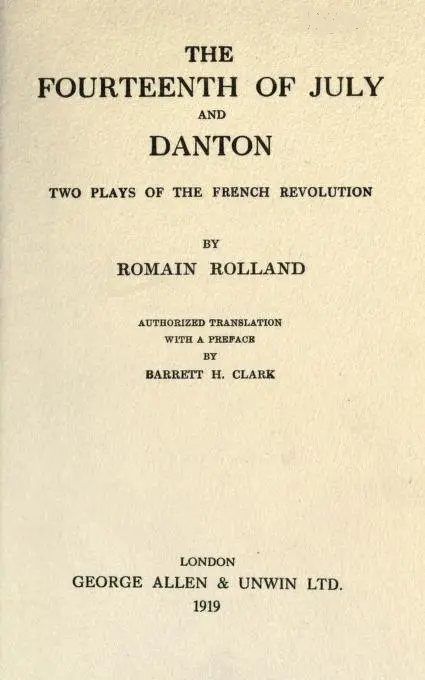
"The Fourteenth of July and Danton: Two Plays of the French Revolution" by Romain Rolland is a collection of historical plays written during the early 20th century. The work dramatizes significant events from the French Revolution, focusing on the interplay between individual heroes and the collective will of the people. The plays emphasize themes of liberty, social justice, and the moral truths behind revolutionary movements. The opening of "The Fourteenth of July" introduces the tense atmosphere in Paris leading up to the storming of the Bastille on July 14th, 1789. It captures the excitement and anxiety among various social classes as they react to the perceived threats from the monarchy. The dialogue features characters such as Camille Desmoulins and members of the crowd who discuss strategies and fears while urging each other to unite against the oppressive forces. The scene is laden with rich dialogue that reveals the characters' passions and the weight of societal expectations, setting the stage for the ensuing revolution. The focus on the "People" as a collective character emphasizes Rolland's aim to portray the revolution as a movement driven by the masses rather than just a few historical figures.
Introduction adapted from the source catalogue; source summaries may be automatically generated.
Free to read · English · 52,400 words · No account needed
MAKE TIME FOR A GOOD BOOK
On by default. Untick to stop anonymous reading totals. Each page counts after 10 seconds in view. How this works.
Anonymous counting is on unless you have switched it off.
DESMOULINS. We surely owe him something. The Marshal has just appointed him guard over the Bastille, with M. de Launey, and he has promised that within two days, we shall go and ask pardon of him, barefooted and with ropes round our necks. I propose that one of us make a present of his rope to that friend of the people.
THE CROWD. Burn him! He lives near! Burn his house--his
furniture--his wife--his children!
VINTIMILLE [appearing in the midst of the Crowd, cold and
ironic]. Messieurs--
LA CONTAT. God save us!
HULIN. Hoche! [He takes hold of HOCHE'S arm.]
HOCHE. What's the matter?
HULIN. It's he!
HOCHE. Who?
HULIN. Vintimille.
VINTIMILLE. Messieurs, M. de Vintimille's upholsterer asks
permission to speak.--
THE CROWD. Hear the upholsterer!
VINTIMILLE. Messieurs, you are quite right in wishing to burn that blackguard aristocrat, who makes game of you, despises you, and who goes about saying that dogs ought to be whipped when they show their teeth. Burn, Messieurs, by all means burn, but I warn you, take care that the flame of your just fury does not scorch you, and demolish what is yours along with what is his. Let me ask you first of all, Messieurs, whether it is right to ruin M. de Vintimille and those who ruin him--his creditors, that is? At least allow me to beg you to spare the furniture, which belongs to me, and for which the scoundrel has not paid a son.
CROWD. Take back your furniture!
VINTIMILLE. I am encouraged, Messieurs, by the success of my request, to make another, this time on behalf of the architect of the house. He has been no more successful than I in extracting écus from the pocket of M. de Vintimille; and he asks you to consider what harm you would do him in destroying his only security?
CROWD. Save the house!
VINTIMILLE. And as for his wife, Messieurs--why burn what belongs to you? His wife is of the people. The Court, the city, the clergy, the middle-classes, have often appreciated her splendid qualities. She possesses a liberal mind, and she recognizes no privileges: the three orders are equal in her eyes. In her person she realizes the perfect union of the nation. Let us do honor to so rare a virtue. Messieurs, let us show mercy for Madame.
DESMOULINS. Mercy for Notre Dame!
THE CROWD [laughing]. Yes, yes, mercy for Madame!
VINTIMILLE. Really, Messieurs, I am taking advantage--
THE CROWD. No, no!
VINTIMILLE. Finally, Messieurs, if you burned M. de Vintimille's children, would you not tremble to vie with our tragediennes?
THE CROWD [laughing]. Long live the children! Ha, ha!
Your reading position is saved on this browser. Take it to another device with a library code. Reading pages adapt to text, rather than matching a printed edition.
BEHIND THE BOOK
This eBook is for the use of anyone anywhere in the United States and most other parts of the world at no cost and with almost no restrictions whatsoever. You may copy it, give it away or re-use it under the terms of the Project Gutenberg License included with this eBook or online at www.gutenberg.org. If you are not located in the United States, you will have to check the laws of the country where you are located before using this eBook. Read the source licence.
The original source file, including credits and licence, is retained by this library. Request an original-format copy at no charge. Please include the book title and Project Gutenberg identifier #49438.
KEEP YOUR CURIOSITY GOING
Cécile Tormay

Moritz Busch
John L. Ransom
Frances Wright
Cécile Tormay

Mabel Potter Daggett