THE CLASSIC COLLECTION✦Pierre and LuceCLASSIC FREE BOOKS
Pierre and Luce
Romain Rolland
THE CLASSIC COLLECTION · 1918
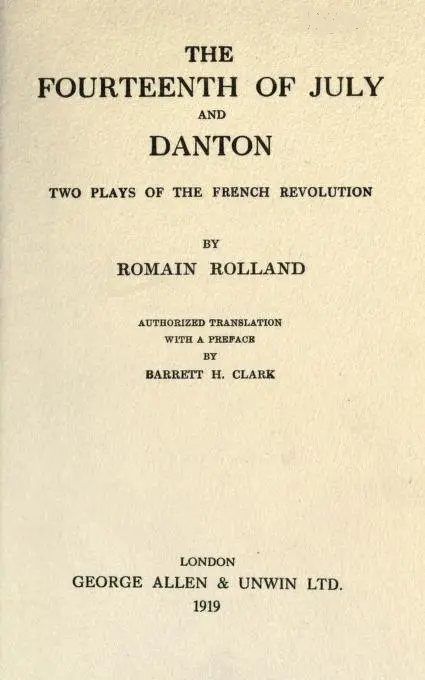
"The Fourteenth of July and Danton: Two Plays of the French Revolution" by Romain Rolland is a collection of historical plays written during the early 20th century. The work dramatizes significant events from the French Revolution, focusing on the interplay between individual heroes and the collective will of the people. The plays emphasize themes of liberty, social justice, and the moral truths behind revolutionary movements. The opening of "The Fourteenth of July" introduces the tense atmosphere in Paris leading up to the storming of the Bastille on July 14th, 1789. It captures the excitement and anxiety among various social classes as they react to the perceived threats from the monarchy. The dialogue features characters such as Camille Desmoulins and members of the crowd who discuss strategies and fears while urging each other to unite against the oppressive forces. The scene is laden with rich dialogue that reveals the characters' passions and the weight of societal expectations, setting the stage for the ensuing revolution. The focus on the "People" as a collective character emphasizes Rolland's aim to portray the revolution as a movement driven by the masses rather than just a few historical figures.
Introduction adapted from the source catalogue; source summaries may be automatically generated.
Free to read · English · 52,400 words · No account needed
MAKE TIME FOR A GOOD BOOK
On by default. Untick to stop anonymous reading totals. Each page counts after 10 seconds in view. How this works.
Anonymous counting is on unless you have switched it off.
VADIER. Citizens, the Committee on Provisions and Necessities [the People are silent] takes this occasion to announce to the public the arrival of a large amount of grain and wood at the port of Bercy. [A great clamor arises. People jostle one another in a wild attempt to leave the hall. After a few moments, only a small knot of curious onlookers remain. VADIER casts a glance of irony at the People.] Their hearts are good, but their stomachs better. [The Jury reenters. The monotony of the Judge's questions is drowned by the last stragglers. The noise outside gradually subsides, and HERMAN'S voice becomes more distinct. Sentence is passed in a death-like silence.]
JUDGE. Jurymen citizens, there was a conspiracy which was to have brought dishonor upon the national representatives, re-established the monarchy, and through corruption destroy the Republican government. Is Georges-Jacques Danton, solicitor, Deputy to the National Convention, guilty of conspiracy against the Republic?
THE HEAD OF THE JURY. He is.
JUDGE. Is Lucie-Simplice-Camille Desmoulins, solicitor, Deputy to the Convention, guilty of conspiring against the Republic?
THE HEAD OF THE JURY. He is.
JUDGE. Is Philippe-François-Nazaire Fabre, known as Fabre
d'Eglantine, Deputy to the Convention, guilty of conspiring
against the Republic?
THE HEAD OF THE JURY. He is.
JUDGE. Is Pierre-Nicolas Philippeaux, former judge, and Deputy to the Convention, guilty of conspiring against the Republic?
THE HEAD OF THE JURY. He is.
JUDGE. Is Marie-Jean Hérault-Séchelles, attorney general, and
Deputy to the Convention, guilty of conspiring against the
Republic?
THE HEAD OF THE JURY. He is.
JUDGE. Is Francis-Joseph Westermann, brigadier-general, guilty of conspiring against the Republic?
THE HEAD OF THE JURY. He is.
FOUQUIER-TINVILLE. I demand the application of the law.
JUDGE. Then the Tribunal condemns Georges-Jacques Danton, Lucie-Simplice-Camille Desmoulins, Marie-Jean Hérault-Séchelles, Philippe-François-Nazaire Fabre, known as Fabre d'Eglantine, Pierre-Nicolas Philippeaux, and François-Joseph Westermann, to the death penalty. The Tribunal commands that this sentence be communicated to them between the two wickets of the Conciergerie by the clerk of the Tribunal, and that they be executed today, the sixteenth of Germinal, in the Place de la Révolution. [The People file out. Outside, the clamor becomes more and more indistinct.--SAINT-JUST, VADIER, and BILLAUD-VARENNE look at each other in silence.]
VADIER. The rotten colossus at last laid low! The Republic can
now draw a free breath.
BILLAUD-VARENNE [looking at SAINT-JUST--fiercely] The Republic will never be free until her dictators have disappeared.
SAINT-JUST [looking straight at VADIER and BILLAUD-VARENNE] The Republic will never be pure until the vultures are no more.
VADIER [banteringly]. The Republic will never be free or pure
until the Republic is no more!
Your reading position is saved on this browser. Take it to another device with a library code. Reading pages adapt to text, rather than matching a printed edition.
BEHIND THE BOOK
This eBook is for the use of anyone anywhere in the United States and most other parts of the world at no cost and with almost no restrictions whatsoever. You may copy it, give it away or re-use it under the terms of the Project Gutenberg License included with this eBook or online at www.gutenberg.org. If you are not located in the United States, you will have to check the laws of the country where you are located before using this eBook. Read the source licence.
The original source file, including credits and licence, is retained by this library. Request an original-format copy at no charge. Please include the book title and Project Gutenberg identifier #49438.
KEEP YOUR CURIOSITY GOING
Cécile Tormay

Moritz Busch
John L. Ransom
Frances Wright
Cécile Tormay

Mabel Potter Daggett