THE CLASSIC COLLECTION✦Pierre and LuceCLASSIC FREE BOOKS
Pierre and Luce
Romain Rolland
THE CLASSIC COLLECTION · 1918
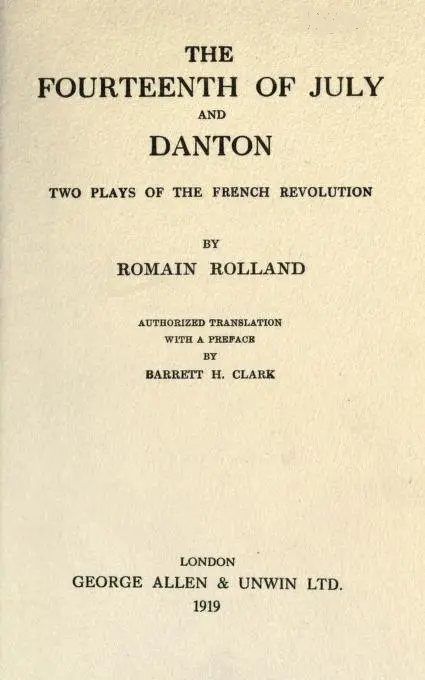
"The Fourteenth of July and Danton: Two Plays of the French Revolution" by Romain Rolland is a collection of historical plays written during the early 20th century. The work dramatizes significant events from the French Revolution, focusing on the interplay between individual heroes and the collective will of the people. The plays emphasize themes of liberty, social justice, and the moral truths behind revolutionary movements. The opening of "The Fourteenth of July" introduces the tense atmosphere in Paris leading up to the storming of the Bastille on July 14th, 1789. It captures the excitement and anxiety among various social classes as they react to the perceived threats from the monarchy. The dialogue features characters such as Camille Desmoulins and members of the crowd who discuss strategies and fears while urging each other to unite against the oppressive forces. The scene is laden with rich dialogue that reveals the characters' passions and the weight of societal expectations, setting the stage for the ensuing revolution. The focus on the "People" as a collective character emphasizes Rolland's aim to portray the revolution as a movement driven by the masses rather than just a few historical figures.
Introduction adapted from the source catalogue; source summaries may be automatically generated.
Free to read · English · 52,400 words · No account needed
MAKE TIME FOR A GOOD BOOK
On by default. Untick to stop anonymous reading totals. Each page counts after 10 seconds in view. How this works.
Anonymous counting is on unless you have switched it off.
WESTERMANN [to DANTON]. Keep that idiot from dishonoring
himself.
DANTON [in consternation]. They are mad. Miserable country, what will become of you without this leader?
HÉRAULT [to DESMOULINS]. Come, my friends, let us show them we
know how to die.
DANTON. We have lived long enough to lay our heads on the breast of glory. Let them take us to the scaffold!
CAMILLE. Oh, my wife! My son! Shall I never see you again? No, I
cannot. My friends, help me!
JUDGE. Take out the prisoners.
DANTON. Don't, don't; this miserable life is not worth
struggling for.
HÉRAULT [as if in a hurry to have done with everything, goes to FABRE D'EGLANTINE, without waiting for the gendarmes, who take charge of the other prisoners]. Give me your arm, my friend; here at last is an end to your troubles.
FABRE D'EGLANTINE. We shall at least have enjoyed a splendid
performance.
DANTON. Well, Fabre, here is a play that is more impressive than any you ever wrote--no offense, I hope?
FABRE D'EGLANTINE. You have not read my latest; there are some good things in it. I tremble for fear Collot d'Herbois may destroy the manuscript. He is jealous of me.
DANTON. Console yourself, we shall all do there what you did
here on earth.
FABRE D'EGLANTINE. What?
DANTON. Write poetry.
HÉRAULT. The Convention will be empty tomorrow. I yawn when I think that our survivors will be condemned, on pain of death, not to sleep through the speeches of Robespierre and Saint-Just, of Saint-Just and of Robespierre.
DANTON. They will not listen very long. I have dug the grave,
and Robespierre will follow me.
FABRE D'EGLANTINE. I should like to have followed the development of the character of some of these little rascals: Barras, Talien, and Fouché. But I must not ask too much. Come, Hérault. [They go out.]
CAMILLE [clinging to his bench, from which the gendarmes pull him]. I won't go! You will kill me in prison. Oh, People, listen to me: it was I who made the Republic. Defend me! I defended you! You won't take me from here, you monsters! Cowards, murderers! Oh, Lucile! Horace! My dear ones! [They take him out.]
DANTON [deeply stirred]. I, too, have a wife and children. [Recovering his self-command.] Come, Danton, no weakness.
WESTERMANN [to DANTON]. Why don't you take advantage of the people's feelings? They are on the point of fighting.
DANTON. The pigs! Nonsense! Pigs! They enjoy our little performance; they are there to applaud the victors. I've taught them only too well to act for themselves.
WESTERMANN. Stir them up now!
Your reading position is saved on this browser. Take it to another device with a library code. Reading pages adapt to text, rather than matching a printed edition.
BEHIND THE BOOK
This eBook is for the use of anyone anywhere in the United States and most other parts of the world at no cost and with almost no restrictions whatsoever. You may copy it, give it away or re-use it under the terms of the Project Gutenberg License included with this eBook or online at www.gutenberg.org. If you are not located in the United States, you will have to check the laws of the country where you are located before using this eBook. Read the source licence.
The original source file, including credits and licence, is retained by this library. Request an original-format copy at no charge. Please include the book title and Project Gutenberg identifier #49438.
KEEP YOUR CURIOSITY GOING
Cécile Tormay

Moritz Busch
John L. Ransom
Frances Wright
Cécile Tormay

Mabel Potter Daggett