THE CLASSIC COLLECTION✦Pierre and LuceCLASSIC FREE BOOKS
Pierre and Luce
Romain Rolland
THE CLASSIC COLLECTION · 1918
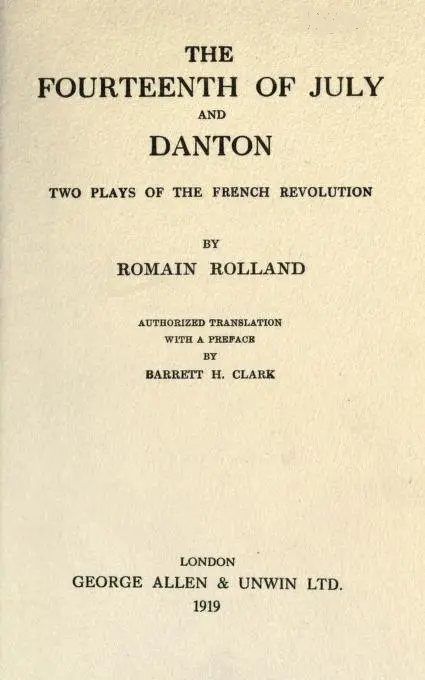
"The Fourteenth of July and Danton: Two Plays of the French Revolution" by Romain Rolland is a collection of historical plays written during the early 20th century. The work dramatizes significant events from the French Revolution, focusing on the interplay between individual heroes and the collective will of the people. The plays emphasize themes of liberty, social justice, and the moral truths behind revolutionary movements. The opening of "The Fourteenth of July" introduces the tense atmosphere in Paris leading up to the storming of the Bastille on July 14th, 1789. It captures the excitement and anxiety among various social classes as they react to the perceived threats from the monarchy. The dialogue features characters such as Camille Desmoulins and members of the crowd who discuss strategies and fears while urging each other to unite against the oppressive forces. The scene is laden with rich dialogue that reveals the characters' passions and the weight of societal expectations, setting the stage for the ensuing revolution. The focus on the "People" as a collective character emphasizes Rolland's aim to portray the revolution as a movement driven by the masses rather than just a few historical figures.
Introduction adapted from the source catalogue; source summaries may be automatically generated.
Free to read · English · 52,400 words · No account needed
MAKE TIME FOR A GOOD BOOK
On by default. Untick to stop anonymous reading totals. Each page counts after 10 seconds in view. How this works.
Anonymous counting is on unless you have switched it off.
CAMILLE. I am beginning to take pleasure in life again. A moment
ago, everything was dark; I felt as if I were already in the
grave.
DANTON. It isn't that everything is light: you yourself have changed. You didn't loom very large on the horizon.
CAMILLE. I am ashamed of my weakness. My flesh is feeble.
DANTON. You're a sly one! You wanted to become an object of sympathy to the women! See that girl there making eyes at you!
HÉRAULT [softly]. My poor friends, I really pity you.
DANTON. Why, my handsome fellow?
HÉRAULT. You're selling the bear-skin, when your own is already
disposed of.
DANTON. My skin? Yes, I know, there are many who would like it. Saint-Just especially. Well, let him come and take it, and if he succeeds, let him make a rug of it.
HÉRAULT. Why bother? [He shrugs his shoulders and lapses into silence. Meanwhile, FOUQUIER-TINVILLE has finished his letter, which is taken out by a guard.]
JUDGE. While we await the Convention's answer, let us continue. [The gendarmes make the prisoners sit down again. He says to PHILIPPEAUX.] Your name and occupation?
PHILIPPEAUX. Pierre-Nicolas Philippeaux, former judge at Le Mans, representative in the Convention.
JUDGE. Your age?
PHILIPPEAUX. Thirty-five.
JUDGE. You are charged with having paralyzed the national defense, during your mission in La Vendée; you attempted to throw the Committee of Public Safety into disrepute, by means of insulting pamphlets; you were a conspirator with Danton and Fabre in their attempt to restore the royalty.
PHILIPPEAUX. I exposed the indignation of the public against
the brigandage of certain generals. It was my duty, and I
accomplished it.
JUDGE. In this implacable struggle for France, your duty was
to do everything in your power to aid the nation. You tried to
hinder it.
PHILIPPEAUX. Ronsin and Rossignol are a dishonor to humanity.
FOUQUIER-TINVILLE. You were not a representative of humanity,
but of the nation.
PHILIPPEAUX. My nation is humanity.
JUDGE. Did those you pitied, the Royalists who were crushed by
Rossignol, think of humanity?
PHILIPPEAUX. There is no excuse for crime.
FOUQUIER-TINVILLE. Victory is.
PHILIPPEAUX. I accuse you.
CAMILLE. Before all the people, I denounce these infamies!
FOUQUIER-TINVILLE [with a shrug]. Let the people judge. [The People are divided: many applaud FOUQUIER-TINVILLE and converse among themselves.]
DANTON [aside to DESMOULINS]. Keep your mouth shut! You're
throwing stones in my garden.
CAMILLE [astounded]. How is that?
DANTON. I said what was necessary.
JUDGE [to WESTERMANN]. Prisoner, stand up.
WESTERMANN. I? Well, forward march!
JUDGE. Your name?
WESTERMANN. You know my name very well.
JUDGE. Your name?
WESTERMANN [with a shrug]. Always mixing things up! Ask the
people!
Your reading position is saved on this browser. Take it to another device with a library code. Reading pages adapt to text, rather than matching a printed edition.
BEHIND THE BOOK
This eBook is for the use of anyone anywhere in the United States and most other parts of the world at no cost and with almost no restrictions whatsoever. You may copy it, give it away or re-use it under the terms of the Project Gutenberg License included with this eBook or online at www.gutenberg.org. If you are not located in the United States, you will have to check the laws of the country where you are located before using this eBook. Read the source licence.
The original source file, including credits and licence, is retained by this library. Request an original-format copy at no charge. Please include the book title and Project Gutenberg identifier #49438.
KEEP YOUR CURIOSITY GOING
Cécile Tormay

Moritz Busch
John L. Ransom
Frances Wright
Cécile Tormay

Mabel Potter Daggett