THE CLASSIC COLLECTION✦The Star of IndiaCLASSIC FREE BOOKS
The Star of India
Edward Sylvester Ellis
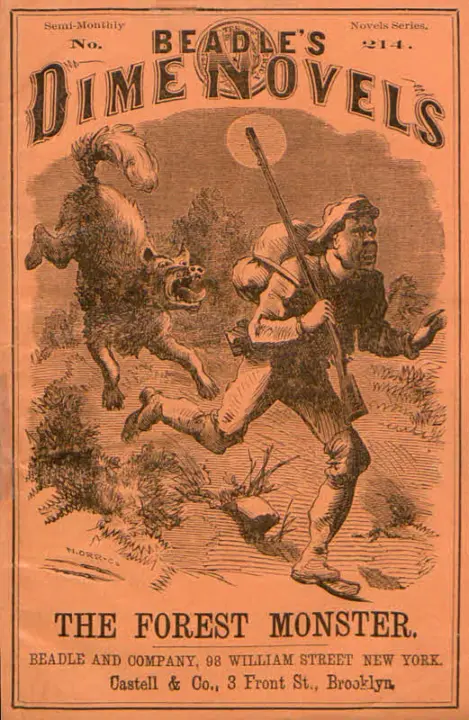
THE CLASSIC COLLECTION · 1870
"The Forest Monster; or, Lamora, the Maid of the Canon" by Edward Sylvester Ellis is a novel written in the late 19th century. The story is set in the American West during an era when wilderness and native tribes presented both adventure and peril to settlers. The narrative introduces characters like Fred Hammond, a young adventurer, and Lamora, a mysterious woman who provides crucial warnings to an emigrant party threatened by Native American warriors. The opening of the book establishes an atmosphere of tension and suspense as an emigrant caravan encounters harsh weather and potential danger from an approaching Native American war party. The protagonist, Fred Hammond, becomes particularly uneasy as he senses a looming threat. His concerns are amplified when Lamora, a woman who declares her intention to help, arrives just in time to warn them of impending danger from a thousand Blackfeet warriors. As the night deepens, the caravan prepares to flee westward into the unknown, setting the stage for further adventures and the search for Lamora, whose own mysterious background intertwines with the tale of survival and romance that unfolds.
Introduction adapted from the source catalogue; source summaries may be automatically generated.
Free to read · English · 33,943 words · No account needed
MAKE TIME FOR A GOOD BOOK
On by default. Untick to stop anonymous reading totals. Each page counts after 10 seconds in view. How this works.
Anonymous counting is on unless you have switched it off.
“No,” was the somewhat hesitating response of Tom.
“But if he don’t come powerful soon,” added old Stebbins, “I’m gwine to start on a hunt for him.”
“Perhaps the horses have wandered some distance away,” suggested
Hammond.
“That’s jest the trouble; thar’s so many hundred things that might keep him, that thar ain’t no guessin’ the right one.”
“Who is that?” asked Lamora, pointing up the cañon.
“That’s Teddy now.”
So it proved; the Irishman was discerned, on the back of one of the
cantering horses, and leading two others that seemed very frisky and
lively.
As they came near, it was noticed that Teddy’s face was very red, as though he were perspiring, and it was evident that he was about as angry as he could possibly be. He had a horse on either side of him, each held by halters that were twisted around his respective wrists.
The horse on the right had a habit of holding suddenly back, or starting spasmodically forward, that threatened to jerk the rider off his own animal; but as, at the critical juncture, the other horse gave a yank in the other direction, this catastrophe was prevented.
This kept Teddy upon his beast, but, at the same time, it was not pleasant to have the shoulders so nearly dislocated. As the only thing possible under the circumstances, he made furious and repeated attempts to kick the playful animals, but they seemed to know enough to keep out of his reach, and had a high opinion of the sport.
The fact was, they had been living in “clover” for the last few days, and they “felt their condition.” They enjoyed it.
“WHOA, THERE!” shrieked Teddy, as he threw his body back, and grew still redder in the face, and the horses flung up their heads and laughed, so far as it is possible for an equine to smile. “Ef I only had my shillaleh, I’d break your heads! Whoa, there, ye spalpeens!”
It was amusing to the witnesses of these maneuvers, as the animals came prancing forward, and finally settled to rest in front of the party.
“What kept you so long?” asked Black Tom, as he and old Stebbins advanced and took charge of their respective horses.
“The ould boy got in them!” he replied, puffing from his severe exertions. “When I cotched one, the ithers give me the slip and got away, and then when I cotched them, the ither jumped over me head, kicked me over, and so the spalpeens kept at it, till I was nearly dead.”
“But you succeeded at last,” laughed Hammond.
Your reading position is saved on this browser. Take it to another device with a library code. Reading pages adapt to text, rather than matching a printed edition.
Edward Sylvester Ellis
Edward Sylvester Ellis
Edward Sylvester Ellis
Edward Sylvester Ellis
BEHIND THE BOOK
This eBook is for the use of anyone anywhere in the United States and most other parts of the world at no cost and with almost no restrictions whatsoever. You may copy it, give it away or re-use it under the terms of the Project Gutenberg License included with this eBook or online at www.gutenberg.org. If you are not located in the United States, you will have to check the laws of the country where you are located before using this eBook. Read the source licence.
The original source file, including credits and licence, is retained by this library. Request an original-format copy at no charge. Please include the book title and Project Gutenberg identifier #59147.
KEEP YOUR CURIOSITY GOING
Coulson Kernahan

Maurice Baring
Frances Wright
Cécile Tormay

Frederic Jesup Stimson

W. H. P. (William Henry Pope) Jarvis