THE CLASSIC COLLECTION✦The Star of IndiaCLASSIC FREE BOOKS
The Star of India
Edward Sylvester Ellis
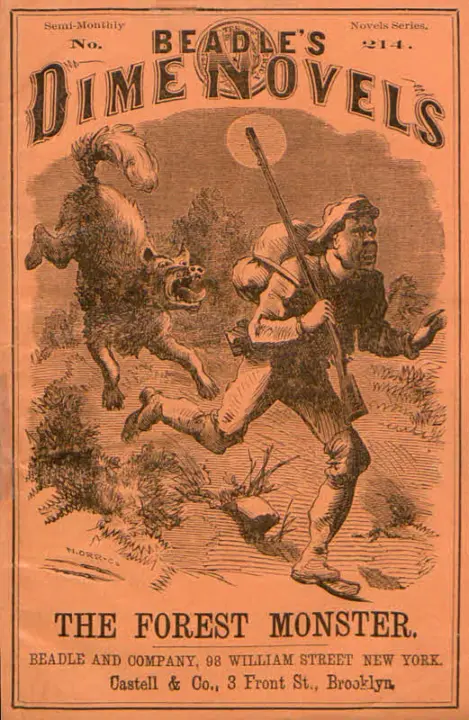
THE CLASSIC COLLECTION · 1870
"The Forest Monster; or, Lamora, the Maid of the Canon" by Edward Sylvester Ellis is a novel written in the late 19th century. The story is set in the American West during an era when wilderness and native tribes presented both adventure and peril to settlers. The narrative introduces characters like Fred Hammond, a young adventurer, and Lamora, a mysterious woman who provides crucial warnings to an emigrant party threatened by Native American warriors. The opening of the book establishes an atmosphere of tension and suspense as an emigrant caravan encounters harsh weather and potential danger from an approaching Native American war party. The protagonist, Fred Hammond, becomes particularly uneasy as he senses a looming threat. His concerns are amplified when Lamora, a woman who declares her intention to help, arrives just in time to warn them of impending danger from a thousand Blackfeet warriors. As the night deepens, the caravan prepares to flee westward into the unknown, setting the stage for further adventures and the search for Lamora, whose own mysterious background intertwines with the tale of survival and romance that unfolds.
Introduction adapted from the source catalogue; source summaries may be automatically generated.
Free to read · English · 33,943 words · No account needed
MAKE TIME FOR A GOOD BOOK
On by default. Untick to stop anonymous reading totals. Each page counts after 10 seconds in view. How this works.
Anonymous counting is on unless you have switched it off.
Several feet separated the hostile parties, when the Irishman made a lightning-like leap, sending out a terrific left-hander at the same time, “straight from the shoulder,” that, striking the nose of the astonished red-skin, sent him turning several back-somersaults.
Wheeling with the same extraordinary celerity, he bestowed a similar compliment upon the other red-skin, and vigorously following it up, forced him over the edge of the rock into the cañon below.
Old Stebbins had not been long in detecting that something was wrong with his friend. He understood what his defiant whoop meant, and knew that he had dropped into a nest of Indians.
But how to help him!
There was no possible way open; for, if he should attempt to descend by means of the grape-vine, he would be at such a disadvantage that it would be nothing less than suicide. So he could only hold his rifle ready to seize the first opportunity that should present itself.
It was not long in coming. When Teddy toppled his man over the edge of the rock, he had scarcely reached the water below, when the sharp crack of the trapper’s rifle rung above the din of waters, and the miserable red-skin floated away, as limp and lifeless as the garments upon his person.
“Now, give us another, Teddy!” called out old Stebbins, as he caught up
the other gun.
But there was good reason why the other didn’t come.
When Teddy turned to seize him, he saw him spring to his feet, and start backward into the cave with all speed.
“Be jabers, yees can’t run fur in that direction, as me mither observed whin the piggy run his head into the pratie-pot,” exclaimed Teddy, as he dashed after him.
But it was impossible for him to take heed to his feet, and he had taken scarcely a half dozen steps, when a sudden rise in the floor of the cavern caused him to trip and fall forward, with no little violence, upon his face.
“Worrah, worrah, but that rock ain’t very soft,” he muttered, as he picked himself up, and rubbed his bruised countenance. “Where did that spalpeen go?”
At his first entrance into the cave, he naturally supposed that it extended backward but a short distance; but he had already penetrated a hundred feet, and there were no signs of its ending.
Nor did the light decrease. It was faint; but still, when the eyes became accustomed to it, sufficient to see one’s surroundings. Looking ahead, Teddy saw a circular opening, through which this partial light of day entered.
Your reading position is saved on this browser. Take it to another device with a library code. Reading pages adapt to text, rather than matching a printed edition.
Edward Sylvester Ellis
Edward Sylvester Ellis
Edward Sylvester Ellis
Edward Sylvester Ellis
BEHIND THE BOOK
This eBook is for the use of anyone anywhere in the United States and most other parts of the world at no cost and with almost no restrictions whatsoever. You may copy it, give it away or re-use it under the terms of the Project Gutenberg License included with this eBook or online at www.gutenberg.org. If you are not located in the United States, you will have to check the laws of the country where you are located before using this eBook. Read the source licence.
The original source file, including credits and licence, is retained by this library. Request an original-format copy at no charge. Please include the book title and Project Gutenberg identifier #59147.
KEEP YOUR CURIOSITY GOING
Coulson Kernahan

Maurice Baring
Frances Wright
Cécile Tormay

Frederic Jesup Stimson

W. H. P. (William Henry Pope) Jarvis