THE CLASSIC COLLECTION✦The Star of IndiaCLASSIC FREE BOOKS
The Star of India
Edward Sylvester Ellis
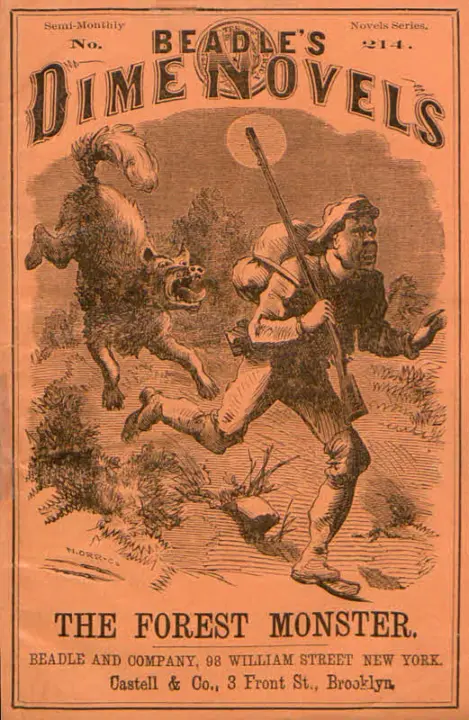
THE CLASSIC COLLECTION · 1870
"The Forest Monster; or, Lamora, the Maid of the Canon" by Edward Sylvester Ellis is a novel written in the late 19th century. The story is set in the American West during an era when wilderness and native tribes presented both adventure and peril to settlers. The narrative introduces characters like Fred Hammond, a young adventurer, and Lamora, a mysterious woman who provides crucial warnings to an emigrant party threatened by Native American warriors. The opening of the book establishes an atmosphere of tension and suspense as an emigrant caravan encounters harsh weather and potential danger from an approaching Native American war party. The protagonist, Fred Hammond, becomes particularly uneasy as he senses a looming threat. His concerns are amplified when Lamora, a woman who declares her intention to help, arrives just in time to warn them of impending danger from a thousand Blackfeet warriors. As the night deepens, the caravan prepares to flee westward into the unknown, setting the stage for further adventures and the search for Lamora, whose own mysterious background intertwines with the tale of survival and romance that unfolds.
Introduction adapted from the source catalogue; source summaries may be automatically generated.
Free to read · English · 33,943 words · No account needed
MAKE TIME FOR A GOOD BOOK
On by default. Untick to stop anonymous reading totals. Each page counts after 10 seconds in view. How this works.
Anonymous counting is on unless you have switched it off.
“I don’t know,” continued Black Tom, who seemed in the best of spirits; “it looked powerful like it when we had to dig out last spring.”
“It did, summat--”
“B’ars and beavers!” exclaimed Tom, suddenly coming to the upright position, jerking his coonskin hat from his head, and dashing it upon the ground, “don’t you remember, Steb.?”
“Remember what?” demanded his companion, not a little startled at his
manner.
“It was right hyar that we see’d that!”
“See’d what?”
“Old Steb., you’re a thunderin’ fool!” replied Tom, with an expression of disgust. “I guess you’re gettin’ childish. I, s’pose, you don’t remember that--that--what shall I call it?--that we see’d near hyar?”
“How did I furget it? How did we all forget it--Teddy, too?”
There was no doubt that Stebbins recalled the creature to which reference had been made. Unquestionably brave as both of these men were, their appearance showed that they were frightened. Their bronzed and scarred faces were pale, and they looked into each other’s eyes in silence, both revolving “terrible thoughts.”
“Right out thar,” said Stebbins, speaking in a terrified whisper, and pointing toward the open prairie, over which they had just ridden; “how was it that we wa’n’t on the look out fur it?”
“Dunno, when we’ve been talkin’ ’bout it all the way. It’s too bad that it should come right hyar--jest near the very spot we’re after.”
“Mebbe it’s gone away,” added Stebbins, speaking not his belief, but
his hope.
“It will be a powerful lucky thing for us, if it has.”
As frightened children huddle close together, around the evening fire, at the thought of the dreadful ghost, so these two stern-featured men, whose faces had never blanched when the howls of the myriad red-skins, who were closing around them, sounded in their ears, now instinctively sat closer together, and looked off furtively in the darkness, as if in mortal dread of some coming and appalling monster.
But this sudden exhibition of fear was mostly temporary in its manifestations. As each clutched his trusty rifle, and recalled the terrible weapon of which he was master, their confidence almost, but not entirely, returned.
“If that thing does come,” finally spoke old Stebbins, in his deliberate but emphatic manner, “and I can get the chance, I’m going to put a rifle-ball into it, smash and clean.”
“S’posen it doesn’t hurt it.”
“That’s onpossible.”
“Dunno,” persisted Black Tom, “from what we’ve hearn of it, they say it don’t mind our guns.”
Your reading position is saved on this browser. Take it to another device with a library code. Reading pages adapt to text, rather than matching a printed edition.
Edward Sylvester Ellis
Edward Sylvester Ellis
Edward Sylvester Ellis
Edward Sylvester Ellis
BEHIND THE BOOK
This eBook is for the use of anyone anywhere in the United States and most other parts of the world at no cost and with almost no restrictions whatsoever. You may copy it, give it away or re-use it under the terms of the Project Gutenberg License included with this eBook or online at www.gutenberg.org. If you are not located in the United States, you will have to check the laws of the country where you are located before using this eBook. Read the source licence.
The original source file, including credits and licence, is retained by this library. Request an original-format copy at no charge. Please include the book title and Project Gutenberg identifier #59147.
KEEP YOUR CURIOSITY GOING
Coulson Kernahan

Maurice Baring
Frances Wright
Cécile Tormay

Frederic Jesup Stimson

W. H. P. (William Henry Pope) Jarvis