THE CLASSIC COLLECTION✦An outlaw’s diary: the CommuneCLASSIC FREE BOOKS
An outlaw’s diary: the Commune
Cécile Tormay
THE CLASSIC COLLECTION · 1917
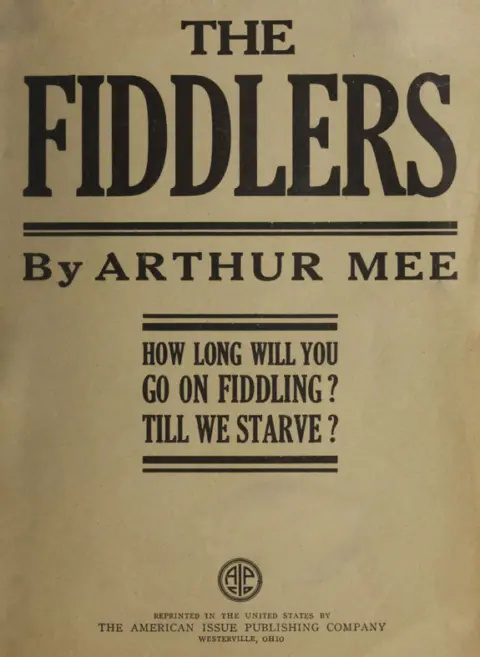
"The Fiddlers; Drink in the Witness Box" by Arthur Mee is a critical examination of the impact of alcohol on society and the war effort, written in the early 20th century, notably during World War I. This work appears to convey strong anti-alcohol sentiments, arguing that the drink trade undermines the country's strength during wartime and contributes to social and economic woes. Mee highlights the detrimental effects of alcohol on both the general population and soldiers, suggesting it is a significant enemy alongside the forces of Germany. The opening of the text establishes a passionate tone as Mee presents a compelling argument against the drink trade, asserting that it prolongs the war and exacerbates dire food shortages. He cites various statistics and examples of the massive quantities of food destroyed for beverage production, claiming that this waste directly threatens national security. Through a series of anecdotes and reports, he builds a case that emphasizes the ruin caused by alcohol at home—neglect, poverty, and broken families—contrasting sharply with the sacrifices of soldiers fighting abroad. The piece serves both as a historical piece and a call to action for societal reform regarding alcohol consumption.
Introduction adapted from the source catalogue; source summaries may be automatically generated.
Free to read · English · 21,745 words · No account needed
MAKE TIME FOR A GOOD BOOK
On by default. Untick to stop anonymous reading totals. Each page counts after 10 seconds in view. How this works.
Anonymous counting is on unless you have switched it off.
A lady visited a soldier’s wife and found her at home with all her clothes in pawn. Her husband and brother had both been home from the Front, and in one week had spent £8 on drink.
Facts in the “Cork Constitution,” Dec. 10, 1915
A labourer, home from tunnelling work at the Front, was fined 13s. for drunkenness on his 33rd appearance, having spent £45 in seven days.
Facts in “Daily News,” Oct. 11, 1916
A disabled soldier was selling papers in Kingsway, London. He was proud of his military record and the character his colonel gave him. He was trying to compound for a pension; he thought he would settle for £50. “Mind you,” said he “there is not a better character in London than mine, and I shall get the £50. Then I shall have a month’s booze.” “What, with that fine character of yours?” a gentleman said to him. “Yes,” said the man, “when I came home, and could leave the hospital, there was £50 due to me, and I had a regular booze.”
Facts known to the Author
A soldier with twelve years’ clean record in the Army was sentenced for felony after being made drunk by his friends.
Police Records of Southport, January 9, 1915
No Government has ever received more warnings than the three war Governments have received concerning drink. There is no room for them here, but we may call a few witnesses such as cannot be ignored by a nation looking forward to the day when millions of men will be home again.
A house in Westminster reeked with filth and drink and drunken overseas soldiers, “and it would be better,” said the Crown Solicitor, “if power were given to the police to sweep such places off the earth.”
Westminster Police Records, Aug. 1916
A sapper seaman was found dead at the quay. Another seaman said his friend had seven drinks. They left the publichouse arm-in-arm, and went to the quay. There he saw a corporal, who was boatswain for the night, and was drunk. Leaving the sapper, he got the corporal into the boat, and went back for his friend, but the sapper had disappeared.
The lieutenant: “The deceased was one of the quietest boys who had ever been on the ship, and one of the best oarsmen. The whole trouble was that it was pay day.”
The Coroner: “Prohibition during the war would be a blessing to all. It seems to be a very rotten state of affairs.”
The foreman: “Drink.”
The lieutenant: “Prohibition would be the best thing.”
The Coroner: “This poor man, unfortunately, is one of many.”
Facts in “Western Daily Mercury,” January 8, 1917
Your reading position is saved on this browser. Take it to another device with a library code. Reading pages adapt to text, rather than matching a printed edition.
BEHIND THE BOOK
This eBook is for the use of anyone anywhere in the United States and most other parts of the world at no cost and with almost no restrictions whatsoever. You may copy it, give it away or re-use it under the terms of the Project Gutenberg License included with this eBook or online at www.gutenberg.org. If you are not located in the United States, you will have to check the laws of the country where you are located before using this eBook. Read the source licence.
The original source file, including credits and licence, is retained by this library. Request an original-format copy at no charge. Please include the book title and Project Gutenberg identifier #53733.
KEEP YOUR CURIOSITY GOING
Cécile Tormay

Moritz Busch
John L. Ransom
Frances Wright
Cécile Tormay

Mabel Potter Daggett