THE CLASSIC COLLECTION✦An outlaw’s diary: the CommuneCLASSIC FREE BOOKS
An outlaw’s diary: the Commune
Cécile Tormay
THE CLASSIC COLLECTION · 1917
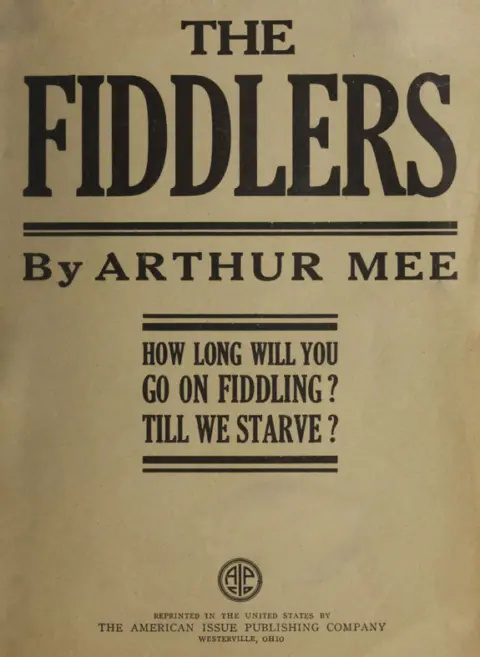
"The Fiddlers; Drink in the Witness Box" by Arthur Mee is a critical examination of the impact of alcohol on society and the war effort, written in the early 20th century, notably during World War I. This work appears to convey strong anti-alcohol sentiments, arguing that the drink trade undermines the country's strength during wartime and contributes to social and economic woes. Mee highlights the detrimental effects of alcohol on both the general population and soldiers, suggesting it is a significant enemy alongside the forces of Germany. The opening of the text establishes a passionate tone as Mee presents a compelling argument against the drink trade, asserting that it prolongs the war and exacerbates dire food shortages. He cites various statistics and examples of the massive quantities of food destroyed for beverage production, claiming that this waste directly threatens national security. Through a series of anecdotes and reports, he builds a case that emphasizes the ruin caused by alcohol at home—neglect, poverty, and broken families—contrasting sharply with the sacrifices of soldiers fighting abroad. The piece serves both as a historical piece and a call to action for societal reform regarding alcohol consumption.
Introduction adapted from the source catalogue; source summaries may be automatically generated.
Free to read · English · 21,745 words · No account needed
MAKE TIME FOR A GOOD BOOK
On by default. Untick to stop anonymous reading totals. Each page counts after 10 seconds in view. How this works.
Anonymous counting is on unless you have switched it off.
A captain in the Royal Flying Corps drove a motor-car through London, knocked a man down, drove on, and ignored the police, who eventually mounted the footboard and found the officer drunk.
Bow Street Police Records, June 3, 1916
A lance-corporal on Chesterfield station was so drunk that he walked off the platform and fell on the line as a passenger train came up.
Chesterfield Police Records, June 2, 1915
A corporal of the Duke of Cornwall’s Light Infantry, leaving the Front with 150 rounds of ammunition and his service rifle, came out drunk into the streets of West Ham and began firing his rifle.
Facts in “Daily Chronicle,” July 10, 1915
A soldier who had received a cartridge from his son at the Front, put it in his rifle, and while drunk fired it in the streets of Manchester.
Manchester Police Records, January 27, 1915
In the early hours of the morning two unarmed soldiers were fired at in Woolwich by a drunken soldier, who chased them for a long distance, firing shots all the time, until he was arrested.
Facts in “Alliance News,” February, 1915
Drunkenness among soldiers and sailors is appalling. Unoffending travellers are delayed by drunken sentries. Sailors landing after weeks of arduous toil in the North Sea find it easy to get so drunk that some are drowned, some die from exposure, and many return to their ships in a condition of helpless inebriety.
Facts in “Inverness Courier,” May 1915
Two drunken soldiers entered the parish church at Codford, set fire to the vestry, threw down the altar cross and candlestick, broke a stained-glass window, and tore leaves out of a Bible 200 years old.
Facts in “Daily Chronicle,” April 3, 1916
A drunken soldier at Cannock was imprisoned for drawing his bayonet in the streets. “If I meet a policeman I will murder the dog,” he said, and, meeting one, he threatened to cut off his head.
Police Records at Cannock, March 1916
400 soldiers tried to get a drunken man from the police in Grantham.
Facts in “Grimsby News,” July 30, 1915
A drunken sergeant was found forcibly detaining a girl at Hornsey. On the police interfering, the drunken soldier drew his bayonet.
Facts in “Daily News,” September 7, 1916
Three splendid-looking fellows, minesweepers, were traveling on the Highland Railway. “All were married men,” said a fellow passenger, “happy and proud of their homes, and they spoke with ache still in their hearts something of their lives and work. Well, these men succumbed during the journey. A change of trains was their opportunity, and I left them in a nearly helpless condition.”
Facts in “The Spectator,” April 8, 1916
Your reading position is saved on this browser. Take it to another device with a library code. Reading pages adapt to text, rather than matching a printed edition.
BEHIND THE BOOK
This eBook is for the use of anyone anywhere in the United States and most other parts of the world at no cost and with almost no restrictions whatsoever. You may copy it, give it away or re-use it under the terms of the Project Gutenberg License included with this eBook or online at www.gutenberg.org. If you are not located in the United States, you will have to check the laws of the country where you are located before using this eBook. Read the source licence.
The original source file, including credits and licence, is retained by this library. Request an original-format copy at no charge. Please include the book title and Project Gutenberg identifier #53733.
KEEP YOUR CURIOSITY GOING
Cécile Tormay

Moritz Busch
John L. Ransom
Frances Wright
Cécile Tormay

Mabel Potter Daggett