The Tale of Two Bad Mice
Beatrix Potter
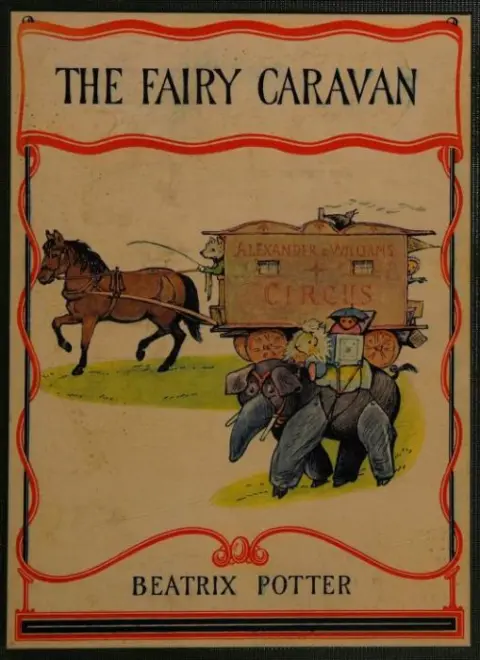
THE CLASSIC COLLECTION · 1929
The Fairy Caravan is a children's book written and illustrated by Beatrix Potter and first published in 1929 by Alexander McKay in Philadelphia. As noted by Leslie Linder, "Potter did not wish for an English edition of The Fairy Caravan, because she felt the stories were 'too personal – too autobiographical' to publish in this country". To secure English copyright, however, Potter produced 100 copies with the first eighteen pages discarded and replaced by sheets privately printed in Ambleside by George Middleton. (This summary is from Wikipedia.)
Introduction adapted from the source catalogue; source summaries may be automatically generated.
Free to read · English · 34,940 words · No account needed
MAKE TIME FOR A GOOD BOOK
On by default. Untick to stop anonymous reading totals. Each page counts after 10 seconds in view. How this works.
Anonymous counting is on unless you have switched it off.
It was four o’clock of the afternoon when Pony Billy trotted into Codlin Croft orchard with Paddy Pig. Sandy and the farm dogs barked joyfully; the turkey cock gobbled; Charles crowed; and Jenny Ferret waved a dishcloth on the caravan steps. Even Tuppenny and Xarifa—dolefully confined in hampers—clapped their little paws in welcome. Paddy Pig took no notice of these greetings. He slid from the saddle, and sat by the camp fire in a heap.
“He looks poorly,” said Sandy, anxiously, “fetch a shawl, Jenny Ferret.” “Ill; very ill,” said Paddy Pig. They wrapped him in the shawl and gave him tea; he was thirsty, but he had no appetite. The raw potatoes appeared to have disagreed, on top of the tartlets. As evening closed in, he shivered more and more. The company plied him with questions—how did he get across the water into Pringle Wood? “Over a plank.” “I don’t remember any plank bridge,” said Pony Billy, “perhaps it might be a tree that had been washed down by the flood?” “Why did you not come back the same way?” “It was gone,” said Paddy Pig, swaying himself about. “What did you do in the wood?” “I tumbled down. Things pulled my tail and pinched me, and peeped at me round trees,” said Paddy Pig, shuddering. “What sort of things?” “Green things with red noses. Oh, oh, oh!” he squealed, “there is a red nose looking at me out of the teapot! Take me away, Pony Billy! I’m going to be sick!” “He is very unwell,” said Jenny Ferret, “he should be put to bed at once.” But where? In an ordinary way, Paddy Pig and Sandy slept in dry straw underneath the caravan. But everybody knows that it is unsafe to allow a delirious pig to sleep on the cold ground. “Do you think we could squeeze him through the door into the caravan, if I pulled and you pushed?” said Sandy. Jenny Ferret shook her head, “He is too big. We might have crammed him into the go-cart; but it is not here; it was left behind, by the ford.” “He must sleep indoors somehow,” said Sandy. “Why all this discussion?” said Charles the cock. “Let our honored visitor, Mr. Patrick Pig, sleep in the middle stall of the stable. It is empty. Maggret, our mare, stands in the stall next to the window. And there is hay, as well as straw. I, myself, scratched it out of the hay-rack. Cock-a-doodle doo! And there is even a horse rug. A large buff, moth-eaten blanket, bound with red braid,” said Charles, swelling with importance. “The very thing! provided Maggret has no objection,” said Sandy. “Come, Paddy Pig.” The invalid rose stiffly to his feet. But he flopped down again, nearly into the fire (which would have caused another red nose for certain, had he fallen into it). It was necessary to borrow a wheelbarrow; also the stable lantern, as by this time it was dark. Fortunately, Farmer Hodgson had bedded up the mare, and fed all for the night. He was having his own supper, quite unconscious that his stable had been requisitioned as a hospital for sick pigs. He supped in the kitchen; and the windows looked another way. Mrs. Hodgson had occasion to go to the pantry for cheese and a pasty. She glanced through the small diamond panes towards the orchard and the warm glow that was Jenny Ferret’s stick fire, “’Tis a red rising moon. Will it freeze?” “Bad for the lambs if so be,” said Farmer Hodgson, cutting the apple pasty. Paddy Pig did not improve; he became worse. His mind wandered. He talked continually about red noses; and he thought that there were green caterpillars in the manger. He was so obsessed with red-nosed peepers that he would have bolted out of the stable if his legs had been strong enough. “Someone must sit up with him,” said Jenny Ferret, “I am no use; I’m only an old body. And you, Sandy, ought to remain on guard at the camp. What is to be done?” “I should esteem it a privilege to be permitted to act as nurse; I am accustomed to night watching,” said Cheesebox, the smithy cat. She had arrived with Mettle, hoping for a circus show; but the company were so anxious about Paddy Pig that they felt unable to give any performance. “I should esteem it a privilege to sit up with Mr. Patrick Pig. At the same time I should prefer to have a colleague to share the responsibility. Send for Mrs. Scales’ Mary Ellen. She has an invaluable prescription for sick pigs. And she understands worm-in-tail,” said Cheesebox; “had it been the time of the moon, we would have hung up rowan berries in the stall. But failing that propicious season, she has medicinal herbs of great virtue. Send for Mary Ellen!” Sandy looked doubtful; “I presume she is another cat? I am afraid she might refuse to come with me, if I went to fetch her. Could you go, Pony Billy? Are you too tired?” Pony Billy sighed the sigh of a weary horse; “Not tired; not at all; but my shoes are past bearing. And here is Mettle out for a lark; otherwise I would have gone to the smithy and had them altered. In any case I was intending to fetch the tilt-cart.” “Go for the cart before your shoes are changed, Billy. You left it over near to Pringle Wood. I will undertake to have the hearth hot, long before you will reach the smithy.”
Your reading position is saved on this browser. Take it to another device with a library code. Reading pages adapt to text, rather than matching a printed edition.
Beatrix Potter
Beatrix Potter
Beatrix Potter
Beatrix Potter
BEHIND THE BOOK
This eBook is for the use of anyone anywhere in the United States and most other parts of the world at no cost and with almost no restrictions whatsoever. You may copy it, give it away or re-use it under the terms of the Project Gutenberg License included with this eBook or online at www.gutenberg.org. If you are not located in the United States, you will have to check the laws of the country where you are located before using this eBook. Read the source licence.
The original source file, including credits and licence, is retained by this library. Request an original-format copy at no charge. Please include the book title and Project Gutenberg identifier #78504.
KEEP YOUR CURIOSITY GOING
Coulson Kernahan

Maurice Baring
Frances Wright
Cécile Tormay

Frederic Jesup Stimson

W. H. P. (William Henry Pope) Jarvis