THE CLASSIC COLLECTION✦An outlaw’s diary: the CommuneCLASSIC FREE BOOKS
An outlaw’s diary: the Commune
Cécile Tormay
THE CLASSIC COLLECTION · 1908
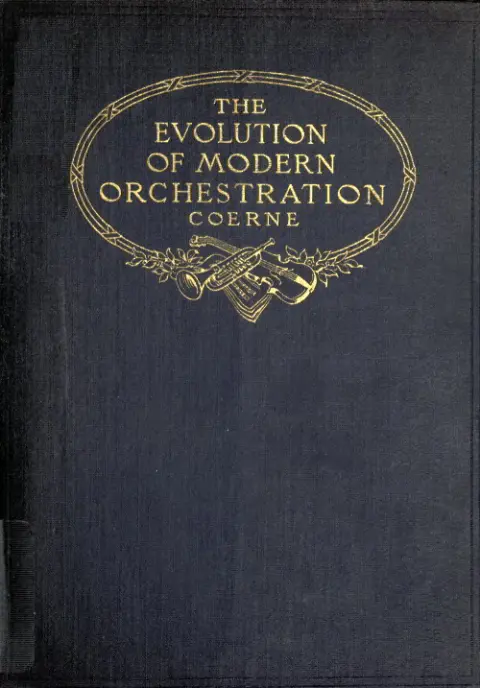
"The Evolution of Modern Orchestration" by Louis Adolphe Coerne is a scholarly examination of the history and development of orchestration, written in the early 20th century. This work aims to trace how orchestration has evolved in conjunction with the broader history of music, emphasizing the influences and key figures that have shaped the modern orchestra. As a study of musical evolution, it explores the intricacies of instrumental combinations, their roles, and techniques, providing insights into the art of writing for orchestras." The opening of the book sets the stage for a detailed exploration of the origins of instrumental music and its progression through various civilizations, including Egypt, Greece, and Rome. Coerne highlights how early music was intertwined with human emotions and rituals, evolving from primitive vocal expressions to the incorporation of instruments. As he moves through history, he discusses pivotal developments such as the introduction of harmony and notation, the resurgence of folk music, and the transformative influences of significant composers and theorists. The first chapters outline the foundational history of instrumental music and the rudimentary beginnings of orchestration, preparing the reader for a deeper analysis of its evolution in later periods.
Introduction adapted from the source catalogue; source summaries may be automatically generated.
Free to read · English · 84,730 words · No account needed
MAKE TIME FOR A GOOD BOOK
On by default. Untick to stop anonymous reading totals. Each page counts after 10 seconds in view. How this works.
Anonymous counting is on unless you have switched it off.
Orchestration in its present development would seem to have reached its highest possible attainment of effectiveness and virtuosity. The problem of the future, therefore, deals not so much with material increase of orchestral resource, as with what manner of thought and music the orchestra is destined to portray. What are to be the musical ethics of the twentieth century composers? The most subtle thinkers of the world have generally taken an idealistic view of the social mission of musical art. Eminent psychologists of Germany, France and England, who otherwise represent distinctive and frequently antagonistic schools of philosophy, all agree on this point, as illustrated by a few quotations selected from the writings of Hegel, Schopenhauer, Emile Montegut and Herbert Spencer. Music, according to Hegel, should "fill the heart and bring to consciousness everything developed and undeveloped which human feeling can carry, experience and bring forth, in its innermost and most secret parts; whatever the human heart in its manifold possibilities and moods desires to express or excite; and especially whatever the spirit has in its idea of the Most Essential and High; the glory of the Honored, the Eternal and the True." Schopenhauer declared that music "never expresses phenomena, but solely the inner being, the essence of phenomena, the will itself. It expresses, therefore, not this or that single and particular joy, this or that sorrow, or pain, or horror, or exultation, or hilarity, or repose of mind itself; but, as it were in abstracto, the essentials of these without their concomitants, therefore without their motives. Nevertheless, in such quintessence we understand it perfectly. Hence our fancy is so easily excited by it and tries to clothe this invisible spirit world, that speaks to us so immediately and eloquently, with flesh and blood, i.e. to embody it in an analogous example." Emile Montegut expresses himself to the effect that this magic sound of what is called music "pierces the material barriers which limit human words; it gives to hearts the means of communicating among themselves; it creates a language of which the most ignorant and the poorest perceive all the power and all the sweetness. Music speaks, and suddenly the hearts which were chilled with consciousness of their own isolation are thrilled with tenderness and radiant with happiness." Herbert Spencer believed that "music ought to take rank at the head of the fine arts because it is the one which adds most to human happiness. Not content with exciting powerfully our better instincts, it awakens sentiments lying dormant in us, of which we had not conceived the possibility, of which we do not understand the sense. This obscure presentment of an unknown happiness, which music awakens in us, this confused dream of an ideal and new life, all this is but a prophecy of something which music itself ought assuredly to accomplish." In contrast to the above enthusiastic utterances, how material and unsatisfying are the dreary speculations of such men as Leibniz! The latter looked upon music as being but the "exercitium arithmeticae occultum nescientis se numerare animi"! The ideal mission of music, therefore, ever has been and surely should continue to be that of uplifting. It should present a moral synonymous for the æsthetic, the pure, the spiritual. It should reveal the highest ideals of the living soul. It should, according to Browning, express truth, not of the mind--knowledge, which is absolute, but of the soul--shifting. Music above all other arts interprets the innermost thoughts of the soul. It is being constantly re-created, whereas all other arts are but the images of what is already created. The imitative arts--sculpture and painting, can no longer be all-satisfying to the self-consciousness of an age influenced by the subjective thought of such men as Goethe and Schiller. Why, therefore, should modern music be reared solely upon a similar realistic basis of imitation instead of upon an idealistic one of representation? The fundamentals of music rest upon an acoustic element dependent upon absolute pitch. Since, however, an isolated tone cannot suggest a definite idea or image, it is necessary, in order that music should mean something, to connect a series of tones so as to produce melody, to combine several tones so as to form chords, and to group these chords so as to obtain contrasts of tonality and modes. This accomplished, there must be added rhythmic life, variety of tone-color, and dynamic contrast. Finally, the whole fabrication must be fitted into a framework of structural form based upon the science of logic. But all this is not enough. There exists an underlying psychological principle that cannot be disregarded. Appreciation for acoustic effects and the realizations of intellectual reflection are but the stepping stones to something higher. The first requirement of a composer is intuition or the spontaneous expression of musical instinct--an element more essential to musical creation than to any other branch of art. Further requisites are imagination, emotion, inspiration, and above all spirituality. There is a tendency among recent exponents of the most advanced school to declare that the possibilities of purely æsthetic music have been exhausted. Morbidness and pessimism dominate the creative conceptions of these recent experimentalists. They are leaning more and more toward the expression of concrete ideas concealing vague abstractions. The present writer is heartily in sympathy with the most catholic application of all legitimate resources so long as the primary object of musical utterance be not lost sight of. It goes without saying that descriptive, imitative, realistic and even morbid music has its proper place in the poetic conceptions of our contemporary tone-masters. Exception only is made to music that is primarily intellectual or pessimistic. On the other hand, it need not be primarily pleasure-giving. In a word, all such objectives should be made subjective to a purer motive. The portrayal of lesser sentiments and passions is legitimate only in so far as to form a background for the nobler, which are thereby thrown into relief. The ideal mission of music is to reflect the loftiest sentiments of the composer's soul, and to awaken similar experiences in the mind of the auditor so as to inspire and uplift him. Such were the ideals of Beethoven. May his example continue to be emulated!
Your reading position is saved on this browser. Take it to another device with a library code. Reading pages adapt to text, rather than matching a printed edition.
BEHIND THE BOOK
This eBook is for the use of anyone anywhere in the United States and most other parts of the world at no cost and with almost no restrictions whatsoever. You may copy it, give it away or re-use it under the terms of the Project Gutenberg License included with this eBook or online at www.gutenberg.org. If you are not located in the United States, you will have to check the laws of the country where you are located before using this eBook. Read the source licence.
The original source file, including credits and licence, is retained by this library. Request an original-format copy at no charge. Please include the book title and Project Gutenberg identifier #49747.
KEEP YOUR CURIOSITY GOING
Cécile Tormay

Moritz Busch
John L. Ransom
Frances Wright
Cécile Tormay

Mabel Potter Daggett