THE CLASSIC COLLECTION✦An outlaw’s diary: the CommuneCLASSIC FREE BOOKS
An outlaw’s diary: the Commune
Cécile Tormay
THE CLASSIC COLLECTION · 1908
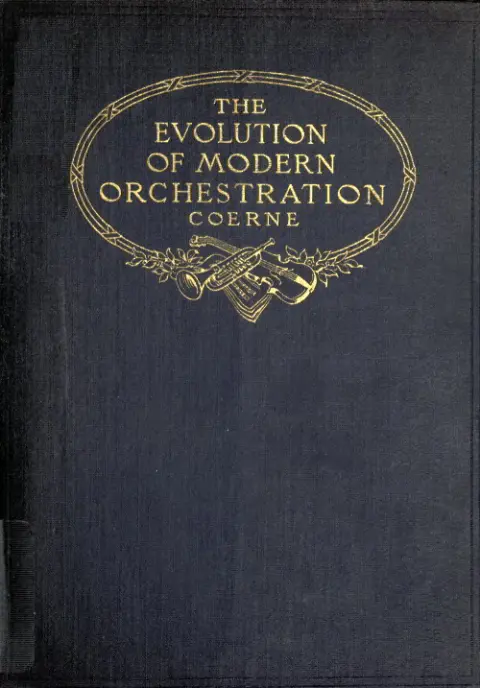
"The Evolution of Modern Orchestration" by Louis Adolphe Coerne is a scholarly examination of the history and development of orchestration, written in the early 20th century. This work aims to trace how orchestration has evolved in conjunction with the broader history of music, emphasizing the influences and key figures that have shaped the modern orchestra. As a study of musical evolution, it explores the intricacies of instrumental combinations, their roles, and techniques, providing insights into the art of writing for orchestras." The opening of the book sets the stage for a detailed exploration of the origins of instrumental music and its progression through various civilizations, including Egypt, Greece, and Rome. Coerne highlights how early music was intertwined with human emotions and rituals, evolving from primitive vocal expressions to the incorporation of instruments. As he moves through history, he discusses pivotal developments such as the introduction of harmony and notation, the resurgence of folk music, and the transformative influences of significant composers and theorists. The first chapters outline the foundational history of instrumental music and the rudimentary beginnings of orchestration, preparing the reader for a deeper analysis of its evolution in later periods.
Introduction adapted from the source catalogue; source summaries may be automatically generated.
Free to read · English · 84,730 words · No account needed
MAKE TIME FOR A GOOD BOOK
On by default. Untick to stop anonymous reading totals. Each page counts after 10 seconds in view. How this works.
Anonymous counting is on unless you have switched it off.
RICHARD STRAUSS[64] (1864). It is universally conceded that the greatest master of orchestration after Richard Wagner is Richard Strauss. The latter's career thus far bears some affinity to that of Mendelssohn as regards early artistic surroundings, scholarly training in branches other than music, and exemption from monetary anxiety. But whereas Mendelssohn's affluent circumstances and prosperous career were undoubtedly detrimental to the development of profound pathos and tragic intensity, Strauss has made the demonstration that worldly cares and petty professional obstacles are not the essential stimuli for herculean artistic growth embodying the portrayal of experiences not personally experienced.
[Footnote 64: See Appendix of Musical Illustrations, Examples 97 to
103.]
(=Biography.=) Strauss was reared in a schooling so orthodox that not even his severest critics can venture to deny his mastery of traditional usages,--indeed, in his earlier works Strauss has given tangible proof of his ability to compose in conservative forms. He is the son of a French-horn player of rare genius, whose memorable performance of his son's horn concerto first taught the present writer the latent possibilities of that instrument. Strauss is said to have produced a polka at the age of six, whereas already during his boyhood days he devoted his spare moments to writing orchestral overtures, choruses, sonatas, and the like. Although enrolled as a student at the Gymnasium and for one year at the University of Munich, he was simultaneously given opportunity to develop his musical talents along the prescribed lines of practical training. His public career as a composer may be said to have begun when two of his choruses were given at a school concert. In 1880 he succeeded in having three of his songs sung at a public concert. He was then only sixteen years old. These minor achievements, however, fall into insignificance in comparison with the recognition awarded him in the following year, when Benno Walther, concertmeister of the Munich Opera, produced the string quartet, op. 2, in the course of the annual series of chamber concerts. Walther's quartet was at that time highly authoritative in musical circles. In the same year Hermann Levi performed the symphony in D minor. Strauss next drew attention to himself with a serenade, op. 7, for thirteen instruments, and thereby interested no less a person than Hans von Bülow. This was destined to influence Strauss' entire career, for in 1885 he was engaged as musical director at Meiningen in a subordinate though honorable position to von Bülow himself. It was von Bülow, therefore, that gave Strauss his initial training as an orchestral conductor, a branch of art in which he has now attained proficiency only secondary to his powers as a composer. At Meiningen he was enabled to assimilate not only von Bülow's magnetic technique and authoritative interpretation, but was also led to grasp Wagner's ideals of conducting. In addition he also appeared occasionally as a concert pianist, and meanwhile completed his more or less conservative symphonic phantasy "Aus Italien." Here, too, he came in contact with the Wagnerian enthusiast, Alexander Ritter, an intimacy that had much to do with the subsequent moulding of his first distinctively original works, "Macbeth" and "Don Juan." Toward the close of 1885 he succeeded von Bülow as conductor of the Meiningen Orchestra, retained the post for one season, and then accepted a subordinate position in his native city under Levi and Fischer at the Munich Royal Opera. Like most prophets in their own country, he had to overcome the prejudice of some of the older gentlemen of the orchestra who had been colleagues of his father and had seen the son grow up. For three years he was now occupied with the rather thankless task of conducting lesser operatic performances, but devoted himself none the less with untiring effort to the development of his creative talents, which bore fruit in "Macbeth," "Don Juan" and "Tod und Verklärung." In 1889 he was called to the Weimar Opera, first as subordinate to Lassen, eventually as full-empowered potentate. He there married one of the operatic singers, Pauline de Ahne, daughter of a Bavarian general. While at Weimar he wrote his first opera, "Guntram." In 1894 Strauss returned to the Munich Opera in a capacity more responsible than formerly. His services as a conductor of unusual ability were by this time much in demand for special concert performances in European musical centres. The atmosphere of his native city must have been particularly inspiring to his creative Muse, for from 1894 to 1899 no less than four mighty orchestral works emanated from his pen--"Till Eulenspiegel," "Also sprach Zarathustra," "Don Quixote," "Ein Heldenleben." In 1899 he was called to the Berlin Opera as an associate with Muck. It is here that he at present wields the baton with unflagging zeal, in spite of his restless activity as a composer. Thus far his most important contributions to the twentieth century have been the opera "Feuersnoth" and the "Symphonia Domestica."[65]
Your reading position is saved on this browser. Take it to another device with a library code. Reading pages adapt to text, rather than matching a printed edition.
BEHIND THE BOOK
This eBook is for the use of anyone anywhere in the United States and most other parts of the world at no cost and with almost no restrictions whatsoever. You may copy it, give it away or re-use it under the terms of the Project Gutenberg License included with this eBook or online at www.gutenberg.org. If you are not located in the United States, you will have to check the laws of the country where you are located before using this eBook. Read the source licence.
The original source file, including credits and licence, is retained by this library. Request an original-format copy at no charge. Please include the book title and Project Gutenberg identifier #49747.
KEEP YOUR CURIOSITY GOING
Cécile Tormay

Moritz Busch
John L. Ransom
Frances Wright
Cécile Tormay

Mabel Potter Daggett