THE CLASSIC COLLECTION✦An outlaw’s diary: the CommuneCLASSIC FREE BOOKS
An outlaw’s diary: the Commune
Cécile Tormay
THE CLASSIC COLLECTION · 1908
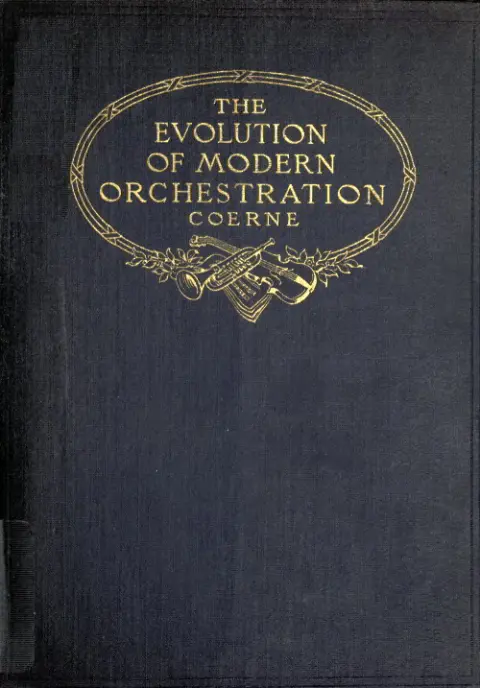
"The Evolution of Modern Orchestration" by Louis Adolphe Coerne is a scholarly examination of the history and development of orchestration, written in the early 20th century. This work aims to trace how orchestration has evolved in conjunction with the broader history of music, emphasizing the influences and key figures that have shaped the modern orchestra. As a study of musical evolution, it explores the intricacies of instrumental combinations, their roles, and techniques, providing insights into the art of writing for orchestras." The opening of the book sets the stage for a detailed exploration of the origins of instrumental music and its progression through various civilizations, including Egypt, Greece, and Rome. Coerne highlights how early music was intertwined with human emotions and rituals, evolving from primitive vocal expressions to the incorporation of instruments. As he moves through history, he discusses pivotal developments such as the introduction of harmony and notation, the resurgence of folk music, and the transformative influences of significant composers and theorists. The first chapters outline the foundational history of instrumental music and the rudimentary beginnings of orchestration, preparing the reader for a deeper analysis of its evolution in later periods.
Introduction adapted from the source catalogue; source summaries may be automatically generated.
Free to read · English · 84,730 words · No account needed
MAKE TIME FOR A GOOD BOOK
On by default. Untick to stop anonymous reading totals. Each page counts after 10 seconds in view. How this works.
Anonymous counting is on unless you have switched it off.
SAINT-SAËNS[83] (1835), greatest of living French composers and mightiest of her orchestral exponents after Berlioz, is assuredly a modern composer in the full sense of that expression. Yet the background of his principles differs but slightly from those of Thomas and Gounod. Plainly in evidence are the outlines of Meyerbeer's operatic forms, in spite of Saint-Saëns' obvious desire to break away from recognized models. On the other hand, the suppression of detached numbers and the adherence to representative and guiding themes disclose his involuntary leanings toward the doctrines of the Bayreuth master, notwithstanding his openly avowed avoidance of such intentions beyond the willingness to accept the advanced spirit of the age. But as to this, it has even been claimed that Saint-Saëns was the first French master to apply Wagnerian principles, even though doing so with discretion. Finally, this peerless contemporary seems to have appropriated to himself all the virtues of eclectic orchestration without one mitigating vice, and crowns this achievement with the indelible impress of his own intensely original individuality to an extent that is verily epoch-making in the history of orchestral evolution. The dual aspect of his symphonic works presents a unique contrast, displaying, as it does, their author's versatility. Saint-Saëns has expressed himself both in symphonies and in symphonic poems. There are four of each on record. Of the former, that in C minor may be looked upon as the most interesting. It contains no programmatic idea, and at first sight would appear to embody a departure from classic form in that it is laid out in two grand divisions. Closer scrutiny, however, reveals a faithful adherence to accepted usage, for the first division contains an introduction, an allegro, and an adagio, whereas the formal structure of the second division can be analyzed into what are in reality a scherzo and a finale. Reminiscent themes and episodes from the first division reoccur in the second, in order to give coherence and organic unity to the work as a whole. Another interesting feature of this symphony is the adaptation of Wagner's "Lohengrin" methods for the wood-wind. The score also includes parts for organ as well as for pianoforte. The four symphonic poems are none of them of the same magnitude and significance as those of Liszt; but just as Liszt's form is simpler and more readily to be grasped than that of Berlioz, so Saint-Saëns' formal structure may be regarded as advancing yet further, if clearness and compactness be the desired objective. "Phaéton"[84] and "Le rouet d'Omphale"[85] display marvellous skill in scoring; "La jeunesse d'Hercule"[86] is the most elaborate, whereas the "Danse Macabre"[87] is the most characteristic as well as the most popular. Saint-Saëns' chamber music affords an interesting study in diversity of style between it and that of his eminent contemporary, Brahms. Both styles display a master's touch, but Saint-Saëns' chamber music is conspicuous for its simplicity of treatment and admirable clearness. He has given still further proof of versatility in a series of memorable concertos. Had Saint-Saëns been content to write nothing beyond such sterling instrumental works as just referred to, his reputation would not have suffered. But the full strength of his greatness reveals itself in attainments of still wider significance. In addition to several oratorios, including the so-called Biblical opera "Le Déluge," no less than nine operas must be accredited to his pen, and of these, "Samson et Dalila" looms up as the ideal embodiment of Saint-Saëns' highest creative genius. Lofty imagination, naturalness of expression and dramatic intensity join in making this opera his greatest masterpiece. Unique is the opening chorus for the captive Hebrews in oratorio style, whereas the ballet in the last act presents an effective adaptation of the peculiar Eastern scale. The orchestration is elaborate, rich and varied,--intricate without being obtuse. Saint-Saëns wields his large orchestral forces with unerring judgment; the score abounds in effects now scintillating or impassioned, now melancholy or heroic. The addition to the usual couplets of wood-wind of a third flute, an English horn, a bass-clarinet and a contra-bassoon again demonstrates the indispensability of triplets of related instruments. Opportunity for obtaining pure tone-color in independent harmony from each family of the brass is effected by employing four horns, by the union of two trumpets and two cornets, by adding to the three trombones a bass-tuba, and by making further requisition for two opheicleides, which together with the bass-tuba are capable of independent deployment. The strings are reënforced by two harps. The array of instruments of percussion would appear rather formidable; nevertheless, they are never used aggressively. This group includes three kettle-drums, a bass-drum, cymbals, tam-tam, a triangle, a Glockenspiel, a tambour de basque, and crotales or castagnettes made of wood and iron. May Saint-Saëns live to enthrall the world a second time with a work that shall rival if not surpass in beauty the rare seductive charm of "Samson et Dalila"!
Your reading position is saved on this browser. Take it to another device with a library code. Reading pages adapt to text, rather than matching a printed edition.
BEHIND THE BOOK
This eBook is for the use of anyone anywhere in the United States and most other parts of the world at no cost and with almost no restrictions whatsoever. You may copy it, give it away or re-use it under the terms of the Project Gutenberg License included with this eBook or online at www.gutenberg.org. If you are not located in the United States, you will have to check the laws of the country where you are located before using this eBook. Read the source licence.
The original source file, including credits and licence, is retained by this library. Request an original-format copy at no charge. Please include the book title and Project Gutenberg identifier #49747.
KEEP YOUR CURIOSITY GOING
Cécile Tormay

Moritz Busch
John L. Ransom
Frances Wright
Cécile Tormay

Mabel Potter Daggett