On the Development and Distribution of Primitive Locks and Keys
Augustus Henry Lane-Fox Pitt-Rivers
THE CLASSIC COLLECTION · 1906
"The Evolution of Culture and Other Essays" by Augustus Henry Lane-Fox Pitt-Rivers is a scientific publication written in the late 19th century. This collection features a series of essays and lectures that explores the application of evolutionary theory to human culture, particularly focusing on the development of material arts and technology throughout history. The work aims to provide a systematic approach to understanding the gradual changes and improvements in human craftsmanship and ideation over time. At the start of the book, the editor, Henry Balfour, recounts the initial efforts of Colonel Lane Fox to apply evolutionary principles to the understanding of human artifacts. He describes how Lane Fox's passion for ethnology led to the establishment of a comprehensive collection that seeks to link different forms of cultural expressions through a classification system based on their evolutionary history. Balfour emphasizes that these early studies serve not only to document artifacts from various cultures but also aim to illustrate the continuous progression from primitive to complex forms of tools and crafts, showcasing how traditional technologies embody traces of ancient practices and ideas.
Introduction adapted from the source catalogue; source summaries may be automatically generated.
Free to read · English · 101,057 words · No account needed
MAKE TIME FOR A GOOD BOOK
On by default. Untick to stop anonymous reading totals. Each page counts after 10 seconds in view. How this works.
Anonymous counting is on unless you have switched it off.
In the same way that we saw that the forms of the palaeolithic flint implements were suggested by accidental fractures in the workshop, so the several forms of the Australian wooden implements were suggested by the various forms of the stems and branches out of which they were made. These savages, having only flint tools to work with, cannot saw out their weapons to any form they please; they can only trim the sticks into a serviceable shape. All their weapons are therefore constructed on the grain of the wood, and their forms and uses have arisen from a selection of the natural curves of the sticks.
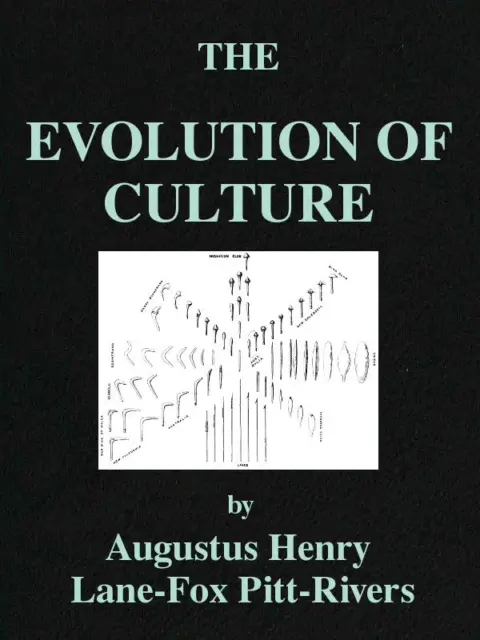
I have arranged, on Plate III, drawings of nearly all the weapons used by the Australians, placing them together according to their affinities in such a manner as to show hypothetically their derivation from a single form. As all the forms given on this diagram are drawings of weapons in use at the present time, and there are many intermediate forms not given here, I have not arranged them in horizontal lines, as in the previous diagrams, to show their place in time, but have arranged them as radiating from a central point. We know nothing of the antiquities of savage countries as yet, and therefore cannot trace their evolution in time. The development has therefore been shown by means of survivals of early forms existing at the present time.
In the centre I have placed the simple cylindrical stick, as being the simplest form. By a gradual development of one end I have traced upwards the formation of a sharp ridge and its transition into a kind of mushroom form. To the right upwards I have traced the same development of the mushroom head, the projecting ridge of which is constantly liable to fractures by blows; and as savages always systematize accidental fractures so as to produce symmetry, scollops have been cut out of the ridge in different places for this purpose, which had the effect of concentrating the force of the blow on the projections. These were further developed; one of the pilei of the mushroom head was made larger than the others, and this suggested the form of a bird’s head, so that it was only necessary to add a line for the mouth and a couple of eyes to complete the resemblance. To the right we see that the plain stick held in the centre gave the first idea of a defensive weapon, and was used to parry off the darts of the assailant; an aperture was then made in the stick for the hand, and the face of it became broader, developing into a shield, the narrow ends, however, being still retained for parrying. Below I have shown that the long stick simply pointed at one end became a lance; a row of sharp flints were gummed on to one side to produce a cutting edge, and these were then imitated in wood, and by pointing them obliquely they were converted into barbs. To the right another kind of barb was produced by binding on a piece of sharp-pointed wood. Between this and the shields we see that the first idea of the throwing-stick, employed to project these lances, was simply constructed like the barbed point of the lance itself. The gradual expansion of the stick arose from its being employed like a battledore, to fence off the enemy’s lances. To the left below I have shown the gradual development of a peculiar curved weapon, called the ‘malga’, formed from a stem and the branch projecting from it at different angles. The part where the continuation of the stem was cut off was trimmed to a kind of ridge; this ridge developed, and suggested the crest of a bird’s head; ultimately the eyes were added, in the same manner as in the club on the opposite side of the diagram. To the left we see the plain round stick first flattened, then curved. Savages are in the habit of throwing all their weapons at their adversaries and at animals. In throwing a flat curved stick it rotates of its own accord, and as the axis of rotation continues parallel to itself, the thin edge is presented to the resistance of the air in front; this increases the range, and its peculiar flight must have forced itself on the attention of the savage as the result of experience: but he has never had the slightest knowledge of the laws of its flight. The different curves of the boomerang are the natural curves of the sticks, and like all the Australian weapons, they are made on the grain of the wood. Some are thicker than others; some will fly in the curves peculiar to that weapon, and others will not: scarcely two are alike.
Your reading position is saved on this browser. Take it to another device with a library code. Reading pages adapt to text, rather than matching a printed edition.
Augustus Henry Lane-Fox Pitt-Rivers
Augustus Henry Lane-Fox Pitt-Rivers
BEHIND THE BOOK
This eBook is for the use of anyone anywhere in the United States and most other parts of the world at no cost and with almost no restrictions whatsoever. You may copy it, give it away or re-use it under the terms of the Project Gutenberg License included with this eBook or online at www.gutenberg.org. If you are not located in the United States, you will have to check the laws of the country where you are located before using this eBook. Read the source licence.
The original source file, including credits and licence, is retained by this library. Request an original-format copy at no charge. Please include the book title and Project Gutenberg identifier #44844.
KEEP YOUR CURIOSITY GOING

David Patterson (Spirit) Hatch

David Patterson (Spirit) Hatch

David Patterson (Spirit) Hatch

Ralph Waldo Emerson

Maurice Baring

Oscar Wilde & James McNeill Whistler