
On the Development and Distribution of Primitive Locks and Keys
Augustus Henry Lane-Fox Pitt-Rivers
THE CLASSIC COLLECTION · 1906
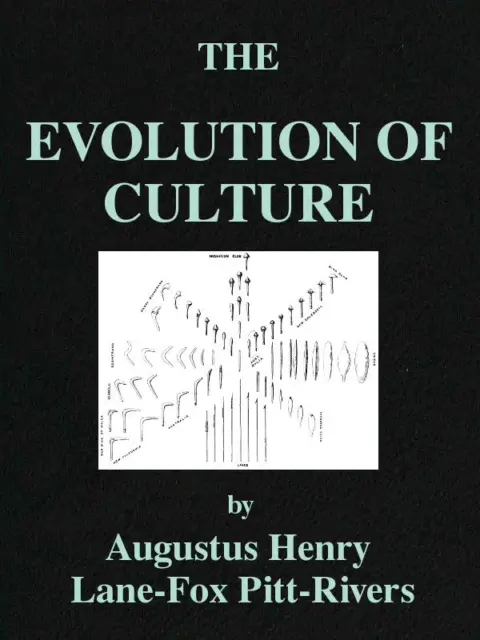
"The Evolution of Culture and Other Essays" by Augustus Henry Lane-Fox Pitt-Rivers is a scientific publication written in the late 19th century. This collection features a series of essays and lectures that explores the application of evolutionary theory to human culture, particularly focusing on the development of material arts and technology throughout history. The work aims to provide a systematic approach to understanding the gradual changes and improvements in human craftsmanship and ideation over time. At the start of the book, the editor, Henry Balfour, recounts the initial efforts of Colonel Lane Fox to apply evolutionary principles to the understanding of human artifacts. He describes how Lane Fox's passion for ethnology led to the establishment of a comprehensive collection that seeks to link different forms of cultural expressions through a classification system based on their evolutionary history. Balfour emphasizes that these early studies serve not only to document artifacts from various cultures but also aim to illustrate the continuous progression from primitive to complex forms of tools and crafts, showcasing how traditional technologies embody traces of ancient practices and ideas.
Introduction adapted from the source catalogue; source summaries may be automatically generated.
Free to read · English · 101,057 words · No account needed
MAKE TIME FOR A GOOD BOOK
On by default. Untick to stop anonymous reading totals. Each page counts after 10 seconds in view. How this works.
Anonymous counting is on unless you have switched it off.
[13] A Lecture delivered at the Royal United Service Institution, Friday, June 28, 1867; illustrated by specimens from the Museum of the Institution: and published in the Journal of the R. U. S. Inst. xi (1867).
[14] Beechey, Voyage to the Pacific (London, 1831), vol. i. p. 298; Oldfield, ‘Aborigines of Australia,’ Trans. Ethno. Soc., N. S. (London, 1865), vol. iii. p. 227.
[15] Oldfield, ‘On the Aborigines of Australia,’ Trans. Ethno. Soc., N.S., vol. iii. pp. 261-7.
[16] Meyrick (Skelton), Engraved Illustrations of Ancient Arms, &c. (1830), vol. ii. pl. cxlix. 11.
[17] Klemm, Werkzeuge und Waffen (Sondershausen, 1858), p. 159.
[18] Turner, Nineteen Years in Polynesia (London, 1861), p. 262.
[19] Williams, Fiji and the Fijians (London, 1858), vol. i. pp. 78-9.
[20] Crawfurd, History (Edinburgh, 1820), vol. i. p. 224.
[21] Tylor, Anahuac (London, 1861), p. 70.
[22] Hdt. vii. 69: Rawlinson, Herodotus, vol. iv (2nd ed., 1862, p.
55).
[23] Petherick, Egypt, the Soudan, and Central Africa (Edinb. and
London, 1861), p. 360.
[24] Le Sieur de Folard, Nouvelles Découvertes sur la Guerre (Paris,
1724), p. 48.
[25] In adopting the nomenclature of phrenology, I am not to be understood as advocating strictly the localization of the faculties which phrenology prescribes. The mind doubtless consists of a congeries of faculties, and phrenology affords the best classification of them that has yet been devised.
[26] Pope, Essay on Man, Epistle iii. 172-80.
[27] Ellis, Polynesian Researches (London, 1829), vol. i. pp. 302-3.
[28] Crawfurd, History of the Indian Archipelago (1820), vol. i. pp.
113-4.
[29] Beckman, History of Inventions (London, 1814), pp.
503-4.--Cock-fighting.
[30] Stanley, History of Birds (London, 1848), p. 389.
[31] Darwin, Origin of Species (London, 1859), p. 88.
[32] Williamson, Oriental Field Sports (London, 1807), p. 94.
[33] Swainson, Habits and Instincts of Animals (London, 1840), p. 142.
[34] Thuc. i. 5 (but what Thucydides says is, that they were the last
to discard it.--ED.).
[35] Beechey, Voyage to the Pacific (London, 1831), vol. i. p. 248.
[36] Dobrizhoffer, An Account of the Abipones (from the Latin; London, 1822), vol. i. p. 262; ii. 361.
[37] Barth, Travels and Discoveries in North and Central Africa (London, 1857), vol. iii. p. 198.
[38] Low, Sarawak (London, 1848), p. 328.
[39] Pigafetta’s Voyage Round the World, Pinkerton, vol. ix. p. 349.
[40] William de Rubruquis, Travels into Tartary and China in 1253; Pinkerton (London, 1811), vol. viii. p. 89.
[41] An Historical Relation of the Kingdom of Chile, by Alonso de Ovalle, of the Company of Jesus, 1649 (London, 1752), p. 71.
[42] Herodotus, vii. 70; Meyrick’s Ancient Armour, vol. i. Introd. p.
iv.
[43] Herodotus, iv. 189; Meyrick’s Ancient Armour, vol. i. Introd. p.
iii.
[44] Herodotus, vii. 65 εἵματα ... ἀπὸ ξύλων πεποιημένα.
[45] Duarte Barbosa, The Coasts of East Africa and Malabar, translated from the Spanish, by the Hon. H. E. Stanley (Hakluyt Society, 1866), p. 55. Since publication, the translator has ascertained that the authorship of this work should be ascribed to Magellan.
Your reading position is saved on this browser. Take it to another device with a library code. Reading pages adapt to text, rather than matching a printed edition.
Augustus Henry Lane-Fox Pitt-Rivers
Augustus Henry Lane-Fox Pitt-Rivers
BEHIND THE BOOK
This eBook is for the use of anyone anywhere in the United States and most other parts of the world at no cost and with almost no restrictions whatsoever. You may copy it, give it away or re-use it under the terms of the Project Gutenberg License included with this eBook or online at www.gutenberg.org. If you are not located in the United States, you will have to check the laws of the country where you are located before using this eBook. Read the source licence.
The original source file, including credits and licence, is retained by this library. Request an original-format copy at no charge. Please include the book title and Project Gutenberg identifier #44844.
KEEP YOUR CURIOSITY GOING

David Patterson (Spirit) Hatch

David Patterson (Spirit) Hatch

David Patterson (Spirit) Hatch

Ralph Waldo Emerson

Maurice Baring

Oscar Wilde & James McNeill Whistler