
On the Development and Distribution of Primitive Locks and Keys
Augustus Henry Lane-Fox Pitt-Rivers
THE CLASSIC COLLECTION · 1906
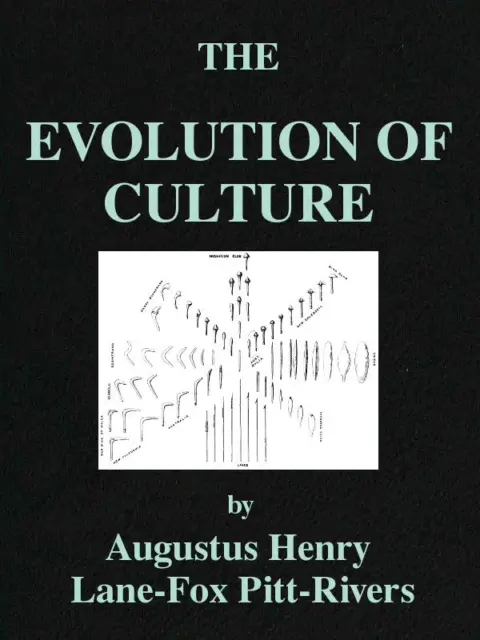
"The Evolution of Culture and Other Essays" by Augustus Henry Lane-Fox Pitt-Rivers is a scientific publication written in the late 19th century. This collection features a series of essays and lectures that explores the application of evolutionary theory to human culture, particularly focusing on the development of material arts and technology throughout history. The work aims to provide a systematic approach to understanding the gradual changes and improvements in human craftsmanship and ideation over time. At the start of the book, the editor, Henry Balfour, recounts the initial efforts of Colonel Lane Fox to apply evolutionary principles to the understanding of human artifacts. He describes how Lane Fox's passion for ethnology led to the establishment of a comprehensive collection that seeks to link different forms of cultural expressions through a classification system based on their evolutionary history. Balfour emphasizes that these early studies serve not only to document artifacts from various cultures but also aim to illustrate the continuous progression from primitive to complex forms of tools and crafts, showcasing how traditional technologies embody traces of ancient practices and ideas.
Introduction adapted from the source catalogue; source summaries may be automatically generated.
Free to read · English · 101,057 words · No account needed
MAKE TIME FOR A GOOD BOOK
On by default. Untick to stop anonymous reading totals. Each page counts after 10 seconds in view. How this works.
Anonymous counting is on unless you have switched it off.
Thus, by means of intercommunication, no less than by spontaneous development, have been formed those numerous combinations which so greatly puzzle the student of culture at the present time.
[219] A Paper read at the Anthropological Institute of Great Britain and Ireland on December 22, 1874, and published in the Journal of the Institute, vol. iv (1875), pp. 399-435. (N.B.--This paper was not furnished by the author with either plates or references. The latter have been supplied, so far as possible, on pp. 229 ff.: for illustrations, reference should be made to the section on Navigation in the Pitt-Rivers Museum, Oxford.--ED.)
[220] (The Catalogue of the Anthropological Collection lent by Col. Lane Fox to Bethnal Green Museum (London, 1874, parts i and ii) only contains ‘Weapons’; part iii was never issued.--ED.)
[221] Notes and Queries on Anthropology, for the Use of Travellers and Residents in Uncivilized Lands, drawn up by a Committee appointed by the British Association for the Advancement of Science (1874); 3rd edition, 1899, published by the Anthropological Institute, 3 Hanover Square, W.
[222] ‘Primitive Warfare,’ pp. 127-30, 148-51, above.
[223] Address to the Anthropological Department at the Brighton meeting of the British Association, 1872. Report Brit. Assoc. (London, 1873), p. 161.
[224] Since writing this I have seen the illustration in Sir H. Rawlinson’s note to this passage, in which he gives it as his opinion that this is the meaning and use to be ascribed to these pins; and he says that this system is still employed in Egypt, where they raise an extra bulwark above the gunwale. Rawlinson, Herodotus (1862), vol. ii. p. 132.
[225] Denmark in the Early Iron Age, by Conrad Engelhardt (London,
1866), p. 31.
[226] ‘On Vessels of Papyrus,’ by John Hogg, Esq., M.A., F.L.S.; Magazine of Nat. Hist., vol. ii (1829), pp. 324-32: cf. p. 206, above.
P. 189. Steinitz, The Ship: its Origin and Progress (London, 1849), Pl. ii (frontispiece): cf. pp. ix, 4.
Gregory, ‘Expedition to the NW. coast of Australia,’ Roy. Geogr. Soc. Journal, xxxii. (1862) p. 376.
P. 190. Cook, Voyages (ed. London, 1842), vol. i. p. 204.
Kitto, Pictorial Bible, note on 2 Sam. xix. 18.
Pliny, ix. 10 (cf. vi. 24); Diodorus, iii. 21, 5; Strabo, p. 773; turtle-shell boats were in actual use among the ‘Turtle-eaters’ (Chelonophagi) of Carmania and the islands of the Red Sea.
P. 191. Kalm, Travels into North America (London, 1771), vol. ii. pp.
38-9.
Raleigh’s Expedition; Amadas and Barlawe, The First Voyage to the Coasts of America (= Pinkerton (1811), vol. xii. p. 567).
Columbus, The Journal of Christopher Columbus, &c.; transl. Markham (Hakluyt Society, 1893), p. 39, mentions dug-out canoes (cf. pp. 58, 94), but not the use of fire.
Mouat, Adventures and Researches among the Andaman Islanders (London, 1863), pp. 315-6; only hand-hollowing in use in his time: no mention of Blair here: perhaps a verbal communication to the author.
Your reading position is saved on this browser. Take it to another device with a library code. Reading pages adapt to text, rather than matching a printed edition.
Augustus Henry Lane-Fox Pitt-Rivers
Augustus Henry Lane-Fox Pitt-Rivers
BEHIND THE BOOK
This eBook is for the use of anyone anywhere in the United States and most other parts of the world at no cost and with almost no restrictions whatsoever. You may copy it, give it away or re-use it under the terms of the Project Gutenberg License included with this eBook or online at www.gutenberg.org. If you are not located in the United States, you will have to check the laws of the country where you are located before using this eBook. Read the source licence.
The original source file, including credits and licence, is retained by this library. Request an original-format copy at no charge. Please include the book title and Project Gutenberg identifier #44844.
KEEP YOUR CURIOSITY GOING

David Patterson (Spirit) Hatch

David Patterson (Spirit) Hatch

David Patterson (Spirit) Hatch

Ralph Waldo Emerson

Maurice Baring

Oscar Wilde & James McNeill Whistler