THE CLASSIC COLLECTION✦Parish life in mediæval EnglandCLASSIC FREE BOOKS
Parish life in mediæval England
Francis Aidan Gasquet
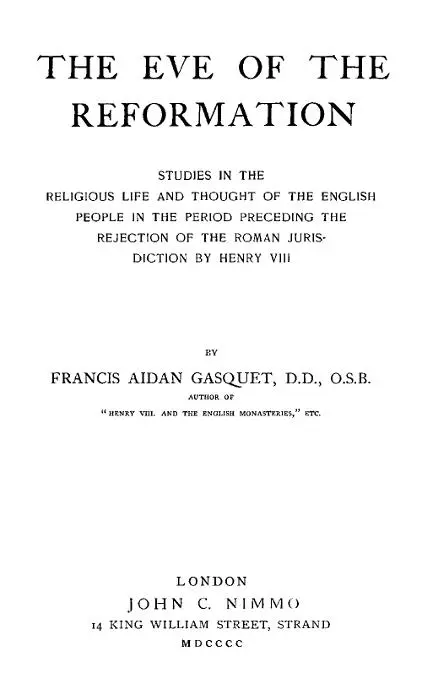
THE CLASSIC COLLECTION · 1900
"The Eve of the Reformation" by Francis Aidan Gasquet is a historical account written in the early 20th century. This work delves into the religious life and thought of the English people just before the significant shift that led to the Reformation and the eventual rejection of Roman jurisdiction by Henry VIII. The book aims to explore the complex relationships and attitudes of the Church and the English populace at that time. At the start of the narrative, the author outlines the challenges historians face in reconciling the seemingly abrupt onset of the Reformation with the prevailing religious convictions of the nation. Gasquet discusses the widespread discontent among the laity with ecclesiastical authorities and mediæval religious teachings, arguing against the notion that these sentiments were indicative of a true spiritual void. Instead, he seeks to uncover the actual opinions and practices of the people, emphasizing the existing momentum for reform from within the Church itself, illustrating a vibrant pre-Reformation religious culture marked by a flourishing of art, learning, and communal involvement in church life. Overall, this opening sets the stage for a nuanced examination of the period, challenging misconceptions about stagnation leading up to the Reformation.
Introduction adapted from the source catalogue; source summaries may be automatically generated.
Free to read · English · 149,070 words · No account needed
MAKE TIME FOR A GOOD BOOK
On by default. Untick to stop anonymous reading totals. Each page counts after 10 seconds in view. How this works.
Anonymous counting is on unless you have switched it off.
Again, in another exposition made eight years later, the same writer complains that still, for lack of teaching what he considers the true meaning of Scripture, the views of the people are still turned towards the “old superstitions” in spite of “the open Bible.” “Although the Bible be in English,” he says, “and be suffered to every man and woman to read at their pleasures, and commanded to be read every day at Matins, Mass, and Evensong, yet there remain great ignorance and corrupt judgments … and these will remain still, except the Holy Scriptures be made more plain to the lay people who are unlearned by some commentary or annotation, so that lay people may understand the Holy Scripture better.”[281] Commentaries would help much, he says in another place, “to deliver the people from ignorance, darkness, errors, heresy, superstitions, false trusts, and from evil opinions fixed and rooted in the hearts of many for lack of true knowledge of God’s Holy Word, and expel the usurped power of the bishop of Rome and all Romish dregs.”[282]
It is interesting to find that from the first, whilst objecting to the interpretation of the old teachers of the Church, and claiming that the plain text of Scripture was a sufficient antidote and complete answer to them and their traditional deductions, the “new teachers” found that without teaching and exposition on their part, the open Bible was by no means sufficient to wean the popular mind from what they regarded as superstitious and erroneous ways. Their attitude in the matter is at least a confirmation of the contention of Sir Thomas More and other contemporary Catholic writers, that the vernacular Scriptures would be useless without a teaching authority to interpret their meaning.
A brief word may now be said as a summary of the attitude towards the vernacular Bible taken up by the ecclesiastical authorities on the eve of the Reformation. The passages quoted from Sir Thomas More make it evident that no such hostility on the part of the Church, as writers of all shades of opinion have too hastily assumed, really existed.[283] In fact, though those responsible for the conduct of affairs, both ecclesiastical and lay, at this period objected to the circulation of Tyndale’s printed New Testament, this objection was based, not on any dread of allowing the English Bible as such, but on the natural objection to an obviously incorrect translation. It is difficult to see how those in authority could have permitted a version with traditional words changed for the hardly concealed purpose of supporting Lutheran tenets, with texts garbled and marginal explanations inserted for the same end. Those who hold that Tyndale’s views were right, and even that his attempt to enforce them in this way was justifiable, can hardly, however, blame the authorities at that time in England, secular or lay, who did not think so, from doing all they could to prevent what they regarded as the circulation of a book calculated to do great harm if no means were taken to prevent it. Men’s actions must be judged by the circumstances under which they acted, and it would be altogether unjust to regard the prohibition of the Tyndale Scriptures as a final attempt on the part of the English Church to prevent the circulation of the vernacular Scriptures. To the authorities in those days at least, the book in question did not represent the Sacred Text at all. That it was full of errors, to say the least, is confessed by Tyndale himself; and as to the chief points in his translation which he defended and which Sir Thomas More so roundly condemned, posterity has sided with More and not with Tyndale, for not one of these special characteristics of the translation in which so much of Tyndale’s Lutheran teaching was allowed to appear, was suffered to remain in subsequent revisions. From this point of view alone, those who examine the question with an unbiassed mind must admit that there was ample justification for the prohibition of Tyndale’s printed Testament. If this be so, the further point may equally well be conceded, namely, that the Church on the eve of the Reformation did not prohibit the vernacular Scriptures as such at all, and that many churchmen in common with the king, Sir Thomas More, and other laymen, would, under happier circumstances, have been glad to see a properly translated English Bible.
Your reading position is saved on this browser. Take it to another device with a library code. Reading pages adapt to text, rather than matching a printed edition.
Francis Aidan Gasquet
Francis Aidan Gasquet
Francis Aidan Gasquet
BEHIND THE BOOK
This eBook is for the use of anyone anywhere in the United States and most other parts of the world at no cost and with almost no restrictions whatsoever. You may copy it, give it away or re-use it under the terms of the Project Gutenberg License included with this eBook or online at www.gutenberg.org. If you are not located in the United States, you will have to check the laws of the country where you are located before using this eBook. Read the source licence.
The original source file, including credits and licence, is retained by this library. Request an original-format copy at no charge. Please include the book title and Project Gutenberg identifier #50328.
KEEP YOUR CURIOSITY GOING
Cécile Tormay

Moritz Busch
John L. Ransom
Frances Wright
Cécile Tormay

Mabel Potter Daggett