THE CLASSIC COLLECTION✦Parish life in mediæval EnglandCLASSIC FREE BOOKS
Parish life in mediæval England
Francis Aidan Gasquet
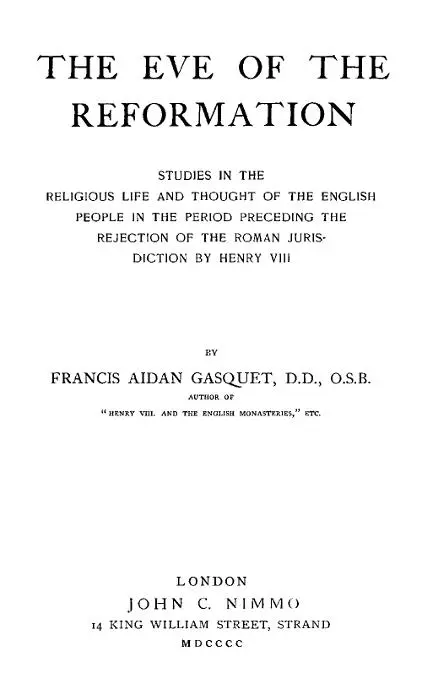
THE CLASSIC COLLECTION · 1900
"The Eve of the Reformation" by Francis Aidan Gasquet is a historical account written in the early 20th century. This work delves into the religious life and thought of the English people just before the significant shift that led to the Reformation and the eventual rejection of Roman jurisdiction by Henry VIII. The book aims to explore the complex relationships and attitudes of the Church and the English populace at that time. At the start of the narrative, the author outlines the challenges historians face in reconciling the seemingly abrupt onset of the Reformation with the prevailing religious convictions of the nation. Gasquet discusses the widespread discontent among the laity with ecclesiastical authorities and mediæval religious teachings, arguing against the notion that these sentiments were indicative of a true spiritual void. Instead, he seeks to uncover the actual opinions and practices of the people, emphasizing the existing momentum for reform from within the Church itself, illustrating a vibrant pre-Reformation religious culture marked by a flourishing of art, learning, and communal involvement in church life. Overall, this opening sets the stage for a nuanced examination of the period, challenging misconceptions about stagnation leading up to the Reformation.
Introduction adapted from the source catalogue; source summaries may be automatically generated.
Free to read · English · 149,070 words · No account needed
MAKE TIME FOR A GOOD BOOK
On by default. Untick to stop anonymous reading totals. Each page counts after 10 seconds in view. How this works.
Anonymous counting is on unless you have switched it off.
It is not uncommonly asserted that the religious changes in England, although for convenience’ sake dated from the rejection of Papal supremacy, were in reality the outcome of long-continued and ever-increasing dissatisfaction with the then existing ecclesiastical system. The Pope’s refusal to grant Henry his wished-for divorce from Katherine, we are told, was a mere incident, which at most, precipitated by a short while what had long been inevitable.[208] Those who take this view are bound to believe that the Church in England in the early sixteenth century was honeycombed by disbelief in the traditional teachings, and that men were only too ready to welcome emancipation. What then is the evidence for this picture of the religious state of men’s minds in England on the eve of the Reformation?
It is, indeed, not improbable that up and down the country there were, at this period, some dissatisfied spirits; some who would eagerly seize any opportunity to free themselves from the restraints which no longer appealed to their consciences, and from teachings they had come to consider as mere ecclesiastical formalism. A Venetian traveller of intelligence and observation, who visited the country at the beginning of the century, whilst struck with the Catholic practices and with the general manifestations of English piety he witnessed, understood that there were “many who have various opinions concerning religion.”[209] But so far as there is evidence at all, it points to the fact, that of religious unrest, in any real sense, there could have been very little in the country generally. It is, of course, impossible to suppose that any measurable proportion of the people could have openly rejected the teaching of the Church or have been even crypto-Lollards, without there being satisfactory evidence of the fact forthcoming at the present day.
The similarity of the doctrines held by the English Reformers of the sixteenth century with many of those taught by the followers of Wycliffe has, indeed, led some writers to assume a direct connection between them which certainly did not exist in fact. So far as England at least is concerned, there is no justification for assuming for the Reformation a line of descent from any form of English Lollardism. It is impossible to study the century which preceded the overthrow of the old religious system in England without coming to the conclusion that as a body the Lollards had been long extinct, and that as individuals, scattered over the length and breadth of the land, without any practical principle of cohesion, the few who clung to the tenets of Wycliffe were powerless to effect any change of opinion in the overwhelming mass of the population at large. Lollardry, to the Englishman of the day, was “heresy,” and any attempt to teach it was firmly repressed by the ecclesiastical authority, supported by the strong arm of the State; but it was also an offence against the common feeling of the people, and there can be no manner of doubt that its repression was popular. The genius of Milton enabled him to see the fact that “Wycliffe’s preaching was soon damped and stifled by the Pope and prelates for six or seven kings’ reigns,” and Mr. James Gairdner, whose studies in this period of our national history enable him to speak with authority, comes to the same conclusion. “Notwithstanding the darkness that surrounds all subjects connected with the history of the fifteenth century,” he writes, “we may venture pretty safely to affirm that Lollardry was not the beginning of modern Protestantism. Plausible as it seems to regard Wycliffe as ‘the morning star of the Reformation,’ the figure conveys an impression which is altogether erroneous. Wycliffe’s real influence did not long survive his own day, and so far from Lollardry having taken any deep root among the English people, the traces of it had wholly disappeared long before the great revolution of which it is thought to be the forerunner. At all events, in the rich historical material for the beginning of Henry VIII.’s reign, supplied by the correspondence of the time, we look in vain for a single indication that any such thing as a Lollard sect existed. The movement had died a natural death; from the time of Oldcastle it sank into insignificance. Though still for a while considerable in point of numbers, it no longer counted among its adherents any men of note; and when another generation had passed away the serious action of civil war left no place for the crotchets of fanaticism.”[210]
Your reading position is saved on this browser. Take it to another device with a library code. Reading pages adapt to text, rather than matching a printed edition.
Francis Aidan Gasquet
Francis Aidan Gasquet
Francis Aidan Gasquet
BEHIND THE BOOK
This eBook is for the use of anyone anywhere in the United States and most other parts of the world at no cost and with almost no restrictions whatsoever. You may copy it, give it away or re-use it under the terms of the Project Gutenberg License included with this eBook or online at www.gutenberg.org. If you are not located in the United States, you will have to check the laws of the country where you are located before using this eBook. Read the source licence.
The original source file, including credits and licence, is retained by this library. Request an original-format copy at no charge. Please include the book title and Project Gutenberg identifier #50328.
KEEP YOUR CURIOSITY GOING
Cécile Tormay

Moritz Busch
John L. Ransom
Frances Wright
Cécile Tormay

Mabel Potter Daggett