THE CLASSIC COLLECTION✦Parish life in mediæval EnglandCLASSIC FREE BOOKS
Parish life in mediæval England
Francis Aidan Gasquet
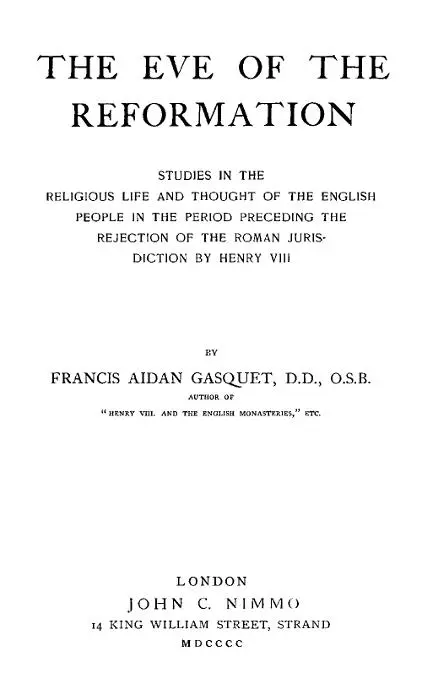
THE CLASSIC COLLECTION · 1900
"The Eve of the Reformation" by Francis Aidan Gasquet is a historical account written in the early 20th century. This work delves into the religious life and thought of the English people just before the significant shift that led to the Reformation and the eventual rejection of Roman jurisdiction by Henry VIII. The book aims to explore the complex relationships and attitudes of the Church and the English populace at that time. At the start of the narrative, the author outlines the challenges historians face in reconciling the seemingly abrupt onset of the Reformation with the prevailing religious convictions of the nation. Gasquet discusses the widespread discontent among the laity with ecclesiastical authorities and mediæval religious teachings, arguing against the notion that these sentiments were indicative of a true spiritual void. Instead, he seeks to uncover the actual opinions and practices of the people, emphasizing the existing momentum for reform from within the Church itself, illustrating a vibrant pre-Reformation religious culture marked by a flourishing of art, learning, and communal involvement in church life. Overall, this opening sets the stage for a nuanced examination of the period, challenging misconceptions about stagnation leading up to the Reformation.
Introduction adapted from the source catalogue; source summaries may be automatically generated.
Free to read · English · 149,070 words · No account needed
MAKE TIME FOR A GOOD BOOK
On by default. Untick to stop anonymous reading totals. Each page counts after 10 seconds in view. How this works.
Anonymous counting is on unless you have switched it off.
Sir Thomas More is all for vigilance on the part of the authorities. He likens those who are in power and office to the guardians of a fertile field who are bound to prevent the sowing of tares on their master’s land; and the multiplication of evil books and their circulation among the people, cannot, in his opinion, have any other effect than to prevent the fertilisation of the good seed of God’s word in the hearts of many. “These new teachers,” he says, “despise Christ’s Sacraments, which are His holy ordinances and a great part of Christ’s New Law and Testament. Who can place less value on His commandments than they who, upon the boldness of faith only, set all good works at naught, and little consider the danger of their evil deeds upon the boldness that a bare faith and slight repentance, without shrift or penance, suffices, and that no vow made to God can bind a man to live chastely or hinder a monk from marriage. All these things, with many pestilent errors besides, these abominable books of Tyndale and his fellows teach us. Of these books of heresies there are so many made within these few years, what by Luther himself and by his fellows, and afterwards by the new sects sprung out of his, which, like the children of Vippara, would now gnaw out their mother’s belly, that the bare names of those books were almost enough to make a book. Some of every sort of those books are brought into this realm and kept in ‘hucker mucker’ by some shrewd masters who keep them for no good. Besides the Latin, French, and German books of which these evil sects have put forth an innumerable number, there are some made in the English tongue. First, Tyndale’s English Testament, father of them all by reason of his false translating, and after that, the Five Books of Moses translated by the same man; we need not doubt in what manner and for what purpose. Then you have his Introduction to Saint Paul’s Epistle, with which he introduces his readers to a false understanding of Saint Paul, making them believe, among many other heresies, that Saint Paul held that faith only was always sufficient for salvation, and that men’s good works were worth nothing and could not deserve thanks or reward in heaven, although they were done in grace.… Then we have from Tyndale The Wicked Mammona, by which many a man has been beguiled and brought into many wicked heresies, which in good faith would be to me a matter of no little wonder, for there was never a more foolish frantic book, were it not that the devil is ever ready to put out the eyes of those who are content to become blind. Then we have Tyndale’s Book of Obedience, by which we are taught to disobey the teaching of Christ’s Catholic Church and set His holy Sacraments at naught. Then we have from Tyndale the First Epistle of Saint John, expounded in such wise that I dare say that blessed Apostle had rather his Epistle had never been put in writing than that his holy words should be believed by all Christian people in such a sense. Then we have the Supplication of Beggars, a piteous beggarly book, in which he would have all the souls in Purgatory beg all about for nothing. Then we have from George Joye, otherwise called Clarke, a Goodly Godly Epistle, wherein he teaches divers other heresies, but specially that men’s vows and promises of chastity are not lawful, and can bind no man in conscience not to wed when he will. And this man, considering that when a man teaches one thing and does another himself, the people set less value by his preaching, determined therefore with himself, that he would show himself an example of his preaching. Therefore, being a priest, he has beguiled a woman and wedded her; the poor woman, I ween, being unaware that he is a priest. Then you have also an Exposition on the Seventh Chapter of Saint Paul’s Epistle to the Corinthians, by which exposition also priests, friars, monks, and nuns are taught the evangelical liberty that they may run out a-caterwauling and wed. That work has no name of the maker, but some think it was Friar Roy who, when he had fallen into heresy, then found it unlawful to live in chastity and ran out of his Order. Then have we the Examinations of Thorpe put forth as it is said by George Constantine (by whom I know well there has been a great many books of that sort sent into this realm). In that book, the heretic that made it as (if it were) a communication between the bishop and his chaplains and himself, makes all the parties speak as he himself likes, and sets down nothing as spoken against his heresies, but what he himself would seem solemnly to answer. When any good Christian man who has either learning or any natural wit reads this book, he shall be able not only to perceive him for a foolish heretic and his arguments easy to answer, but shall also see that he shows himself a false liar in his rehearsal of the matter in which he makes the other part sometimes speak for his own convenience such manner of things as no man who was not a very wild goose would have done.
Your reading position is saved on this browser. Take it to another device with a library code. Reading pages adapt to text, rather than matching a printed edition.
Francis Aidan Gasquet
Francis Aidan Gasquet
Francis Aidan Gasquet
BEHIND THE BOOK
This eBook is for the use of anyone anywhere in the United States and most other parts of the world at no cost and with almost no restrictions whatsoever. You may copy it, give it away or re-use it under the terms of the Project Gutenberg License included with this eBook or online at www.gutenberg.org. If you are not located in the United States, you will have to check the laws of the country where you are located before using this eBook. Read the source licence.
The original source file, including credits and licence, is retained by this library. Request an original-format copy at no charge. Please include the book title and Project Gutenberg identifier #50328.
KEEP YOUR CURIOSITY GOING
Cécile Tormay

Moritz Busch
John L. Ransom
Frances Wright
Cécile Tormay

Mabel Potter Daggett