THE CLASSIC COLLECTION✦Her countryCLASSIC FREE BOOKS
Her country
Mary Raymond Shipman Andrews
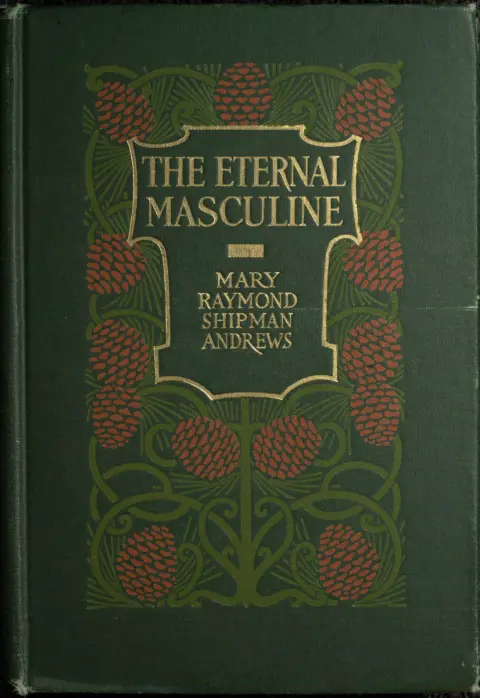
THE CLASSIC COLLECTION · 1913
"The Eternal Masculine: Stories of Men and Boys" by Mary Raymond Shipman Andrews is a collection of illustrated stories written in the early 20th century. The book explores themes of masculinity through the lens of various male characters, focusing on their youthful adventures and interactions, particularly in nature. It seems to delve into the contrasting experiences of young boys and older men as they navigate their identities and relationships in the context of the outdoors, friendship, and skill in activities like fishing. At the start of the book, readers are introduced to two boys, Jack and his guide, Josef, who are navigating a Canadian forest during a fishing trip. The narrative captures their camaraderie, with Jack showcasing both enthusiasm and curiosity as he observes and learns from Josef's expertise in woodcraft. As they journey to a spot known as Profanity Pool, they encounter challenges and engage in conversations that reveal their backgrounds and personalities. Through vivid descriptions of nature and dialogue, Andrews sets the stage for a deeper exploration of male friendships and the formative experiences of youth, emphasizing the joys and trials that accompany these relationships.
Introduction adapted from the source catalogue; source summaries may be automatically generated.
Free to read · English · 81,523 words · No account needed
MAKE TIME FOR A GOOD BOOK
On by default. Untick to stop anonymous reading totals. Each page counts after 10 seconds in view. How this works.
Anonymous counting is on unless you have switched it off.
The paper dropped from the boy’s hand as if a bullet had struck it, and his lips moved in wordless anathema. He sat for a moment stunned by the blow, then picked up the letter and read on.
“We send him, as advised, to your nephew, Cadet Theodore Fitzhugh.”
The lad groaned.
“He is a fine child of ten months. Feed him condensed milk. It should be prepared in the following way.”
Fitzhugh skipped four lines.
“This should be fed to him every—”
He skipped again. His eyes wandered down the page, and he read aloud, in a gasping voice, bits of sentences:
“His bath should be tested with a thermometer.” “Must have four hours a day of fresh air.” “Sleeps every morning from ten to—”
He sprang to his feet, dashing the letter to the floor, and marched back and forth across his room, muttering. Then he rubbed his eyes as if to see better. “What under the canopy am I going to do?” he groaned.
A subdued but firm knock rat-a-tat-tatted at the door. “Come in,” moaned the cadet, too lost in misery to try to pull himself together, and in the open doorway Wipes stood saluting.
Wipes was a tall, ugly soldier with a large nose, a red complexion,
and a wooden expression. Fitzhugh greeted him like a messenger from
heaven.
“Wipes! Oh, Wipes!” he cried in a bleat of joy. “I’d rather see you than any one on earth.”
“Very good, sorr,” said Wipes, and saluted again. Under his stolidity was a heart much like hominy served for breakfast—as warm, as soft, as steaming with fragrant kindliness. In spite of experience, such a greeting flattered him to its depths. It was five minutes before the boy’s nervous statement made apparent impression on the slaty surface of Wipes’s intellect. Then a smile expanded slowly over the hatchet face, as if a mountainside had cracked.
“Wipes, if you grin like that I’ll kill you,” said Fitzhugh, exasperated, and Wipes answered respectfully:
“Very good, sorr.”
Fitzhugh went on. “It’s up to you to get me out of this hole. It’s the worst one yet, but you’ve never failed me, Wipesy. Now tell me what can be done? The kid’s due”—he took out his watch—“oh, momma! In an hour. Something’s got to be done, and quick.”
“If ye’d excuse me, sorr,” said Wipes, “Oi’ve ’n idea.”
“I’ll excuse you this time,” Fitzhugh agreed. “Get it out of your
system.”
“F’r me to meet th’ kid, sorr, and sind him back.”
Your reading position is saved on this browser. Take it to another device with a library code. Reading pages adapt to text, rather than matching a printed edition.
Mary Raymond Shipman Andrews

Mary Raymond Shipman Andrews
Mary Raymond Shipman Andrews
Mary Raymond Shipman Andrews
BEHIND THE BOOK
This eBook is for the use of anyone anywhere in the United States and most other parts of the world at no cost and with almost no restrictions whatsoever. You may copy it, give it away or re-use it under the terms of the Project Gutenberg License included with this eBook or online at www.gutenberg.org. If you are not located in the United States, you will have to check the laws of the country where you are located before using this eBook. Read the source licence.
The original source file, including credits and licence, is retained by this library. Request an original-format copy at no charge. Please include the book title and Project Gutenberg identifier #71145.
KEEP YOUR CURIOSITY GOING
Coulson Kernahan

Maurice Baring
Frances Wright
Cécile Tormay

Frederic Jesup Stimson

W. H. P. (William Henry Pope) Jarvis