THE CLASSIC COLLECTION✦RomolaCLASSIC FREE BOOKS
Romola
George Eliot
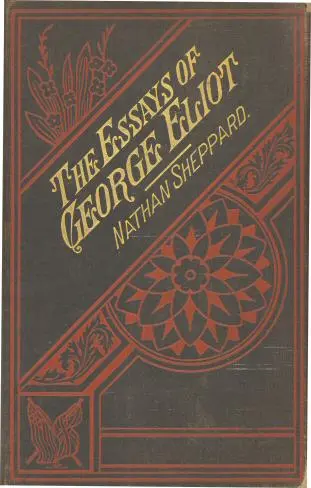
THE CLASSIC COLLECTION · 1883
"The Essays of 'George Eliot'" by George Eliot is a collection of literary essays written in the late 19th century. The essays cover a wide range of topics, reflecting on human emotions, societal dynamics, and the nature of literature, presenting George Eliot's insightful analysis of motives and character. As the work encompasses her contributions to periodical literature, it provides a detailed examination of her thoughts and ideas that contribute to her legacy as a prominent female novelist of her time. At the start of the collection, the preface sets the stage for the essays, explaining the curiosity surrounding George Eliot's earlier writings. It highlights her unique talent for analyzing human motives, positioning her as a distinctive voice in fiction, separate from her contemporaries who focus primarily on storytelling. The opening chapters delve into the intricacies of women’s roles in society and literature, with the discussion focusing on Eliot's perspective on characters like Dorothea Brooke from her famous novel "Middlemarch." A key theme emerges in the exploration of the disparity between external appearances and internal realities, as well as the constraints placed on women's lives, fostering a rich conversation about identity, societal expectations, and emotional depth that runs throughout Eliot's work.
Introduction adapted from the source catalogue; source summaries may be automatically generated.
Free to read · English · 105,866 words · No account needed
MAKE TIME FOR A GOOD BOOK
On by default. Untick to stop anonymous reading totals. Each page counts after 10 seconds in view. How this works.
Anonymous counting is on unless you have switched it off.
Private prayer—but “is private prayer necessarily candid? Does it necessarily go to the roots of action? Private prayer is inaudible speech, and speech is representative. Who can represent himself just as he is, even in his own reflections?”
Bulstrode’s course up to the time of his being suspected “had, he thought, been sanctioned by remarkable providences, appearing to point the way for him to be the agent in making the best use of a large property.” Providence would have him use for the glory of God the money he had stolen. “Could it be for God’s service that this fortune should go to” its rightful owners, when its rightful owners were “a young woman and her husband who were given up to the lightest pursuits, and might scatter it abroad in triviality—people who seemed to lie outside the path of remarkable providences?”
Bulstrode felt at times “that his action was unrighteous, but how could he go back? He had mental exercises calling himself naught, laid hold on redemption and went on in his course of instrumentality.” He was “carrying on two distinct lives”—a religious one and a wicked one. “His religious activity could not be incompatible with his wicked business as soon as he had argued himself into not feeling it incompatible.”
“The spiritual kind of rescue was a genuine need with him. There may be coarse hypocrites, who consciously affect beliefs and emotions for the sake of gulling the world, but Bulstrode was not one of them. He was simply a man whose desires had been stronger than his theoretic beliefs, and who had gradually explained the gratification of his desires into satisfactory agreement with those beliefs.”
And now Providence seemed to be taking sides against him. “A threatening Providence—in other words, a public exposure—urged him to a kind of propitiation which was not a doctrinal transaction. The divine tribunal had changed its aspect to him. Self-prostration was no longer enough. He must bring restitution in his hand. By what sacrifice could he stay the rod? He believed that if he did something right God would stay the rod, and save him from the consequences of his wrong-doing.” His religion was “the religion of personal fear,” which “remains nearly at the level of the savage.” The exposure comes, and the explosion. Society shudders with hypocritical horror, especially in the presence of poor Mrs. Bulstrode, who “should have some hint given her, that if she knew the truth she would have less complacency in her bonnet.” Society when it is very candid, and very conscientious, and very scrupulous, cannot “allow a wife to remain ignorant long that the town holds a bad opinion of her husband.” The photograph of the Middlemarch gossips sitting upon the case of Mrs. Bulstrode is taken accurately. Equally accurate, and far more impressive, is the narrative of circumstantial evidence gathering against the innocent Lydgate and the guilty Bulstrode—circumstances that will sometimes weave into one tableau of public odium the purest and the blackest characters. From this tableau you may turn to that one in “Adam Bede,” and see how circumstances are made to crush the weak woman and clear the wicked man. And then you can go to “Romola,” or indeed to almost any of these novels, and see how wrong-doing may come of an indulged infirmity of purpose, that unconscious weakness and conscious wickedness may bring about the same disastrous results, and that repentance has no more effect in averting or altering the consequences in one case than the other. Tito’s ruin comes of a feeble, Felix Holt’s victory of an unconquerable, will. Nothing is more characteristic of George Eliot than her tracking of Tito through all the motives and counter motives from which he acted. “Because he tried to slip away from everything that was unpleasant, and cared for nothing so much as his own safety, he came at last to commit such deeds as make a man infamous.” So poor Romola tells her son, as a warning, and adds: “If you make it the rule of your life to escape from what is disagreeable, calamity may come just the same, and it would be calamity falling on a base mind, which is the one form of sorrow that has no balm in it.”
Your reading position is saved on this browser. Take it to another device with a library code. Reading pages adapt to text, rather than matching a printed edition.
George Eliot
George Eliot

George Eliot & Elizabeth Barrett Browning & Robert Browning & Percy Bysshe Shelley
George Eliot
BEHIND THE BOOK
This eBook is for the use of anyone anywhere in the United States and most other parts of the world at no cost and with almost no restrictions whatsoever. You may copy it, give it away or re-use it under the terms of the Project Gutenberg License included with this eBook or online at www.gutenberg.org. If you are not located in the United States, you will have to check the laws of the country where you are located before using this eBook. Read the source licence.
The original source file, including credits and licence, is retained by this library. Request an original-format copy at no charge. Please include the book title and Project Gutenberg identifier #28289.
KEEP YOUR CURIOSITY GOING

David Patterson (Spirit) Hatch

David Patterson (Spirit) Hatch

David Patterson (Spirit) Hatch
Cécile Tormay

Moritz Busch
John L. Ransom