THE CLASSIC COLLECTION✦RomolaCLASSIC FREE BOOKS
Romola
George Eliot
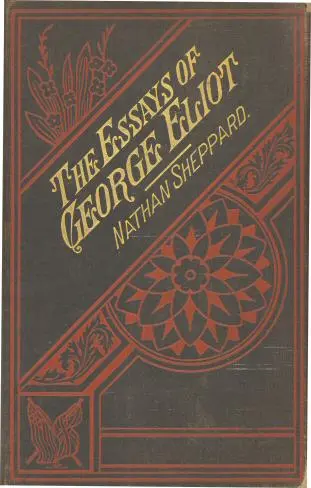
THE CLASSIC COLLECTION · 1883
"The Essays of 'George Eliot'" by George Eliot is a collection of literary essays written in the late 19th century. The essays cover a wide range of topics, reflecting on human emotions, societal dynamics, and the nature of literature, presenting George Eliot's insightful analysis of motives and character. As the work encompasses her contributions to periodical literature, it provides a detailed examination of her thoughts and ideas that contribute to her legacy as a prominent female novelist of her time. At the start of the collection, the preface sets the stage for the essays, explaining the curiosity surrounding George Eliot's earlier writings. It highlights her unique talent for analyzing human motives, positioning her as a distinctive voice in fiction, separate from her contemporaries who focus primarily on storytelling. The opening chapters delve into the intricacies of women’s roles in society and literature, with the discussion focusing on Eliot's perspective on characters like Dorothea Brooke from her famous novel "Middlemarch." A key theme emerges in the exploration of the disparity between external appearances and internal realities, as well as the constraints placed on women's lives, fostering a rich conversation about identity, societal expectations, and emotional depth that runs throughout Eliot's work.
Introduction adapted from the source catalogue; source summaries may be automatically generated.
Free to read · English · 105,866 words · No account needed
MAKE TIME FOR A GOOD BOOK
On by default. Untick to stop anonymous reading totals. Each page counts after 10 seconds in view. How this works.
Anonymous counting is on unless you have switched it off.
As soon as the closing of the Great Exhibition afforded a reasonable hope that there would once more be a reading public, “The Life of Sterling” appeared. A new work by Carlyle must always be among the literary births eagerly chronicled by the journals and greeted by the public. In a book of such parentage we care less about the subject than about its treatment, just as we think the “Portrait of a Lord” worth studying if it come from the pencil of a Vandyck. The life of John Sterling, however, has intrinsic interest, even if it be viewed simply as the struggle of a restless aspiring soul, yearning to leave a distinct impress of itself on the spiritual development of humanity, with that fell disease which, with a refinement of torture, heightens the susceptibility and activity of the faculties, while it undermines their creative force. Sterling, moreover, was a man thoroughly in earnest, to whom poetry and philosophy were not merely another form of paper currency or a ladder to fame, but an end in themselves—one of those finer spirits with whom, amid the jar and hubbub of our daily life,
“The melodies abide
Of the everlasting chime.”
But his intellect was active and rapid, rather than powerful, and in all his writings we feel the want of a stronger electric current to give that vigor of conception and felicity of expression, by which we distinguish the undefinable something called genius; while his moral nature, though refined and elevated, seems to have been subordinate to his intellectual tendencies and social qualities, and to have had itself little determining influence on his life. His career was less exceptional than his character: a youth marked by delicate health and studious tastes, a short-lived and not very successful share in the management of the Athenæum, a fever of sympathy with Spanish patriots, arrested before it reached a dangerous crisis by an early love affair ending in marriage, a fifteen months’ residence in the West Indies, eight months of curate’s duty at Herstmonceux, relinquished on the ground of failing health, and through his remaining years a succession of migrations to the South in search of a friendly climate, with the occasional publication of an “article,” a tale, or a poem in Blackwood or elsewhere—this, on the prosaic background of an easy competence, was what made up the outer tissue of Sterling’s existence. The impression of his intellectual power on his personal friends seems to have been produced chiefly by the eloquence and brilliancy of his conversation; but the mere reader of his works and letters would augur from them neither the wit nor the curiosa felicitas of epithet and imagery, which would rank him with the men whose sayings are thought worthy of perpetuation in books of table-talk and “ana.” The public, then, since it is content to do without biographies of much more remarkable men, cannot be supposed to have felt any pressing demand even for a single life of Sterling; still less, it might be thought, when so distinguished a writer as Archdeacon Hare had furnished this, could there be any need for another. But, in opposition to the majority of Mr. Carlyle’s critics, we agree with him that the first life is properly the justification of the second. Even among the readers personally unacquainted with Sterling, those who sympathized with his ultimate alienation from the Church, rather than with his transient conformity, were likely to be dissatisfied with the entirely apologetic tone of Hare’s life, which, indeed, is confessedly an incomplete presentation of Sterling’s mental course after his opinions diverged from those of his clerical biographer; while those attached friends (and Sterling possessed the happy magic that secures many such) who knew him best during this latter part of his career, would naturally be pained to have it represented, though only by implication, as a sort of deepening declension ending in a virtual retraction. Of such friends Carlyle was the most eminent, and perhaps the most highly valued, and, as co-trustee with Archdeacon Hare of Sterling’s literary character and writings, he felt a kind of responsibility that no mistaken idea of his departed friend should remain before the world without correction. Evidently, however, his “Life of Sterling” was not so much the conscientious discharge of a trust as a labor of love, and to this is owing its strong charm. Carlyle here shows us his “sunny side.” We no longer see him breathing out threatenings and slaughter as in the Latter-Day Pamphlets, but moving among the charities and amenities of life, loving and beloved—a Teufelsdröckh still, but humanized by a Blumine worthy of him. We have often wished that genius would incline itself more frequently to the task of the biographer—that when some great or good personage dies, instead of the dreary three or five volumed compilations of letter, and diary, and detail, little to the purpose, which two thirds of the reading public have not the chance, nor the other third the inclination, to read, we could have a real “Life,” setting forth briefly and vividly the man’s inward and outward struggles, aims, and achievements, so as to make clear the meaning which his experience has for his fellows. A few such lives (chiefly, indeed, autobiographies) the world possesses, and they have, perhaps, been more influential on the formation of character than any other kind of reading. But the conditions required for the perfection of life writing—personal intimacy, a loving and poetic nature which sees the beauty and the depth of familiar things, and the artistic power which seizes characteristic points and renders them with lifelike effect—are seldom found in combination. “The Life of Sterling” is an instance of this rare conjunction. Its comparatively tame scenes and incidents gather picturesqueness and interest under the rich lights of Carlyle’s mind. We are told neither too little nor too much; the facts noted, the letters selected, are all such as serve to give the liveliest conception of what Sterling was and what he did; and though the book speaks much of other persons, this collateral matter is all a kind of scene-painting, and is accessory to the main purpose. The portrait of Coleridge, for example, is precisely adapted to bring before us the intellectual region in which Sterling lived for some time before entering the Church. Almost every review has extracted this admirable description, in which genial veneration and compassion struggle with irresistible satire; but the emphasis of quotation cannot be too often given to the following pregnant paragraph:
Your reading position is saved on this browser. Take it to another device with a library code. Reading pages adapt to text, rather than matching a printed edition.
George Eliot
George Eliot

George Eliot & Elizabeth Barrett Browning & Robert Browning & Percy Bysshe Shelley
George Eliot
BEHIND THE BOOK
This eBook is for the use of anyone anywhere in the United States and most other parts of the world at no cost and with almost no restrictions whatsoever. You may copy it, give it away or re-use it under the terms of the Project Gutenberg License included with this eBook or online at www.gutenberg.org. If you are not located in the United States, you will have to check the laws of the country where you are located before using this eBook. Read the source licence.
The original source file, including credits and licence, is retained by this library. Request an original-format copy at no charge. Please include the book title and Project Gutenberg identifier #28289.
KEEP YOUR CURIOSITY GOING

David Patterson (Spirit) Hatch

David Patterson (Spirit) Hatch

David Patterson (Spirit) Hatch
Cécile Tormay

Moritz Busch
John L. Ransom