THE CLASSIC COLLECTION✦RomolaCLASSIC FREE BOOKS
Romola
George Eliot
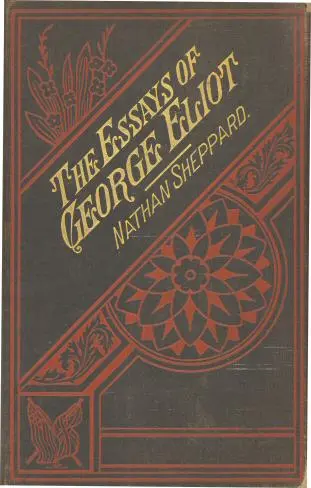
THE CLASSIC COLLECTION · 1883
"The Essays of 'George Eliot'" by George Eliot is a collection of literary essays written in the late 19th century. The essays cover a wide range of topics, reflecting on human emotions, societal dynamics, and the nature of literature, presenting George Eliot's insightful analysis of motives and character. As the work encompasses her contributions to periodical literature, it provides a detailed examination of her thoughts and ideas that contribute to her legacy as a prominent female novelist of her time. At the start of the collection, the preface sets the stage for the essays, explaining the curiosity surrounding George Eliot's earlier writings. It highlights her unique talent for analyzing human motives, positioning her as a distinctive voice in fiction, separate from her contemporaries who focus primarily on storytelling. The opening chapters delve into the intricacies of women’s roles in society and literature, with the discussion focusing on Eliot's perspective on characters like Dorothea Brooke from her famous novel "Middlemarch." A key theme emerges in the exploration of the disparity between external appearances and internal realities, as well as the constraints placed on women's lives, fostering a rich conversation about identity, societal expectations, and emotional depth that runs throughout Eliot's work.
Introduction adapted from the source catalogue; source summaries may be automatically generated.
Free to read · English · 105,866 words · No account needed
MAKE TIME FOR A GOOD BOOK
On by default. Untick to stop anonymous reading totals. Each page counts after 10 seconds in view. How this works.
Anonymous counting is on unless you have switched it off.
It may be readily imagined that Heine, with so large a share of the Gallic element as he has in his composition, was soon at his ease in Parisian society, and the years here were bright with intellectual activity and social enjoyment. “His wit,” wrote August Lewald, “is a perpetual gushing fountain; he throws off the most delicious descriptions with amazing facility, and sketches the most comic characters in conversations.” Such a man could not be neglected in Paris, and Heine was sought on all sides—as a guest in distinguished salons, as a possible proselyte in the circle of the Saint Simonians. His literary productiveness seems to have been furthered by his congenial life, which, however, was soon to some extent embittered by the sense of exile; for since 1835 both his works and his person have been the object of denunciation by the German governments. Between 1833 and 1845 appeared the four volumes of the “Salon,” “Die Romantische Schule” (both written, in the first instance, in French), the book on Börne, “Atta Troll,” a romantic poem, “Deutschland,” an exquisitely humorous poem, describing his last visit to Germany, and containing some grand passages of serious writing; and the “Neue Gedichte,” a collection of lyrical poems. Among the most interesting of his prose works are the second volume of the “Salon,” which contains a survey of religion and philosophy in Germany, and the “Romantische Schule,” a delightful introduction to that phase of German literature known as the Romantic school. The book on Börne, which appeared in 1840, two years after the death of that writer, excited great indignation in Germany, as a wreaking of vengeance on the dead, an insult to the memory of a man who had worked and suffered in the cause of freedom—a cause which was Heine’s own. Börne, we may observe parenthetically for the information of those who are not familiar with recent German literature, was a remarkable political writer of the ultra-liberal party in Germany, who resided in Paris at the same time with Heine: a man of stern, uncompromising partisanship and bitter humor. Without justifying Heine’s production of this book, we see excuses for him which should temper the condemnation passed on it. There was a radical opposition of nature between him and Börne; to use his own distinction, Heine is a Hellene—sensuous, realistic, exquisitely alive to the beautiful; while Börne was a Nazarene—ascetic, spiritualistic, despising the pure artist as destitute of earnestness. Heine has too keen a perception of practical absurdities and damaging exaggerations ever to become a thoroughgoing partisan; and with a love of freedom, a faith in the ultimate triumph of democratic principles, of which we see no just reason to doubt the genuineness and consistency, he has been unable to satisfy more zealous and one-sided liberals by giving his adhesion to their views and measures, or by adopting a denunciatory tone against those in the opposite ranks. Börne could not forgive what he regarded as Heine’s epicurean indifference and artistic dalliance, and he at length gave vent to his antipathy in savage attacks on him through the press, accusing him of utterly lacking character and principle, and even of writing under the influence of venal motives. To these attacks Heine remained absolutely mute—from contempt according to his own account; but the retort, which he resolutely refrained from making during Börne’s life, comes in this volume published after his death with the concentrated force of long-gathering thunder. The utterly inexcusable part of the book is the caricature of Börne’s friend, Madame Wohl, and the scurrilous insinuations concerning Börne’s domestic life. It is said, we know not with how much truth, that Heine had to answer for these in a duel with Madame Wohl’s husband, and that, after receiving a serious wound, he promised to withdraw the offensive matter from a future edition. That edition, however, has not been called for. Whatever else we may think of the book, it is impossible to deny its transcendent talent—the dramatic vigor with which Börne is made present to us, the critical acumen with which he is characterized, and the wonderful play of wit, pathos, and thought which runs through the whole. But we will let Heine speak for himself, and first we will give part of his graphic description of the way in which Börne’s mind and manners grated on his taste:
Your reading position is saved on this browser. Take it to another device with a library code. Reading pages adapt to text, rather than matching a printed edition.
George Eliot
George Eliot

George Eliot & Elizabeth Barrett Browning & Robert Browning & Percy Bysshe Shelley
George Eliot
BEHIND THE BOOK
This eBook is for the use of anyone anywhere in the United States and most other parts of the world at no cost and with almost no restrictions whatsoever. You may copy it, give it away or re-use it under the terms of the Project Gutenberg License included with this eBook or online at www.gutenberg.org. If you are not located in the United States, you will have to check the laws of the country where you are located before using this eBook. Read the source licence.
The original source file, including credits and licence, is retained by this library. Request an original-format copy at no charge. Please include the book title and Project Gutenberg identifier #28289.
KEEP YOUR CURIOSITY GOING

David Patterson (Spirit) Hatch

David Patterson (Spirit) Hatch

David Patterson (Spirit) Hatch
Cécile Tormay

Moritz Busch
John L. Ransom