THE CLASSIC COLLECTION✦RomolaCLASSIC FREE BOOKS
Romola
George Eliot
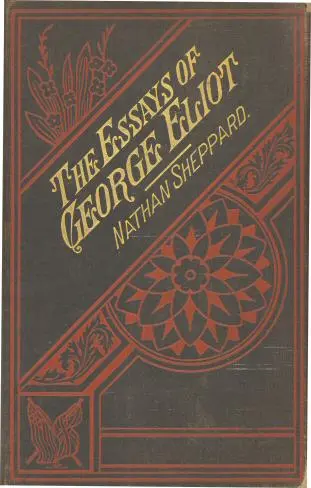
THE CLASSIC COLLECTION · 1883
"The Essays of 'George Eliot'" by George Eliot is a collection of literary essays written in the late 19th century. The essays cover a wide range of topics, reflecting on human emotions, societal dynamics, and the nature of literature, presenting George Eliot's insightful analysis of motives and character. As the work encompasses her contributions to periodical literature, it provides a detailed examination of her thoughts and ideas that contribute to her legacy as a prominent female novelist of her time. At the start of the collection, the preface sets the stage for the essays, explaining the curiosity surrounding George Eliot's earlier writings. It highlights her unique talent for analyzing human motives, positioning her as a distinctive voice in fiction, separate from her contemporaries who focus primarily on storytelling. The opening chapters delve into the intricacies of women’s roles in society and literature, with the discussion focusing on Eliot's perspective on characters like Dorothea Brooke from her famous novel "Middlemarch." A key theme emerges in the exploration of the disparity between external appearances and internal realities, as well as the constraints placed on women's lives, fostering a rich conversation about identity, societal expectations, and emotional depth that runs throughout Eliot's work.
Introduction adapted from the source catalogue; source summaries may be automatically generated.
Free to read · English · 105,866 words · No account needed
MAKE TIME FOR A GOOD BOOK
On by default. Untick to stop anonymous reading totals. Each page counts after 10 seconds in view. How this works.
Anonymous counting is on unless you have switched it off.
Madame de Sablé’s life, for anything we know, flowed on evenly enough until 1640, when the death of her husband threw upon her the care of an embarrassed fortune. She found a friend in Réné de Longueil, Seigneur de Maisons, of whom we are content to know no more than that he helped Madame de Sablé to arrange her affairs, though only by means of alienating from her family the estate of Sablé, that his house was her refuge during the blockade of Paris in 1649, and that she was not unmindful of her obligations to him, when, subsequently, her credit could be serviceable to him at court. In the midst of these pecuniary troubles came a more terrible trial—the loss of her favorite son, the brave and handsome Guy de Laval, who, after a brilliant career in the campaigns of Condé, was killed at the siege of Dunkirk, in 1646, when scarcely four-and-twenty. The fine qualities of this young man had endeared him to the whole army, and especially to Condé, had won him the hand of the Chancellor Séguire’s daughter, and had thus opened to him the prospect of the highest honors. His loss seems to have been the most real sorrow of Madame de Sablé’s life. Soon after followed the commotions of the Fronde, which put a stop to social intercourse, and threw the closest friends into opposite ranks. According to Lenet, who relies on the authority of Gourville, Madame de Sablé was under strong obligations to the court, being in the receipt of a pension of 2000 crowns; at all events, she adhered throughout to the Queen and Mazarin, but being as far as possible from a fierce partisan, and given both by disposition and judgment to hear both sides of the question, she acted as a conciliator, and retained her friends of both parties. The Countess de Maure, whose husband was the most obstinate of frondeurs, remained throughout her most cherished friend, and she kept up a constant correspondence with the lovely and intrepid heroine of the Fronde, Madame de Longueville. Her activity was directed to the extinction of animosities, by bringing about marriages between the Montagues and Capulets of the Fronde—between the Prince de Condé, or his brother, and the niece of Mazarin, or between the three nieces of Mazarin and the sons of three noblemen who were distinguished leaders of the Fronde. Though her projects were not realized, her conciliatory position enabled her to preserve all her friendships intact, and when the political tempest was over, she could assemble around her in her residence, in the Place Royal, the same society as before. Madame de Sablé was now approaching her twelfth lustrum, and though the charms of her mind and character made her more sought after than most younger women, it is not surprising that, sharing as she did in the religious ideas of her time, the concerns of “salvation” seemed to become pressing. A religious retirement, which did not exclude the reception of literary friends or the care for personal comforts, made the most becoming frame for age and diminished fortune. Jansenism was then to ordinary Catholicism what Puseyism is to ordinary Church of Englandism in these days—it was a récherché form of piety unshared by the vulgar; and one sees at once that it must have special attractions for the précieuse. Madame de Sablé, then, probably about 1655 or ’56, determined to retire to Port Royal, not because she was already devout, but because she hoped to become so; as, however, she wished to retain the pleasure of intercourse with friends who were still worldly, she built for herself a set of apartments at once distinct from the monastery and attached to it. Here, with a comfortable establishment, consisting of her secretary, Dr. Valant, Mademoiselle de Chalais, formerly her dame de compagnie, and now become her friend; an excellent cook; a few other servants, and for a considerable time a carriage and coachman; with her best friends within a moderate distance, she could, as M. Cousin says, be out of the noise of the world without altogether forsaking it, preserve her dearest friendships, and have before her eyes edifying examples—“vaquer enfin à son aise aux soins de son salut et à ceux de sa santé.”
Your reading position is saved on this browser. Take it to another device with a library code. Reading pages adapt to text, rather than matching a printed edition.
George Eliot
George Eliot

George Eliot & Elizabeth Barrett Browning & Robert Browning & Percy Bysshe Shelley
George Eliot
BEHIND THE BOOK
This eBook is for the use of anyone anywhere in the United States and most other parts of the world at no cost and with almost no restrictions whatsoever. You may copy it, give it away or re-use it under the terms of the Project Gutenberg License included with this eBook or online at www.gutenberg.org. If you are not located in the United States, you will have to check the laws of the country where you are located before using this eBook. Read the source licence.
The original source file, including credits and licence, is retained by this library. Request an original-format copy at no charge. Please include the book title and Project Gutenberg identifier #28289.
KEEP YOUR CURIOSITY GOING

David Patterson (Spirit) Hatch

David Patterson (Spirit) Hatch

David Patterson (Spirit) Hatch
Cécile Tormay

Moritz Busch
John L. Ransom