THE CLASSIC COLLECTION✦RomolaCLASSIC FREE BOOKS
Romola
George Eliot
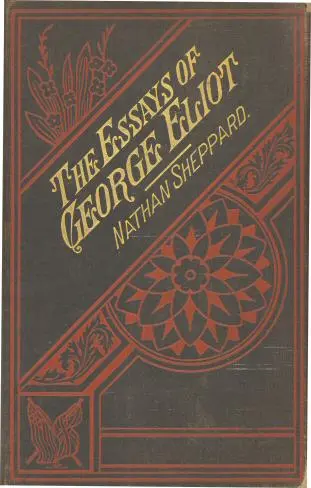
THE CLASSIC COLLECTION · 1883
"The Essays of 'George Eliot'" by George Eliot is a collection of literary essays written in the late 19th century. The essays cover a wide range of topics, reflecting on human emotions, societal dynamics, and the nature of literature, presenting George Eliot's insightful analysis of motives and character. As the work encompasses her contributions to periodical literature, it provides a detailed examination of her thoughts and ideas that contribute to her legacy as a prominent female novelist of her time. At the start of the collection, the preface sets the stage for the essays, explaining the curiosity surrounding George Eliot's earlier writings. It highlights her unique talent for analyzing human motives, positioning her as a distinctive voice in fiction, separate from her contemporaries who focus primarily on storytelling. The opening chapters delve into the intricacies of women’s roles in society and literature, with the discussion focusing on Eliot's perspective on characters like Dorothea Brooke from her famous novel "Middlemarch." A key theme emerges in the exploration of the disparity between external appearances and internal realities, as well as the constraints placed on women's lives, fostering a rich conversation about identity, societal expectations, and emotional depth that runs throughout Eliot's work.
Introduction adapted from the source catalogue; source summaries may be automatically generated.
Free to read · English · 105,866 words · No account needed
MAKE TIME FOR A GOOD BOOK
On by default. Untick to stop anonymous reading totals. Each page counts after 10 seconds in view. How this works.
Anonymous counting is on unless you have switched it off.
Now the security of this treasure demands, not only the preservation of order, but a certain patience on our part with many institutions and facts of various kinds, especially touching the accumulation of wealth, which from the light we stand in, we are more likely to discern the evil than the good of. It is constantly the task of practical wisdom not to say, “This is good, and I will have it,” but to say, “This is the less of two unavoidable evils, and I will bear it.” And this treasure of knowledge, which consists in the fine activity, the exalted vision of many minds, is bound up at present with conditions which have much evil in them. Just as in the case of material wealth and its distribution we are obliged to take the selfishness and weaknesses of human nature into account, and however we insist that men might act better, are forced, unless we are fanatical simpletons, to consider how they are likely to act; so in this matter of the wealth that is carried in men’s minds, we have to reflect that the too absolute predominance of a class whose wants have been of a common sort, who are chiefly struggling to get better and more food, clothing, shelter, and bodily recreation, may lead to hasty measures for the sake of having things more fairly shared, which, even if they did not fail of their object, would at last debase the life of the nation. Do anything which will throw the classes who hold the treasures of knowledge—nay, I may say, the treasure of refined needs—into the background, cause them to withdraw from public affairs, stop too suddenly any of the sources by which their leisure and ease are furnished, rob them of the chances by which they may be influential and pre-eminent, and you do something as short-sighted as the acts of France and Spain when in jealousy and wrath, not altogether unprovoked, they drove from among them races and classes that held the traditions of handicraft and agriculture. You injure your own inheritance and the inheritance of your children. You may truly say that this which I call the common estate of society has been anything but common to you; but the same may be said, by many of us, of the sunlight and the air, of the sky and the fields, of parks and holiday games. Nevertheless that these blessings exist makes life worthier to us, and urges us the more to energetic, likely means of getting our share in them; and I say, let us watch carefully, lest we do anything to lessen this treasure which is held in the minds of men, while we exert ourselves, first of all, and to the very utmost, that we and our children may share in all its benefits. Yes; exert ourselves to the utmost, to break the yoke of ignorance. If we demand more leisure, more ease in our lives, let us show that we don’t deserve the reproach of wanting to shirk that industry which, in some form or other, every man, whether rich or poor, should feel himself as much bound to as he is bound to decency. Let us show that we want to have some time and strength left to us, that we may use it, not for brutal indulgence, but for the rational exercise of the faculties which make us men. Without this no political measures can benefit us. No political institution will alter the nature of Ignorance, or hinder it from producing vice and misery. Let Ignorance start how it will, it must run the same round of low appetites, poverty, slavery, and superstition. Some of us know this well—nay, I will say, feel it; for knowledge of this kind cuts deep; and to us it is one of the most painful facts belonging to our condition that there are numbers of our fellow-workmen who are so far from feeling in the same way, that they never use the imperfect opportunities already offered them for giving their children some schooling, but turn their little ones of tender age into bread-winners, often at cruel tasks, exposed to the horrible infection of childish vice. Of course, the causes of these hideous things go a long way back. Parents’ misery has made parents’ wickedness. But we, who are still blessed with the hearts of fathers and the consciences of men—we who have some knowledge of the curse entailed on broods of creatures in human shape, whose enfeebled bodies and dull perverted minds are mere centres of uneasiness in whom even appetite is feeble and joy impossible—I say we are bound to use all the means at our command to help in putting a stop to this horror. Here, it seems to me, is a way in which we may use extended co-operation among us to the most momentous of all purposes, and make conditions of enrolment that would strengthen all educational measures. It is true enough that there is a low sense of parental duties in the nation at large, and that numbers who have no excuse in bodily hardship seem to think it a light thing to beget children, to bring human beings with all their tremendous possibilities into this difficult world, and then take little heed how they are disciplined and furnished for the perilous journey they are sent on without any asking of their own. This is a sin shared in more or less by all classes; but there are sins which, like taxation, fall the heaviest on the poorest, and none have such galling reasons as we working men to try and rouse to the utmost the feeling of responsibility in fathers and mothers. We have been urged into co-operation by the pressure of common demands. In war men need each other more; and where a given point has to be defended, fighters inevitably find themselves shoulder to shoulder. So fellowship grows, so grow the rules of fellowship, which gradually shape themselves to thoroughness as the idea of a common good becomes more complete. We feel a right to say, If you will be one of us, you must make such and such a contribution—you must renounce such and such a separate advantage—you must set your face against such and such an infringement. If we have any false ideas about our common good, our rules will be wrong, and we shall be co-operating to damage each other. But, now, here is a part of our good, without which everything else we strive for will be worthless—I mean the rescue of our children. Let us demand from the members of our unions that they fulfil their duty as parents in this definite matter, which rules can reach. Let us demand that they send their children to school, so as not to go on recklessly, breeding a moral pestilence among us, just as strictly as we demand that they pay their contributions to a common fund, understood to be for a common benefit. While we watch our public men, let us watch one another as to this duty, which is also public, and more momentous even than obedience to sanitary regulations. While we resolutely declare against the wickedness in high places, let us set ourselves also against the wickedness in low places, not quarrelling which came first, or which is the worse of the two—not trying to settle the miserable precedence of plague or famine, but insisting unflinchingly on remedies once ascertained, and summoning those who hold the treasure of knowledge to remember that they hold it in trust, and that with them lies the task of searching for new remedies, and finding the right methods of applying them.
Your reading position is saved on this browser. Take it to another device with a library code. Reading pages adapt to text, rather than matching a printed edition.
George Eliot
George Eliot

George Eliot & Elizabeth Barrett Browning & Robert Browning & Percy Bysshe Shelley
George Eliot
BEHIND THE BOOK
This eBook is for the use of anyone anywhere in the United States and most other parts of the world at no cost and with almost no restrictions whatsoever. You may copy it, give it away or re-use it under the terms of the Project Gutenberg License included with this eBook or online at www.gutenberg.org. If you are not located in the United States, you will have to check the laws of the country where you are located before using this eBook. Read the source licence.
The original source file, including credits and licence, is retained by this library. Request an original-format copy at no charge. Please include the book title and Project Gutenberg identifier #28289.
KEEP YOUR CURIOSITY GOING

David Patterson (Spirit) Hatch

David Patterson (Spirit) Hatch

David Patterson (Spirit) Hatch
Cécile Tormay

Moritz Busch
John L. Ransom