THE CLASSIC COLLECTION✦RomolaCLASSIC FREE BOOKS
Romola
George Eliot
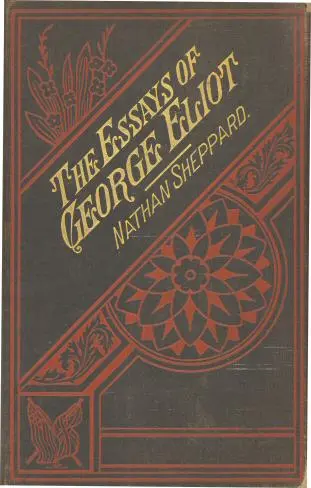
THE CLASSIC COLLECTION · 1883
"The Essays of 'George Eliot'" by George Eliot is a collection of literary essays written in the late 19th century. The essays cover a wide range of topics, reflecting on human emotions, societal dynamics, and the nature of literature, presenting George Eliot's insightful analysis of motives and character. As the work encompasses her contributions to periodical literature, it provides a detailed examination of her thoughts and ideas that contribute to her legacy as a prominent female novelist of her time. At the start of the collection, the preface sets the stage for the essays, explaining the curiosity surrounding George Eliot's earlier writings. It highlights her unique talent for analyzing human motives, positioning her as a distinctive voice in fiction, separate from her contemporaries who focus primarily on storytelling. The opening chapters delve into the intricacies of women’s roles in society and literature, with the discussion focusing on Eliot's perspective on characters like Dorothea Brooke from her famous novel "Middlemarch." A key theme emerges in the exploration of the disparity between external appearances and internal realities, as well as the constraints placed on women's lives, fostering a rich conversation about identity, societal expectations, and emotional depth that runs throughout Eliot's work.
Introduction adapted from the source catalogue; source summaries may be automatically generated.
Free to read · English · 105,866 words · No account needed
MAKE TIME FOR A GOOD BOOK
On by default. Untick to stop anonymous reading totals. Each page counts after 10 seconds in view. How this works.
Anonymous counting is on unless you have switched it off.
We have reason to be discontented with many things, and, looking back either through the history of England to much earlier generations or to the legislation and administrations of later times, we are justified in saying that many of the evils under which our country now suffers are the consequences of folly, ignorance, neglect, or self-seeking in those who, at different times have wielded the powers of rank, office, and money. But the more bitterly we feel this, the more loudly we utter it, the stronger is the obligation we lay on ourselves to beware, lest we also, by a too hasty wresting of measures which seem to promise an immediate partial relief, make a worse time of it for our own generation, and leave a bad inheritance to our children. The deepest curse of wrong-doing, whether of the foolish or wicked sort, is that its effects are difficult to be undone. I suppose there is hardly anything more to be shuddered at than that part of the history of disease which shows how, when a man injures his constitution by a life of vicious excess, his children and grandchildren inherit diseased bodies and minds, and how the effects of that unhappy inheritance continue to spread beyond our calculation. This is only one example of the law by which human lives are linked together; another example of what we complain of when we point to our pauperism, to the brutal ignorance of multitudes among our fellow countrymen, to the weight of taxation laid on us by blamable wars, to the wasteful channels made for the public money, to the expense and trouble of getting justice, and call these the effects of bad rule. This is the law that we all bear the yoke of, the law of no man’s making, and which no man can undo. Everybody now sees an example of it in the case of Ireland. We who are living now are sufferers by the wrong-doing of those who lived before us; we are the sufferers by each other’s wrong-doing; and the children who come after us are and will be sufferers from the same causes. Will any man say he doesn’t care for that law—it is nothing to him—what he wants is to better himself? With what face then will he complain of any injury? If he says that in politics or in any sort of social action he will not care to know what are likely to be the consequences to others besides himself, he is defending the very worst doings that have brought about his discontent. He might as well say that there is no better rule needful for men than that each should tug and drive for what will please him, without caring how that tugging will act on the fine widespread network of society in which he is fast meshed. If any man taught that as a doctrine, we should know him for a fool. But there are men who act upon it; every scoundrel, for example, whether he is a rich religious scoundrel who lies and cheats on a large scale, and will perhaps come and ask you to send him to Parliament, or a poor pocket-picking scoundrel, who will steal your loose pence while you are listening round the platform. None of us are so ignorant as not to know that a society, a nation is held together by just the opposite doctrine and action—by the dependence of men on each other and the sense they have of a common interest in preventing injury. And we working men are, I think, of all classes the last that can afford to forget this; for if we did we should be much like sailors cutting away the timbers of our own ship to warm our grog with. For what else is the meaning of our trades-unions? What else is the meaning of every flag we carry, every procession we make, every crowd we collect for the sake of making some protest on behalf of our body as receivers of wages, if not this: that it is our interest to stand by each other, and that this being the common interest, no one of us will try to make a good bargain for himself without considering what will be good for his fellows? And every member of a union believes that the wider he can spread his union, the stronger and surer will be the effect of it. So I think I shall be borne out in saying that a working man who can put two and two together, or take three from four and see what will be the remainder, can understand that a society, to be well off, must be made up chiefly of men who consider the general good as well as their own.
Your reading position is saved on this browser. Take it to another device with a library code. Reading pages adapt to text, rather than matching a printed edition.
George Eliot
George Eliot

George Eliot & Elizabeth Barrett Browning & Robert Browning & Percy Bysshe Shelley
George Eliot
BEHIND THE BOOK
This eBook is for the use of anyone anywhere in the United States and most other parts of the world at no cost and with almost no restrictions whatsoever. You may copy it, give it away or re-use it under the terms of the Project Gutenberg License included with this eBook or online at www.gutenberg.org. If you are not located in the United States, you will have to check the laws of the country where you are located before using this eBook. Read the source licence.
The original source file, including credits and licence, is retained by this library. Request an original-format copy at no charge. Please include the book title and Project Gutenberg identifier #28289.
KEEP YOUR CURIOSITY GOING

David Patterson (Spirit) Hatch

David Patterson (Spirit) Hatch

David Patterson (Spirit) Hatch
Cécile Tormay

Moritz Busch
John L. Ransom