THE CLASSIC COLLECTION✦RomolaCLASSIC FREE BOOKS
Romola
George Eliot
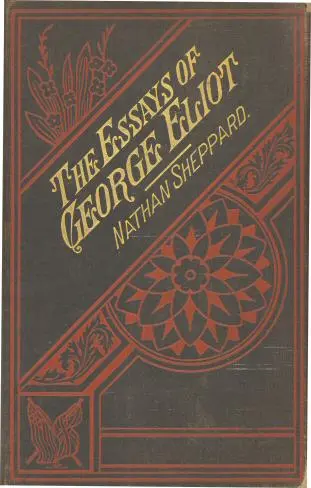
THE CLASSIC COLLECTION · 1883
"The Essays of 'George Eliot'" by George Eliot is a collection of literary essays written in the late 19th century. The essays cover a wide range of topics, reflecting on human emotions, societal dynamics, and the nature of literature, presenting George Eliot's insightful analysis of motives and character. As the work encompasses her contributions to periodical literature, it provides a detailed examination of her thoughts and ideas that contribute to her legacy as a prominent female novelist of her time. At the start of the collection, the preface sets the stage for the essays, explaining the curiosity surrounding George Eliot's earlier writings. It highlights her unique talent for analyzing human motives, positioning her as a distinctive voice in fiction, separate from her contemporaries who focus primarily on storytelling. The opening chapters delve into the intricacies of women’s roles in society and literature, with the discussion focusing on Eliot's perspective on characters like Dorothea Brooke from her famous novel "Middlemarch." A key theme emerges in the exploration of the disparity between external appearances and internal realities, as well as the constraints placed on women's lives, fostering a rich conversation about identity, societal expectations, and emotional depth that runs throughout Eliot's work.
Introduction adapted from the source catalogue; source summaries may be automatically generated.
Free to read · English · 105,866 words · No account needed
MAKE TIME FOR A GOOD BOOK
On by default. Untick to stop anonymous reading totals. Each page counts after 10 seconds in view. How this works.
Anonymous counting is on unless you have switched it off.
Mr. Lecky proceeds to some questionable views concerning the evidences of witchcraft, which seem to be irreconcilable even with his own remarks later on; but they lead him to the statement, thoroughly made out by his historical survey, that “movement was mainly silent, unargumentative, and insensible; that men came gradually to disbelieve in witchcraft, because they came gradually to look upon it as absurd; and that this new tone of thought appeared, first of all, in those who were least subject to theological influences, and soon spread through the educated laity, and, last of all, took possession of the clergy.”
We have rather painful proof that this “second class of influences,” with a vast number go hardly deeper than Fashion, and that witchcraft to many of us is absurd only on the same ground that our grandfathers’ gigs are absurd. It is felt preposterous to think of spiritual agencies in connection with ragged beldames soaring on broomsticks, in an age when it is known that mediums of communication with the invisible world are usually unctuous personages dressed in excellent broadcloth, who soar above the curtain-poles without any broomstick, and who are not given to unprofitable intrigues. The enlightened imagination rejects the figure of a witch with her profile in dark relief against the moon and her broomstick cutting a constellation. No undiscovered natural laws, no names of “respectable” witnesses, are invoked to make us feel our presumption in questioning the diabolic intimacies of that obsolete old woman, for it is known now that the undiscovered laws, and the witnesses qualified by the payment of income tax, are all in favor of a different conception—the image of a heavy gentleman in boots and black coat-tails foreshortened against the cornice. Yet no less a person than Sir Thomas Browne once wrote that those who denied there were witches, inasmuch as they thereby denied spirits also, were “obliquely and upon consequence a sort, not of infidels, but of atheists.” At present, doubtless, in certain circles, unbelievers in heavy gentlemen who float in the air by means of undiscovered laws are also taxed with atheism; illiberal as it is not to admit that mere weakness of understanding may prevent one from seeing how that phenomenon is necessarily involved in the Divine origin of things. With still more remarkable parallelism, Sir Thomas Browne goes on: “Those that, to refute their incredulity, desire to see apparitions, shall questionless never behold any, nor have the power to be so much as witches. The devil hath made them already in a heresy as capital as witchcraft, and to appear to them were but to convert them.” It would be difficult to see what has been changed here, but the mere drapery of circumstance, if it were not for this prominent difference between our own days and the days of witchcraft, that instead of torturing, drowning, or burning the innocent, we give hospitality and large pay to—the highly distinguished medium. At least we are safely rid of certain horrors; but if the multitude—that “farraginous concurrence of all conditions, tempers, sexes, and ages”—do not roll back even to a superstition that carries cruelty in its train, it is not because they possess a cultivated reason, but because they are pressed upon and held up by what we may call an external reason—the sum of conditions resulting from the laws of material growth, from changes produced by great historical collisions shattering the structures of ages and making new highways for events and ideas, and from the activities of higher minds no longer existing merely as opinions and teaching, but as institutions and organizations with which the interests, the affections, and the habits of the multitude are inextricably interwoven. No undiscovered laws accounting for small phenomena going forward under drawing-room tables are likely to affect the tremendous facts of the increase of population, the rejection of convicts by our colonies, the exhaustion of the soil by cotton plantations, which urge even upon the foolish certain questions, certain claims, certain views concerning the scheme of the world, that can never again be silenced. If right reason is a right representation of the co-existence and sequences of things, here are co-existences and sequences that do not wait to be discovered, but press themselves upon us like bars of iron. No séances at a guinea a head for the sake of being pinched by “Mary Jane” can annihilate railways, steamships, and electric telegraphs, which are demonstrating the interdependence of all human interests, and making self-interest a duct for sympathy. These things are part of the external Reason to which internal silliness has inevitably to accommodate itself.
Your reading position is saved on this browser. Take it to another device with a library code. Reading pages adapt to text, rather than matching a printed edition.
George Eliot
George Eliot

George Eliot & Elizabeth Barrett Browning & Robert Browning & Percy Bysshe Shelley
George Eliot
BEHIND THE BOOK
This eBook is for the use of anyone anywhere in the United States and most other parts of the world at no cost and with almost no restrictions whatsoever. You may copy it, give it away or re-use it under the terms of the Project Gutenberg License included with this eBook or online at www.gutenberg.org. If you are not located in the United States, you will have to check the laws of the country where you are located before using this eBook. Read the source licence.
The original source file, including credits and licence, is retained by this library. Request an original-format copy at no charge. Please include the book title and Project Gutenberg identifier #28289.
KEEP YOUR CURIOSITY GOING

David Patterson (Spirit) Hatch

David Patterson (Spirit) Hatch

David Patterson (Spirit) Hatch
Cécile Tormay

Moritz Busch
John L. Ransom