THE CLASSIC COLLECTION✦RomolaCLASSIC FREE BOOKS
Romola
George Eliot
THE CLASSIC COLLECTION · 1883
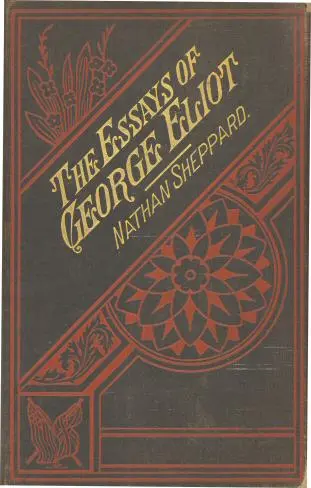
"The Essays of 'George Eliot'" by George Eliot is a collection of literary essays written in the late 19th century. The essays cover a wide range of topics, reflecting on human emotions, societal dynamics, and the nature of literature, presenting George Eliot's insightful analysis of motives and character. As the work encompasses her contributions to periodical literature, it provides a detailed examination of her thoughts and ideas that contribute to her legacy as a prominent female novelist of her time. At the start of the collection, the preface sets the stage for the essays, explaining the curiosity surrounding George Eliot's earlier writings. It highlights her unique talent for analyzing human motives, positioning her as a distinctive voice in fiction, separate from her contemporaries who focus primarily on storytelling. The opening chapters delve into the intricacies of women’s roles in society and literature, with the discussion focusing on Eliot's perspective on characters like Dorothea Brooke from her famous novel "Middlemarch." A key theme emerges in the exploration of the disparity between external appearances and internal realities, as well as the constraints placed on women's lives, fostering a rich conversation about identity, societal expectations, and emotional depth that runs throughout Eliot's work.
Introduction adapted from the source catalogue; source summaries may be automatically generated.
Free to read · English · 105,866 words · No account needed
MAKE TIME FOR A GOOD BOOK
On by default. Untick to stop anonymous reading totals. Each page counts after 10 seconds in view. How this works.
Anonymous counting is on unless you have switched it off.
If we except the passages in “Philander,” “Narcissa,” and “Lucia,” there is hardly a trace of human sympathy, of self-forgetfulness in the joy or sorrow of a fellow-being, throughout this long poem, which professes to treat the various phases of man’s destiny. And even in the “Narcissa” Night, Young repels us by the low moral tone of his exaggerated lament. This married step-daughter died at Lyons, and, being a Protestant, was denied burial, so that her friends had to bury her in secret—one of the many miserable results of superstition, but not a fact to throw an educated, still less a Christian man, into a fury of hatred and vengeance, in contemplating it after the lapse of five years. Young, however, takes great pains to simulate a bad feeling:
“Of grief
And indignation rival bursts I pour’d,
Half execration mingled with my pray’r;
Kindled at man, while I his God adored;
Sore grudg’d the savage land her sacred dust;
Stamp’d the cursed soil; and with humanity
(Denied Narcissa) wish’d them all a grave.”
The odiously bad taste of this last clause makes us hope that it is simply a platitude, and not intended as witticism, until he removes the possibility of this favorable doubt by immediately asking, “Flows my resentment into guilt?”
When, by an afterthought, he attempts something like sympathy, he only betrays more clearly his want of it. Thus, in the first Night, when he turns from his private griefs to depict earth as a hideous abode of misery for all mankind, and asks,
“What then am I, who sorrow for myself?”
he falls at once into calculating the benefit of sorrowing for others:
“More generous sorrow, while it sinks, exalts;
And conscious virtue mitigates the pang.
Nor virtue, more than prudence, bids me give
Swollen thought a second channel.”
This remarkable negation of sympathy is in perfect consistency with
Young’s theory of ethics:
“Virtue is a crime,
A crime of reason, if it costs us pain
Unpaid.”
If there is no immortality for man—
“Sense! take the rein; blind Passion, drive us on; And Ignorance! befriend us on our way. . . Yes; give the pulse full empire; live the Brute, Since as the brute we die. The sum of man, Of godlike man, to revel and to rot.”
“If this life’s gain invites him to the deed, Why not his country sold, his father slain?”
“Ambition, avarice, by the wise disdain’d,
Is perfect wisdom, while mankind are fools,
And think a turf or tombstone covers all.”
“Die for thy country, thou romantic fool! Seize, seize the plank thyself, and let her sink.”
Your reading position is saved on this browser. Take it to another device with a library code. Reading pages adapt to text, rather than matching a printed edition.
George Eliot
George Eliot

George Eliot & Elizabeth Barrett Browning & Robert Browning & Percy Bysshe Shelley
George Eliot
BEHIND THE BOOK
This eBook is for the use of anyone anywhere in the United States and most other parts of the world at no cost and with almost no restrictions whatsoever. You may copy it, give it away or re-use it under the terms of the Project Gutenberg License included with this eBook or online at www.gutenberg.org. If you are not located in the United States, you will have to check the laws of the country where you are located before using this eBook. Read the source licence.
The original source file, including credits and licence, is retained by this library. Request an original-format copy at no charge. Please include the book title and Project Gutenberg identifier #28289.
KEEP YOUR CURIOSITY GOING

David Patterson (Spirit) Hatch

David Patterson (Spirit) Hatch

David Patterson (Spirit) Hatch
Cécile Tormay

Moritz Busch
John L. Ransom