THE CLASSIC COLLECTION✦RomolaCLASSIC FREE BOOKS
Romola
George Eliot
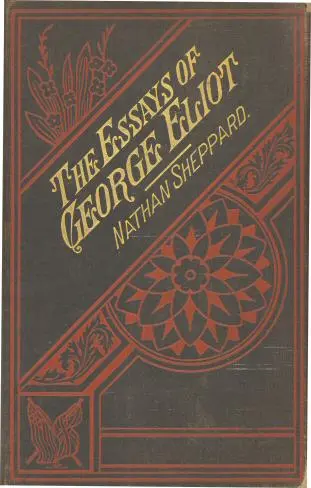
THE CLASSIC COLLECTION · 1883
"The Essays of 'George Eliot'" by George Eliot is a collection of literary essays written in the late 19th century. The essays cover a wide range of topics, reflecting on human emotions, societal dynamics, and the nature of literature, presenting George Eliot's insightful analysis of motives and character. As the work encompasses her contributions to periodical literature, it provides a detailed examination of her thoughts and ideas that contribute to her legacy as a prominent female novelist of her time. At the start of the collection, the preface sets the stage for the essays, explaining the curiosity surrounding George Eliot's earlier writings. It highlights her unique talent for analyzing human motives, positioning her as a distinctive voice in fiction, separate from her contemporaries who focus primarily on storytelling. The opening chapters delve into the intricacies of women’s roles in society and literature, with the discussion focusing on Eliot's perspective on characters like Dorothea Brooke from her famous novel "Middlemarch." A key theme emerges in the exploration of the disparity between external appearances and internal realities, as well as the constraints placed on women's lives, fostering a rich conversation about identity, societal expectations, and emotional depth that runs throughout Eliot's work.
Introduction adapted from the source catalogue; source summaries may be automatically generated.
Free to read · English · 105,866 words · No account needed
MAKE TIME FOR A GOOD BOOK
On by default. Untick to stop anonymous reading totals. Each page counts after 10 seconds in view. How this works.
Anonymous counting is on unless you have switched it off.
“Wits spare not Heaven, O Wilmington!—nor thee”—
is an intense specimen of that perilous juxtaposition of ideas by which Young, in his incessant search after point and novelty, unconsciously converts his compliments into sarcasms; and his apostrophe to the moon as more likely to be favorable to his song if he calls her “fair Portland of the skies,” is worthy even of his Pindaric ravings. His ostentatious renunciation of worldly schemes, and especially of his twenty-years’ siege of Court favor, are in the tone of one who retains some hope in the midst of his querulousness.
He descended from the astronomical rhapsodies of his “Ninth Night,” published in 1745, to more terrestrial strains in his “Reflections on the Public Situation of the Kingdom,” dedicated to the Duke of Newcastle; but in this critical year we get a glimpse of him through a more prosaic and less refracting medium. He spent a part of the year at Tunbridge Wells; and Mrs. Montagu, who was there too, gives a very lively picture of the “divine Doctor” in her letters to the Duchess of Portland, on whom Young had bestowed the superlative bombast to which we have recently alluded. We shall borrow the quotations from Dr. Doran, in spite of their length, because, to our mind, they present the most agreeable portrait we possess of Young:
“I have great joy in Dr. Young, whom I disturbed in a reverie. At first he started, then bowed, then fell back into a surprise; then began a speech, relapsed into his astonishment two or three times, forgot what he had been saying; began a new subject, and so went on. I told him your grace desired he would write longer letters; to which he cried ‘Ha!’ most emphatically, and I leave you to interpret what it meant. He has made a friendship with one person here, whom I believe you would not imagine to have been made for his bosom friend. You would, perhaps, suppose it was a bishop or dean, a prebend, a pious preacher, a clergyman of exemplary life, or, if a layman, of most virtuous conversation, one that had paraphrased St. Matthew, or wrote comments on St. Paul. . . . You would not guess that this associate of the doctor’s was—old Cibber! Certainly, in their religious, moral, and civil character, there is no relation; but in their dramatic capacity there is some.—Mrs. Montagu was not aware that Cibber, whom Young had named not disparagingly in his Satires, was the brother of his old school-fellow; but to return to our hero. ‘The waters,’ says Mrs. Montagu, ‘have raised his spirits to a fine pitch, as your grace will imagine, when I tell you how sublime an answer he made to a very vulgar question. I asked him how long he stayed at the Wells; he said, ‘As long as my rival stayed;—as long as the sun did.’ Among the visitors at the Wells were Lady Sunderland (wife of Sir Robert Sutton), and her sister, Mrs. Tichborne. ‘He did an admirable thing to Lady Sunderland: on her mentioning Sir Robert Sutton, he asked her where Sir Robert’s lady was; on which we all laughed very heartily, and I brought him off, half ashamed, to my lodgings, where, during breakfast, he assured me he had asked after Lady Sunderland, because he had a great honor for her; and that, having a respect for her sister, he designed to have inquired after her, if we had not put it out of his head by laughing at him. You must know, Mrs. Tichborne sat next to Lady Sunderland. It would have been admirable to have had him finish his compliment in that manner.’ . . . ‘His expressions all bear the stamp of novelty, and his thoughts of sterling sense. He practises a kind of philosophical abstinence. . . . He carried Mrs. Rolt and myself to Tunbridge, five miles from hence, where we were to see some fine old ruins. First rode the doctor on a tall steed, decently caparisoned in dark gray; next, ambled Mrs. Rolt on a hackney horse; . . . then followed your humble servant on a milk-white palfrey. I rode on in safety, and at leisure to observe the company, especially the two figures that brought up the rear. The first was my servant, valiantly armed with two uncharged pistols; the last was the doctor’s man, whose uncombed hair so resembled the mane of the horse he rode, one could not help imagining they were of kin, and wishing, for the honor of the family, that they had had one comb betwixt them. On his head was a velvet cap, much resembling a black saucepan, and on his side hung a little basket. At last we arrived at the King’s Head, where the loyalty of the doctor induced him to alight; and then, knight-errant-like, he took his damsels from off their palfreys, and courteously handed us into the inn.’ . . . The party returned to the Wells; and ‘the silver Cynthia held up her lamp in the heavens’ the while. ‘The night silenced all but our divine doctor, who sometimes uttered things fit to be spoken in a season when all nature seems to be hushed and hearkening. I followed, gathering wisdom as I went, till I found, by my horse’s stumbling, that I was in a bad road, and that the blind was leading the blind. So I placed my servant between the doctor and myself; which he not perceiving, went on in a most philosophical strain, to the great admiration of my poor clown of a servant, who, not being wrought up to any pitch of enthusiasm, nor making any answer to all the fine things he heard, the doctor, wondering I was dumb, and grieving I was so stupid, looked round and declared his surprise.’”
Your reading position is saved on this browser. Take it to another device with a library code. Reading pages adapt to text, rather than matching a printed edition.
George Eliot
George Eliot

George Eliot & Elizabeth Barrett Browning & Robert Browning & Percy Bysshe Shelley
George Eliot
BEHIND THE BOOK
This eBook is for the use of anyone anywhere in the United States and most other parts of the world at no cost and with almost no restrictions whatsoever. You may copy it, give it away or re-use it under the terms of the Project Gutenberg License included with this eBook or online at www.gutenberg.org. If you are not located in the United States, you will have to check the laws of the country where you are located before using this eBook. Read the source licence.
The original source file, including credits and licence, is retained by this library. Request an original-format copy at no charge. Please include the book title and Project Gutenberg identifier #28289.
KEEP YOUR CURIOSITY GOING

David Patterson (Spirit) Hatch

David Patterson (Spirit) Hatch

David Patterson (Spirit) Hatch
Cécile Tormay

Moritz Busch
John L. Ransom