THE CLASSIC COLLECTION✦RomolaCLASSIC FREE BOOKS
Romola
George Eliot
THE CLASSIC COLLECTION · 1883
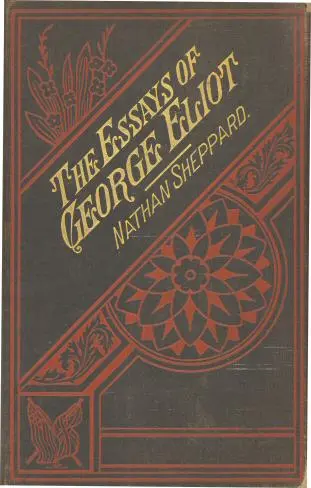
"The Essays of 'George Eliot'" by George Eliot is a collection of literary essays written in the late 19th century. The essays cover a wide range of topics, reflecting on human emotions, societal dynamics, and the nature of literature, presenting George Eliot's insightful analysis of motives and character. As the work encompasses her contributions to periodical literature, it provides a detailed examination of her thoughts and ideas that contribute to her legacy as a prominent female novelist of her time. At the start of the collection, the preface sets the stage for the essays, explaining the curiosity surrounding George Eliot's earlier writings. It highlights her unique talent for analyzing human motives, positioning her as a distinctive voice in fiction, separate from her contemporaries who focus primarily on storytelling. The opening chapters delve into the intricacies of women’s roles in society and literature, with the discussion focusing on Eliot's perspective on characters like Dorothea Brooke from her famous novel "Middlemarch." A key theme emerges in the exploration of the disparity between external appearances and internal realities, as well as the constraints placed on women's lives, fostering a rich conversation about identity, societal expectations, and emotional depth that runs throughout Eliot's work.
Introduction adapted from the source catalogue; source summaries may be automatically generated.
Free to read · English · 105,866 words · No account needed
MAKE TIME FOR A GOOD BOOK
On by default. Untick to stop anonymous reading totals. Each page counts after 10 seconds in view. How this works.
Anonymous counting is on unless you have switched it off.
In 1730 Young was presented by his college with the rectory of Welwyn, in Hertfordshire, and, in the following year, when he was just fifty, he married Lady Elizabeth Lee, a widow with two children, who seems to have been in favor with Queen Caroline, and who probably had an income—two attractions which doubtless enhanced the power of her other charms. Pastoral duties and domesticity probably cured Young of some bad habits; but, unhappily, they did not cure him either of flattery or of fustian. Three more odes followed, quite as bad as those of his bachelorhood, except that in the third he announced the wise resolution of never writing another. It must have been about this time, since Young was now “turned of fifty,” that he wrote the letter to Mrs. Howard (afterward Lady Suffolk), George the Second’s mistress, which proves that he used other engines, besides Pindaric ones, in “besieging Court favor.” The letter is too characteristic to be omitted:
“Monday Morning.
“MADAM: I know his Majesty’s goodness to his servants, and his love of justice in general, so well, that I am confident, if his Majesty knew my case, I should not have any cause to despair of his gracious favor to me.
“Abilities. Want.
Good Manners. Sufferings }
Service. and } for his
Majesty.
Age. Zeal }
These, madam, are the proper points of consideration in the person that humbly hopes his Majesty’s favor.
“As to Abilities, all I can presume to say is, I have done the best I could to improve them.
“As to Good manners, I desire no favor, if any just objection lies
against them.
“As for Service, I have been near seven years in his Majesty’s and never omitted any duty in it, which few can say.
“As for Age, I am turned of fifty.
“As for Want, I have no manner of preferment.
“As for Sufferings, I have lost £300 per ann. by being in his Majesty’s service; as I have shown in a Representation which his Majesty has been so good as to read and consider.
“As for Zeal, I have written nothing without showing my duty to their Majesties, and some pieces are dedicated to them.
“This, madam, is the short and true state of my case. They that make their court to the ministers, and not their Majesties, succeed better. If my case deserves some consideration, and you can serve me in it, I humbly hope and believe you will: I shall, therefore, trouble you no farther; but beg leave to subscribe myself, with truest respect and gratitude,
“Yours, etc.,
EDWARD YOUNG.
Your reading position is saved on this browser. Take it to another device with a library code. Reading pages adapt to text, rather than matching a printed edition.
George Eliot
George Eliot

George Eliot & Elizabeth Barrett Browning & Robert Browning & Percy Bysshe Shelley
George Eliot
BEHIND THE BOOK
This eBook is for the use of anyone anywhere in the United States and most other parts of the world at no cost and with almost no restrictions whatsoever. You may copy it, give it away or re-use it under the terms of the Project Gutenberg License included with this eBook or online at www.gutenberg.org. If you are not located in the United States, you will have to check the laws of the country where you are located before using this eBook. Read the source licence.
The original source file, including credits and licence, is retained by this library. Request an original-format copy at no charge. Please include the book title and Project Gutenberg identifier #28289.
KEEP YOUR CURIOSITY GOING

David Patterson (Spirit) Hatch

David Patterson (Spirit) Hatch

David Patterson (Spirit) Hatch
Cécile Tormay

Moritz Busch
John L. Ransom