THE CLASSIC COLLECTION✦RomolaCLASSIC FREE BOOKS
Romola
George Eliot
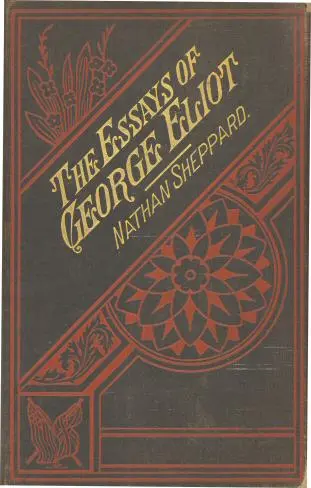
THE CLASSIC COLLECTION · 1883
"The Essays of 'George Eliot'" by George Eliot is a collection of literary essays written in the late 19th century. The essays cover a wide range of topics, reflecting on human emotions, societal dynamics, and the nature of literature, presenting George Eliot's insightful analysis of motives and character. As the work encompasses her contributions to periodical literature, it provides a detailed examination of her thoughts and ideas that contribute to her legacy as a prominent female novelist of her time. At the start of the collection, the preface sets the stage for the essays, explaining the curiosity surrounding George Eliot's earlier writings. It highlights her unique talent for analyzing human motives, positioning her as a distinctive voice in fiction, separate from her contemporaries who focus primarily on storytelling. The opening chapters delve into the intricacies of women’s roles in society and literature, with the discussion focusing on Eliot's perspective on characters like Dorothea Brooke from her famous novel "Middlemarch." A key theme emerges in the exploration of the disparity between external appearances and internal realities, as well as the constraints placed on women's lives, fostering a rich conversation about identity, societal expectations, and emotional depth that runs throughout Eliot's work.
Introduction adapted from the source catalogue; source summaries may be automatically generated.
Free to read · English · 105,866 words · No account needed
MAKE TIME FOR A GOOD BOOK
On by default. Untick to stop anonymous reading totals. Each page counts after 10 seconds in view. How this works.
Anonymous counting is on unless you have switched it off.
Probably, if we could ascertain the images called up by the terms “the people,” “the masses,” “the proletariat,” “the peasantry,” by many who theorize on those bodies with eloquence, or who legislate without eloquence, we should find that they indicate almost as small an amount of concrete knowledge—that they are as far from completely representing the complex facts summed up in the collective term, as the railway images of our non-locomotive gentleman. How little the real characteristics of the working-classes are known to those who are outside them, how little their natural history has been studied, is sufficiently disclosed by our Art as well as by our political and social theories. Where, in our picture exhibitions, shall we find a group of true peasantry? What English artist even attempts to rival in truthfulness such studies of popular life as the pictures of Teniers or the ragged boys of Murillo? Even one of the greatest painters of the pre-eminently realistic school, while, in his picture of “The Hireling Shepherd,” he gave us a landscape of marvellous truthfulness, placed a pair of peasants in the foreground who were not much more real than the idyllic swains and damsels of our chimney ornaments. Only a total absence of acquaintance and sympathy with our peasantry could give a moment’s popularity to such a picture as “Cross Purposes,” where we have a peasant girl who looks as if she knew L. E. L.’s poems by heart, and English rustics, whose costume seems to indicate that they are meant for ploughmen, with exotic features that remind us of a handsome primo tenore. Rather than such cockney sentimentality as this, as an education for the taste and sympathies, we prefer the most crapulous group of boors that Teniers ever painted. But even those among our painters who aim at giving the rustic type of features, who are far above the effeminate feebleness of the “Keepsake” style, treat their subjects under the influence of traditions and prepossessions rather than of direct observation. The notion that peasants are joyous, that the typical moment to represent a man in a smock-frock is when he is cracking a joke and showing a row of sound teeth, that cottage matrons are usually buxom, and village children necessarily rosy and merry, are prejudices difficult to dislodge from the artistic mind, which looks for its subjects into literature instead of life. The painter is still under the influence of idyllic literature, which has always expressed the imagination of the cultivated and town-bred, rather than the truth of rustic life. Idyllic ploughmen are jocund when they drive their team afield; idyllic shepherds make bashful love under hawthorn bushes; idyllic villagers dance in the checkered shade and refresh themselves, not immoderately, with spicy nut-brown ale. But no one who has seen much of actual ploughmen thinks them jocund; no one who is well acquainted with the English peasantry can pronounce them merry. The slow gaze, in which no sense of beauty beams, no humor twinkles, the slow utterance, and the heavy, slouching walk, remind one rather of that melancholy animal the camel than of the sturdy countryman, with striped stockings, red waistcoat, and hat aside, who represents the traditional English peasant. Observe a company of haymakers. When you see them at a distance, tossing up the forkfuls of hay in the golden light, while the wagon creeps slowly with its increasing burden over the meadow, and the bright green space which tells of work done gets larger and larger, you pronounce the scene “smiling,” and you think these companions in labor must be as bright and cheerful as the picture to which they give animation. Approach nearer, and you will certainly find that haymaking time is a time for joking, especially if there are women among the laborers; but the coarse laugh that bursts out every now and then, and expresses the triumphant taunt, is as far as possible from your conception of idyllic merriment. That delicious effervescence of the mind which we call fun has no equivalent for the northern peasant, except tipsy revelry; the only realm of fancy and imagination for the English clown exists at the bottom of the third quart pot.
Your reading position is saved on this browser. Take it to another device with a library code. Reading pages adapt to text, rather than matching a printed edition.
George Eliot
George Eliot

George Eliot & Elizabeth Barrett Browning & Robert Browning & Percy Bysshe Shelley
George Eliot
BEHIND THE BOOK
This eBook is for the use of anyone anywhere in the United States and most other parts of the world at no cost and with almost no restrictions whatsoever. You may copy it, give it away or re-use it under the terms of the Project Gutenberg License included with this eBook or online at www.gutenberg.org. If you are not located in the United States, you will have to check the laws of the country where you are located before using this eBook. Read the source licence.
The original source file, including credits and licence, is retained by this library. Request an original-format copy at no charge. Please include the book title and Project Gutenberg identifier #28289.
KEEP YOUR CURIOSITY GOING

David Patterson (Spirit) Hatch

David Patterson (Spirit) Hatch

David Patterson (Spirit) Hatch
Cécile Tormay

Moritz Busch
John L. Ransom