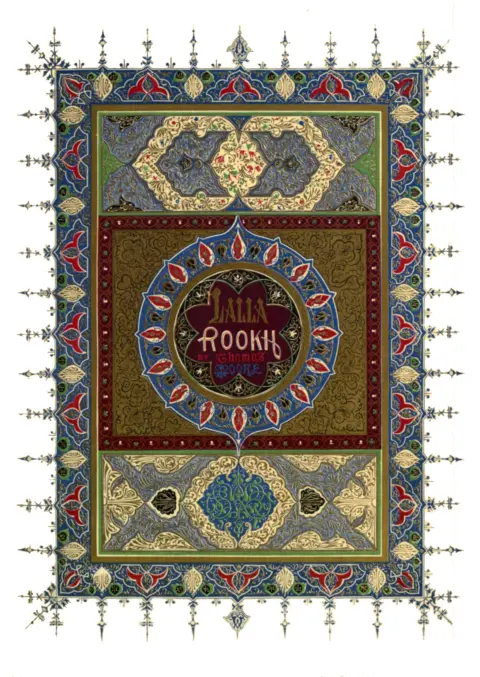
Lalla Rookh
Thomas Moore
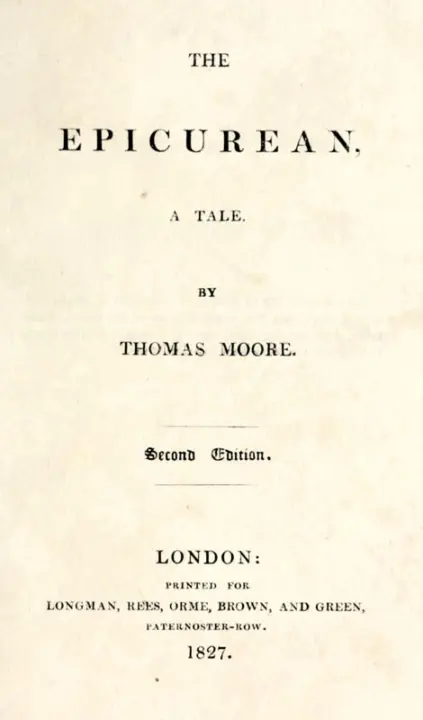
THE CLASSIC COLLECTION · 1827
"The Epicurean: A Tale" by Thomas Moore is a novel written in the early 19th century. The narrative revolves around the philosophy of Epicureanism, exploring themes of pleasure, mortality, and the quest for immortality through the eyes of a young protagonist who is chosen as the leader of the Epicurean sect in Athens. The protagonist's inner turmoil and existential musings set the stage for a rich exploration of human desires and the philosophical debates surrounding life and death. The opening portion of the novel introduces the protagonist, a young Epicurean philosopher, as he reflects on the pleasures of life while grappling with an underlying melancholy regarding mortality. Set against the backdrop of a grand festival celebrating their philosophy, he revels in the beauty of the gardens and the camaraderie of fellow epicureans. However, a dream prompts him to seek eternal life in Egypt, where he believes the secrets of immortality may lie hidden. As he embarks on his journey, the narrative hints at the perils and trials he will face in his pursuit, intricately weaving supernatural and philosophical elements into his quest for understanding life itself.
Introduction adapted from the source catalogue; source summaries may be automatically generated.
Free to read · English · 55,535 words · No account needed
MAKE TIME FOR A GOOD BOOK
On by default. Untick to stop anonymous reading totals. Each page counts after 10 seconds in view. How this works.
Anonymous counting is on unless you have switched it off.
Page 176.—“That rich tapestry,” &c.
Non ego prætulerim Babylonica picta superbè
Texta, Semiramiâ quæ variantur acu.
Martial.
Page 200.—“The Place of Weeping.”—v. Wilford, Asiatic Researches,
vol. 3. p. 340.
Page 210.—“We had long since left this mountain behind.”—The voyages on the Nile are, under favourable circumstances, performed with considerable rapidity. “En cinq ou six jours,” says Maillet, “on pourroit aisément remonter de l’embouchure du Nil à ses cataractes, ou descendre des cataractes jusqu’à la mer.” The great uncertainty of the navigation is proved by what Belzoni tells us:—“Nous ne mîmes cette fois que deux jours et demi pour faire le trajet du Caire à Melawi, auquel, dans notre second voyage, nous avions employés dix‐huit jours.”
Page 212.—“Those mighty statues, that fling their shadows.”—“Elles out près de vingt mètres (61 pieds) d’élévation; et au lever du soleil, leurs ombres immenses s’étendent au loin sur la chaine Libyen.” Description générale de Thèbes, par Messrs. Jollois et Desvilliers.
Ib.—“Those cool alcoves.”—Paul Lucas.
Page 219.—“Whose waters are half sweet, half bitter.”—Paul Lucas.
Page 224.—“The Mountain of the Birds.”—There has been much controversy among the Arabian writers, with respect to the site of this mountain, for which see Quatremere, tom. 1. art. Amoun.
Page 230.—“The hand of labour had succeeded,” &c.—The monks of Mount Sinai (Shaw says) have covered over near four acres of the naked rocks with fruitful gardens and orchards.
Page 233.—“The image of a head.”—There was usually, Tertullian tells us, the image of Christ on the communion‐cups.
Ib.—“Kissed her forehead.”—“We are rather disposed to infer,” says the present Bishop of Lincoln, in his very sensible work on Tertullian, “that, at the conclusion of all their meetings for the purpose of devotion, the early Christians were accustomed to give the kiss of peace, in token of the brotherly love subsisting between them.”
Page 237.—“In the middle of the seven valleys.”—See Macrizy’s account of these valleys, given by Quatremere, tom. 1. p. 450.
Ib.—“Red lakes of Nitria.”—For a striking description of this region, see “Rameses,”—a work which, though, in general, too technical and elaborate, shows, in many passages, to what picturesque effects the scenery and mythology of Egypt may be made subservient.
Page 238.—“In the neighbourhood of Antinoë.”—From the position assigned to Antinoë in this work, we should conclude that it extended much farther to the north, than these few ruins of it that remain would seem to indicate; so as to render the distance between the city and the Mountain of the Birds considerably less than what it appears to be at present.
Your reading position is saved on this browser. Take it to another device with a library code. Reading pages adapt to text, rather than matching a printed edition.
BEHIND THE BOOK
This eBook is for the use of anyone anywhere in the United States and most other parts of the world at no cost and with almost no restrictions whatsoever. You may copy it, give it away or re-use it under the terms of the Project Gutenberg License included with this eBook or online at www.gutenberg.org. If you are not located in the United States, you will have to check the laws of the country where you are located before using this eBook. Read the source licence.
The original source file, including credits and licence, is retained by this library. Request an original-format copy at no charge. Please include the book title and Project Gutenberg identifier #49332.
KEEP YOUR CURIOSITY GOING

David Patterson (Spirit) Hatch
Coulson Kernahan

Ralph Waldo Emerson

Maurice Baring
Frances Wright
Cécile Tormay