Lalla Rookh
Thomas Moore
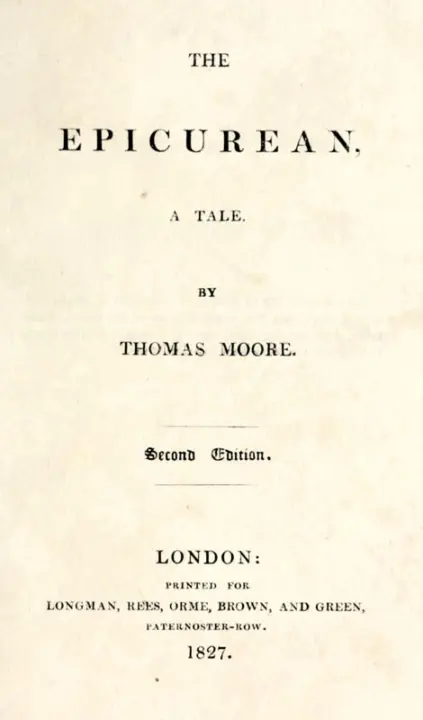
THE CLASSIC COLLECTION · 1827
"The Epicurean: A Tale" by Thomas Moore is a novel written in the early 19th century. The narrative revolves around the philosophy of Epicureanism, exploring themes of pleasure, mortality, and the quest for immortality through the eyes of a young protagonist who is chosen as the leader of the Epicurean sect in Athens. The protagonist's inner turmoil and existential musings set the stage for a rich exploration of human desires and the philosophical debates surrounding life and death. The opening portion of the novel introduces the protagonist, a young Epicurean philosopher, as he reflects on the pleasures of life while grappling with an underlying melancholy regarding mortality. Set against the backdrop of a grand festival celebrating their philosophy, he revels in the beauty of the gardens and the camaraderie of fellow epicureans. However, a dream prompts him to seek eternal life in Egypt, where he believes the secrets of immortality may lie hidden. As he embarks on his journey, the narrative hints at the perils and trials he will face in his pursuit, intricately weaving supernatural and philosophical elements into his quest for understanding life itself.
Introduction adapted from the source catalogue; source summaries may be automatically generated.
Free to read · English · 55,535 words · No account needed
MAKE TIME FOR A GOOD BOOK
On by default. Untick to stop anonymous reading totals. Each page counts after 10 seconds in view. How this works.
Anonymous counting is on unless you have switched it off.
Page 150.—“For a draught of whose flood,” &c.—“Anciennement on portoit les eaux du Nil jusqu’au des contrées fort éloignées, et surtout chez les princesses du sang des Ptolomées, mariées dans des families étrangères.” De Pauw.
Page 154.—“Bearing each the name of its owner.”—“Le nom du maître y étoit écrit, pendant la nuit en lettres de feu.” Maillet.
Page 155.—“Cups of that frail crystal”—called Alassontes. For their brittleness Martial is an authority:—
Tolle, puer, calices, tepidique toreumata Nili,
Et mihi securâ pocula trade manu.
Ib.—“Bracelets of the black beans of Abyssinia.”—The bean of the Glycyne, which is so beautiful as to be strung into necklaces and bracelets, is generally known by the name of the black bean of Abyssinia. Niebhur.
Ib.—“Sweet lotus‐wood flute.”—See M. Villoteau on the musical instruments of the Egyptians.
Page 156.—“Shine like the brow of Mount Atlas at night.”—Solinus speaks of the snowy summit of Mount Atlas glittering with flames at night. In the account of the Periplus of Hanno, as well as in that of Eudoxus, we read that as those navigators were coasting this part of Africa, torrents of light were seen to fall on the sea.
Page 158.—“The tears of Isis.”—“Per lacrymas, vero, Isidis intelligo effluvia quædam Lunæ, quibus tantam vim videntur tribuisse Ægypti.” Jablonski.—He is of opinion that the superstition of the Nucta, or miraculous drop, is of a relic of the veneration paid to the dews, as the tears of Isis.
Page 158.—“The rustling of the acacias,” &c.—Travels of Captain
Mangles.
Ib.—“Supposed to rest in the valley of the moon.”—Plutarch. Dupuis, tom. 10. The Manicheans held the same belief. See Beausobre, p. 565.
Page 160.—“Sothis, the fair star of the waters.”—ὑδραγωγον is the epithet applied to this star by Plutarch, de Isid.
Ib.—“Was its birth‐star.”—Ἡ Σωθεως ανατολη γενεσεως καταρχουσα της εις τον κοσμον. Porphyr. de Antro Nymph.
Page 168.—“Golden Mountains.”—v. Wilford on Egypt and the Nile,
Asiatic Researches.
Ib.—“Sweet‐smelling wood.”—“’A l’époque de la crue le Nil Vert charie les planches d’un bois qui a une odeur semblable à celle de l’encens.” Quatremere.
Page 169.—“Barges full of bees.”—Maillet.
Page 170.—“Such a profusion of the white flowers,” &c.—“On les voit comme jadis cueillir dans les champs des tiges du lotus, signes du débordement et présages de l’abondance; ils s’enveloppent les bras et le corps avec les longues tiges fleuries, et parcourent les rues,” &c. Description des Tombeaux des Rois, par M. Costaz.
Page 173.—“While composing his commentary on the scriptures.”—It was during the composition of his great critical work, the Hexapla, that Origen employed these female scribes.
Your reading position is saved on this browser. Take it to another device with a library code. Reading pages adapt to text, rather than matching a printed edition.
BEHIND THE BOOK
This eBook is for the use of anyone anywhere in the United States and most other parts of the world at no cost and with almost no restrictions whatsoever. You may copy it, give it away or re-use it under the terms of the Project Gutenberg License included with this eBook or online at www.gutenberg.org. If you are not located in the United States, you will have to check the laws of the country where you are located before using this eBook. Read the source licence.
The original source file, including credits and licence, is retained by this library. Request an original-format copy at no charge. Please include the book title and Project Gutenberg identifier #49332.
KEEP YOUR CURIOSITY GOING

David Patterson (Spirit) Hatch
Coulson Kernahan

Ralph Waldo Emerson

Maurice Baring
Frances Wright
Cécile Tormay