
The Writing of News A Handbook with Chapters on Newspaper Correspondence and Copy Reading
Charles G. (Charles Griffith) Ross
THE CLASSIC COLLECTION · 1851
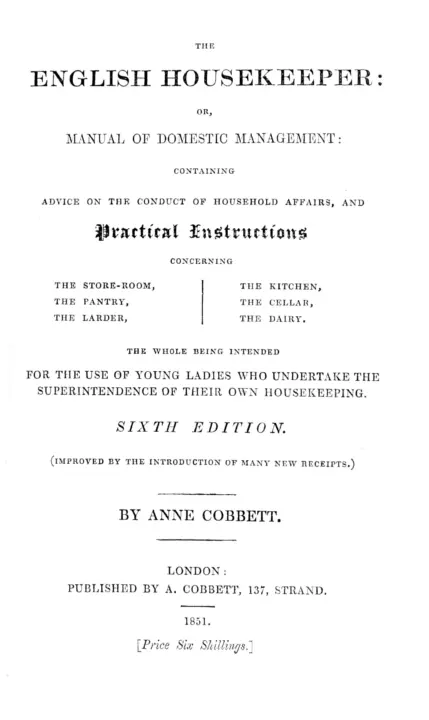
"The English Housekeeper: Or, Manual of Domestic Management" by Anne Cobbett is a practical guide to domestic management written in the mid-19th century. This work serves as a manual for young ladies entering housekeeping, providing instruction on various aspects of household management including cooking, organizing, and maintaining a household effectively. The author emphasizes the importance of practical knowledge in managing a home efficiently, particularly for women of moderate means. The opening of the book outlines the author's goals in providing helpful advice for young housekeepers, particularly in a time when the women of her era may be lacking in essential domestic skills. Cobbett discusses the significance of practical experience over academic learning, lamenting that many young women are ill-prepared for domestic responsibilities due to current educational practices. She emphasizes the value of homemaking skills, from managing finances to culinary practices, and criticizes the societal shift away from these practical arts, thereby setting the stage for the detailed guidance that follows in the subsequent chapters.
Introduction adapted from the source catalogue; source summaries may be automatically generated.
Free to read · English · 150,289 words · No account needed
MAKE TIME FOR A GOOD BOOK
On by default. Untick to stop anonymous reading totals. Each page counts after 10 seconds in view. How this works.
Anonymous counting is on unless you have switched it off.
Although I like French cookery, I am not sufficiently acquainted with the interior of French kitchens to know whether we should improve in the fitting up of ours by imitating our neighbours. When I was abroad, and had opportunities of informing myself upon this subject, I had not the present work in contemplation. And though it is the object of travellers in general to inquire into almost every thing while passing through a foreign country, it happened once to me to meet with so much discouragement, when prying into the culinary department of a large Hotel in the south of France, that I hesitated to enter a foreign kitchen again. I was then on the way to Italy, and from what was afterwards told me respecting the kitchens of the latter country, I have reason to think that my resolution was not unwise, since, had it been overcome by fresh curiosity, I might have been induced to starve from too intimate knowledge of the mode in which the dishes of our table were prepared. We had, at the hotel I am speaking of, fared sumptuously for three days. There were, among other things, the finest poultry and the most delicate pastry imaginable. But some chicken broth was wanted for an invalid of our party, and the landlord suggested that if Mademoiselle would herself give directions to the cook, the broth might, perhaps, be the better made; and he went, accordingly, to announce my intended visit to the important person who commanded in the kitchen. Upon receiving intimation that all was ready, I descended, and was introduced to the said cook, who met me at the door of a large, lofty, vaulted apartment, the walls of which were black, not from any effect of antiquity, but from those of modern smoke, and decorated with a variety of copper utensils, all nearly as black on their outsides as the walls on which they hung. Of what hue their insides might be I did not ascertain; and, at the moment, my attention was suddenly diverted by the cook, who, begging me to be seated, placed a chair by the side of a large, wild-looking fire-place. I had not expected to see a tall, thin and bony, or a short and {43}fat woman, like the cook of an English kitchen; I imagined a man, somewhat advanced in age, and retaining some traces of the ancien regime, with large features and a small body, with grizzly and half-powdered hair, and, perhaps, a pigtail; at all events, with slippers down at heel, hands unclean, and a large snuff-box. It was, therefore, not without surprise that I found the very contrary of this in the personage who, dressed in a white apron, white sleeves, and white night cap of unexceptionable cleanness, and bowing with a grace that would have done credit to the most accomplished petit maître of the last century, proceeded to relate how he had been instructed in the art of making chicken broth by an English Miledi, who in passing into Italy for the benefit of her health, had staid some weeks at the Hotel de l'Europe. His detail of the process of broth-making was minute, and no doubt scientific, but unhappily for the narrator, it was interrupted by his producing a delicate white fowl, which he without ceremony laid on the kitchen table, which stood in the middle of the room, and rivalled the very walls themselves in blackness. I was assured, by the first glance at this table, by reason of the fragments of fish, fowl, and pastry, strewed over it, that the same piece of furniture served every purpose of chopping-block and paste-board. When, therefore, under these circumstances, I saw the preparation for the broth just going to commence, the exclamation of "Dirty pigs!" was making its way to my lips, and I, in order to avoid outraging the ears of French politeness, in the spot of all France most famous for the romantic, made the best of my way out of the kitchen, and endeavoured, when the next dinner-time arrived, to forget that I had ever seen it. Whenever afterwards the figure of this black table appeared to my fancy, like a spectre rising to warn me against tasteful and delicate looking entremets, I strove to forget the reality; but I never recovered the feeling of perfect security in what I was about to eat until the sea again rolled between me and the kitchen of the Hotel de l'Europe, and I again actually saw the clear bright fire, the whitened hearth, the yellow-ochred walls, the polished tins, the clean-scrubbed tables and chairs, and the white dresser cloths, of the kitchen, such as I had always been used to see at my own home.
Your reading position is saved on this browser. Take it to another device with a library code. Reading pages adapt to text, rather than matching a printed edition.
BEHIND THE BOOK
This eBook is for the use of anyone anywhere in the United States and most other parts of the world at no cost and with almost no restrictions whatsoever. You may copy it, give it away or re-use it under the terms of the Project Gutenberg License included with this eBook or online at www.gutenberg.org. If you are not located in the United States, you will have to check the laws of the country where you are located before using this eBook. Read the source licence.
The original source file, including credits and licence, is retained by this library. Request an original-format copy at no charge. Please include the book title and Project Gutenberg identifier #55314.
KEEP YOUR CURIOSITY GOING
Charles G. (Charles Griffith) Ross
Hannah Webster Foster

Emily Lawless
Edwin Hamlin Carr

Charles De Lano Hine
Andrew Ure