
The Writing of News A Handbook with Chapters on Newspaper Correspondence and Copy Reading
Charles G. (Charles Griffith) Ross
THE CLASSIC COLLECTION · 1851
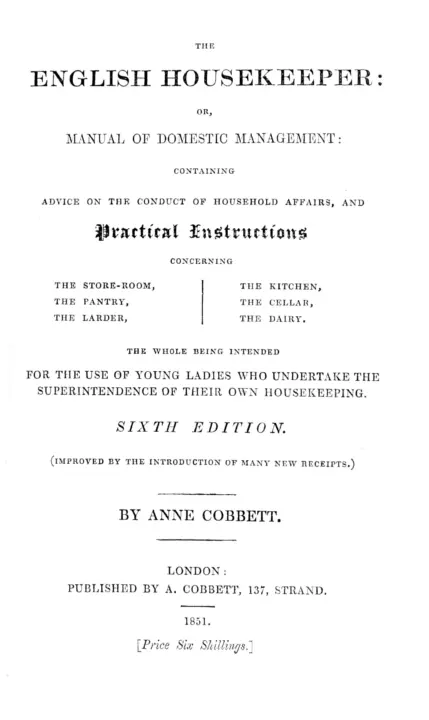
"The English Housekeeper: Or, Manual of Domestic Management" by Anne Cobbett is a practical guide to domestic management written in the mid-19th century. This work serves as a manual for young ladies entering housekeeping, providing instruction on various aspects of household management including cooking, organizing, and maintaining a household effectively. The author emphasizes the importance of practical knowledge in managing a home efficiently, particularly for women of moderate means. The opening of the book outlines the author's goals in providing helpful advice for young housekeepers, particularly in a time when the women of her era may be lacking in essential domestic skills. Cobbett discusses the significance of practical experience over academic learning, lamenting that many young women are ill-prepared for domestic responsibilities due to current educational practices. She emphasizes the value of homemaking skills, from managing finances to culinary practices, and criticizes the societal shift away from these practical arts, thereby setting the stage for the detailed guidance that follows in the subsequent chapters.
Introduction adapted from the source catalogue; source summaries may be automatically generated.
Free to read · English · 150,289 words · No account needed
MAKE TIME FOR A GOOD BOOK
On by default. Untick to stop anonymous reading totals. Each page counts after 10 seconds in view. How this works.
Anonymous counting is on unless you have switched it off.
IT would be impossible to give rules for the management of a domestic establishment, because they would necessarily be subject to many and various exceptions, produced by various circumstances. But a few general observations, accompanied by remarks on the most important matters in domestic life, may not be unacceptable to young housekeepers.
In the young and thoughtless, a spirit of emulation, leading them to vie with those who are richer than themselves, is often the source of domestic unhappiness, by causing so much to be sacrificed to appearance, as to circumscribe the means of enjoying the substantial comforts of life. It sometimes manifests itself in houses, equipages, and retinues of servants; but amongst persons of moderate income, for whose use this work is principally intended, it is commonly displayed in costly furniture and expensive entertainments. Many young married women conceive the notion, that unless they have as fine a house, as expensive furniture, plate, china, and glass, as some others have, and give as fine entertainments as others give; in short, unless they make the appearance of living quite as well as their richer neighbours, they will not be held in equal estimation. It is not that they derive any real pleasure from the false appearance which they make; indeed, expensive furniture is but an annoyance to its possessor, if there be not a sufficient number of good servants to keep it in order. Where the whole family concur in this sort of pride, no {2}mortification arises from difference of opinion, but the unanimity tends only to accelerate the ruin.
The young housekeeper should consider the serious consequences that are likely to result from setting out in a style of lavish expenditure, and she should remember that, while it is easy to extend, it is extremely difficult to reduce, her establishment. One expensive article requires another to correspond with it, and one expensive entertainment imposes the necessity of other equally expensive entertainments; for it requires no small share of moral courage to risk the loss of consequence which may result by its being surmised that we are not so well off, as we have been supposed to be. And when the time comes, as sooner or later it assuredly must, when the means are not adequate to the demands, what sacrifices are made, and what unseemly contrivances are resorted to, in order to keep up, to the last, a poor remnant of "appearance!" and, when this can no longer be effected, then comes the humiliation, with all the bitter feelings attendant upon retrenchment; of all which feelings, the bitterest is, the dread of being degraded in the world's estimation. To endure privations with resignation, to feel the want of habitual comforts, yet be grateful for the blessings which are left to us, is the duty of every Christian, and is the less arduous when the reverse of fortune which has befallen us, has not been produced by any fault of our own. But if, in addition to the distresses of adversity, the wife and the mother be doomed to writhe under the pang of self-reproach, great indeed must be her suffering, and one for which I can suggest no adequate relief. To the young and generous-minded, the hardest portion which accompanies reverses of fortune, is, the change which they sometimes produce in the behaviour of acquaintances. When we are become poorer than we were, and have lost the ability to entertain guests in the accustomed manner, it is painful to perceive some of those very people who have been the most hospitably entertained, and who, in our prosperity, have appeared the most attached to us, turn from us and our difficulties, while they banish from their minds the recollection of past kindness. To meet with indifference in those whose smiles have courted ours; to feel that we have thrown away sincere friendship upon mere heartlessness, is hard to be endured, even by the faultless, but how {3}intolerable must it be, when aggravated by the consciousness that we have incurred it by our own misconduct. To the experienced, this is one of the severest vicissitudes of life; what, then, must it be to us, before we have acquired that equanimity of mind, which falls only to the lot of those who have passed through the ordeal of the world, and who have been amply compensated for the desertion of the many, by the sincerity, the warmth of heart, and the steadfastness of the few.
Your reading position is saved on this browser. Take it to another device with a library code. Reading pages adapt to text, rather than matching a printed edition.
BEHIND THE BOOK
This eBook is for the use of anyone anywhere in the United States and most other parts of the world at no cost and with almost no restrictions whatsoever. You may copy it, give it away or re-use it under the terms of the Project Gutenberg License included with this eBook or online at www.gutenberg.org. If you are not located in the United States, you will have to check the laws of the country where you are located before using this eBook. Read the source licence.
The original source file, including credits and licence, is retained by this library. Request an original-format copy at no charge. Please include the book title and Project Gutenberg identifier #55314.
KEEP YOUR CURIOSITY GOING
Charles G. (Charles Griffith) Ross
Hannah Webster Foster

Emily Lawless
Edwin Hamlin Carr

Charles De Lano Hine
Andrew Ure