
The Writing of News A Handbook with Chapters on Newspaper Correspondence and Copy Reading
Charles G. (Charles Griffith) Ross
THE CLASSIC COLLECTION · 1851
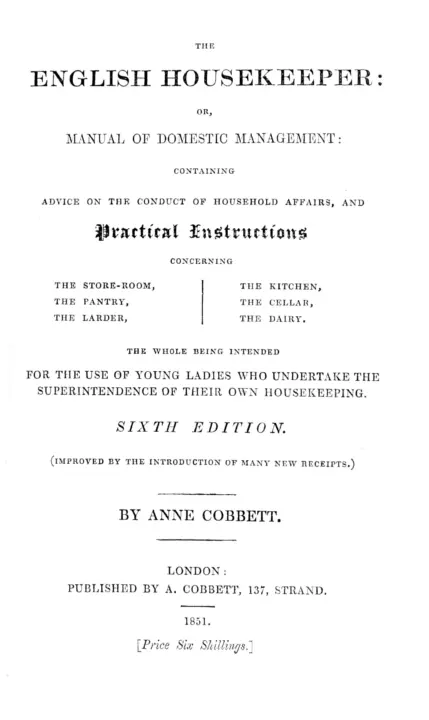
"The English Housekeeper: Or, Manual of Domestic Management" by Anne Cobbett is a practical guide to domestic management written in the mid-19th century. This work serves as a manual for young ladies entering housekeeping, providing instruction on various aspects of household management including cooking, organizing, and maintaining a household effectively. The author emphasizes the importance of practical knowledge in managing a home efficiently, particularly for women of moderate means. The opening of the book outlines the author's goals in providing helpful advice for young housekeepers, particularly in a time when the women of her era may be lacking in essential domestic skills. Cobbett discusses the significance of practical experience over academic learning, lamenting that many young women are ill-prepared for domestic responsibilities due to current educational practices. She emphasizes the value of homemaking skills, from managing finances to culinary practices, and criticizes the societal shift away from these practical arts, thereby setting the stage for the detailed guidance that follows in the subsequent chapters.
Introduction adapted from the source catalogue; source summaries may be automatically generated.
Free to read · English · 150,289 words · No account needed
MAKE TIME FOR A GOOD BOOK
On by default. Untick to stop anonymous reading totals. Each page counts after 10 seconds in view. How this works.
Anonymous counting is on unless you have switched it off.
When ladies take the trouble to teach the poor to read and write, they mean well, no doubt, and think they are doing the best they can for their pupils. But teaching industry is more to the purpose; for when learning has been found insufficient to preserve the morals of princes, nobles, and gentry, how can it be supposed that it will preserve those of their dependents? The supposition is, in fact, injurious to the cause of true learning, since the system founded upon it has been attended by no moral improvement. Our well-being is best secured by an early habit of earning our bread by honest labour; and
"Not to know at large of things remote
From use, obscure, and subtle, but to know
That which before us lies in daily life,
Is the prime wisdom; what is more, is fume.
Or emptiness, or fond impertinence,
And renders us in things that most concern,
Unpractis'd, unprepar'd, and still to seek."
A country girl, the daughter of a labourer, would, by making herself in some way practically useful to society, and gaining a respectable livelihood, be more profitably employed than in going through that long course of literary exercise which has, of late, been so generally bestowed on the children of poor people, but which, I fear, has not generally imparted to them much of what MILTON styles "the prime wisdom." It should also be considered, that the literary education of the poor, such as it is, cannot be much more than half completed at the age when the children cease to receive lessons from their charitable instructors. They are taught to read, to write a little, and perhaps something of the elements of arithmetic. The reading, however, is the principal attainment; and in this, they generally become well enough schooled before they are eleven, or, at most, twelve years of age. But alas! have they at that age, or at the age of thirteen or fourteen, {xiv}been taught all that is necessary for girls so young to learn, with regard to the choice of books? With the use of letters, indeed, as the mere components of words, they have been made acquainted. But why have they been taught to read at all, unless there be some profit to be derived from their reading; and how can any profit be looked for from that reading, unless there be the same kind of pains taken to point out the proper objects of study as there have been to teach the little scholars to spell? Surely that advice which is required by all young persons in the pursuit of book-learning, is at least as necessary to those who can do no more than just read their own native language, as it is to those who are brought up in a superior way. The education of youth, among the higher and middle classes, does not terminate, or, at least, it never should, immediately on their leaving school. At that period, a fresh series of anxieties occur to the parent or the guardian, who is quite as sedulous as before, to finish that which has been, in fact, only begun at school. If this be not the case, how is it, that though the son may have been eight or ten years at the best schools, the father, after the schooling is ended, finds it necessary to consult the most discreet and experienced advisers, concerning the right guidance of his child in the course of his future studies? The attention paid to the studies of young ladies, after they come from school, is, to be sure, not precisely the same as that which parents think requisite for their sons. But, while the daughter has generally the advantage of being with her mother, or with some female relative much older than herself; and while the success in life of our sex does not so frequently depend upon literary acquirements, and the proper employment of them; yet under such circumstances, favourable as they are, we all know that there is still much wanting, both in the way of counsel and attractive example, from the parent or guardian, to render the learning which a young girl has acquired at school, of substantial service to her in after years. If the daughters of the rich require to be taught, not merely to read, but, also, what to read, why should not this be the case with the daughters of the poor? in whose fate, it is too often proved, that "a little learning is a dangerous thing," owing to the want of that discretion which is necessary to prevent the little learning becoming worthless, and even mischievous, to its possessor.
Your reading position is saved on this browser. Take it to another device with a library code. Reading pages adapt to text, rather than matching a printed edition.
BEHIND THE BOOK
This eBook is for the use of anyone anywhere in the United States and most other parts of the world at no cost and with almost no restrictions whatsoever. You may copy it, give it away or re-use it under the terms of the Project Gutenberg License included with this eBook or online at www.gutenberg.org. If you are not located in the United States, you will have to check the laws of the country where you are located before using this eBook. Read the source licence.
The original source file, including credits and licence, is retained by this library. Request an original-format copy at no charge. Please include the book title and Project Gutenberg identifier #55314.
KEEP YOUR CURIOSITY GOING
Charles G. (Charles Griffith) Ross
Hannah Webster Foster

Emily Lawless
Edwin Hamlin Carr

Charles De Lano Hine
Andrew Ure