
The Writing of News A Handbook with Chapters on Newspaper Correspondence and Copy Reading
Charles G. (Charles Griffith) Ross
THE CLASSIC COLLECTION · 1851
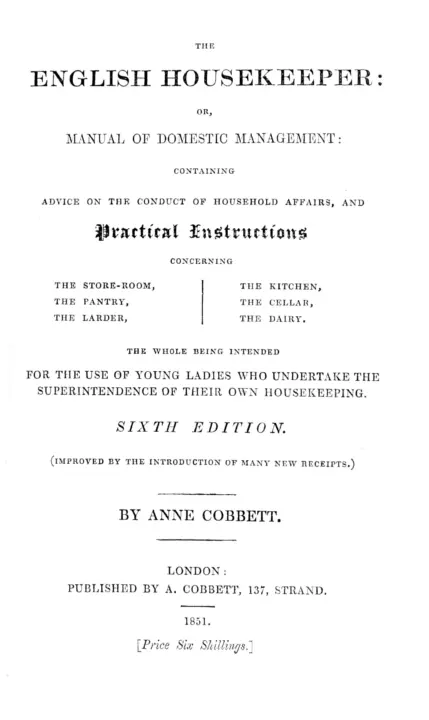
"The English Housekeeper: Or, Manual of Domestic Management" by Anne Cobbett is a practical guide to domestic management written in the mid-19th century. This work serves as a manual for young ladies entering housekeeping, providing instruction on various aspects of household management including cooking, organizing, and maintaining a household effectively. The author emphasizes the importance of practical knowledge in managing a home efficiently, particularly for women of moderate means. The opening of the book outlines the author's goals in providing helpful advice for young housekeepers, particularly in a time when the women of her era may be lacking in essential domestic skills. Cobbett discusses the significance of practical experience over academic learning, lamenting that many young women are ill-prepared for domestic responsibilities due to current educational practices. She emphasizes the value of homemaking skills, from managing finances to culinary practices, and criticizes the societal shift away from these practical arts, thereby setting the stage for the detailed guidance that follows in the subsequent chapters.
Introduction adapted from the source catalogue; source summaries may be automatically generated.
Free to read · English · 150,289 words · No account needed
MAKE TIME FOR A GOOD BOOK
On by default. Untick to stop anonymous reading totals. Each page counts after 10 seconds in view. How this works.
Anonymous counting is on unless you have switched it off.
Asparagus, forced, may be obtained in January; the natural growth, it comes in about the middle of April, and continues through May, June, and July.
French Beans, forced, may be obtained in February, of the natural growth, the beginning of July; and they continue in succession through August.
Red Beet is in season all the year.
Scotch Cale in November.
Brocoli in October.
Cabbage of most sorts in May, June, July, and August.
Cardoons from November till March.
Carrots come in in May.
Cauliflowers, the beginning of June.
Celery, the beginning of September.
Corn Salad, in May.
Cucumbers may be forced as early as March; of their natural growth they come in July, and are plentiful in August and September.
{34}Endive comes in in June, and continues through the winter.
Leeks come in in September, and continue till the Spring.
Lettuce, both the Coss and the Cabbage, come in about April, and continue to the end of August.
Onions, for keeping, in August.
Parsley, all the year.
Parsnips come in in October; but they are not good until the frost has
touched them.
Peas, the earliest forced, come in about the beginning of May; of their natural growth, about the beginning of June, and continue till the end of August.
Potatoes, forced, in the beginning of March; and the earliest of natural
growth in May.
Radishes, about the beginning of March.
Small Salad, in May and June; but may be had all the year.
Salsify and Scorzonera, in July and August.
Sea Kale may be found as early as December or January, but of the natural growth it comes in in April and May.
Eschalots, for keeping, in August and three following months.
Spring Spinach, in March, April, and three following months.
Winter Spinach from October through the winter.
Turnips, of the garden, in May; but the field Turnips, which are best, in
October.
Your reading position is saved on this browser. Take it to another device with a library code. Reading pages adapt to text, rather than matching a printed edition.
BEHIND THE BOOK
This eBook is for the use of anyone anywhere in the United States and most other parts of the world at no cost and with almost no restrictions whatsoever. You may copy it, give it away or re-use it under the terms of the Project Gutenberg License included with this eBook or online at www.gutenberg.org. If you are not located in the United States, you will have to check the laws of the country where you are located before using this eBook. Read the source licence.
The original source file, including credits and licence, is retained by this library. Request an original-format copy at no charge. Please include the book title and Project Gutenberg identifier #55314.
KEEP YOUR CURIOSITY GOING
Charles G. (Charles Griffith) Ross
Hannah Webster Foster

Emily Lawless
Edwin Hamlin Carr

Charles De Lano Hine
Andrew Ure