
The Writing of News A Handbook with Chapters on Newspaper Correspondence and Copy Reading
Charles G. (Charles Griffith) Ross
THE CLASSIC COLLECTION · 1851
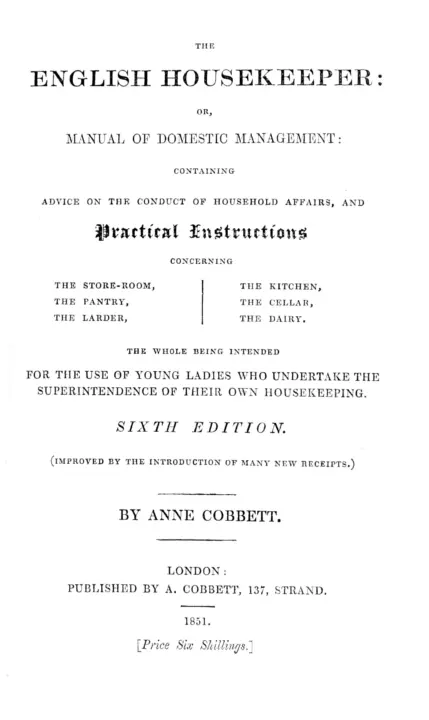
"The English Housekeeper: Or, Manual of Domestic Management" by Anne Cobbett is a practical guide to domestic management written in the mid-19th century. This work serves as a manual for young ladies entering housekeeping, providing instruction on various aspects of household management including cooking, organizing, and maintaining a household effectively. The author emphasizes the importance of practical knowledge in managing a home efficiently, particularly for women of moderate means. The opening of the book outlines the author's goals in providing helpful advice for young housekeepers, particularly in a time when the women of her era may be lacking in essential domestic skills. Cobbett discusses the significance of practical experience over academic learning, lamenting that many young women are ill-prepared for domestic responsibilities due to current educational practices. She emphasizes the value of homemaking skills, from managing finances to culinary practices, and criticizes the societal shift away from these practical arts, thereby setting the stage for the detailed guidance that follows in the subsequent chapters.
Introduction adapted from the source catalogue; source summaries may be automatically generated.
Free to read · English · 150,289 words · No account needed
MAKE TIME FOR A GOOD BOOK
On by default. Untick to stop anonymous reading totals. Each page counts after 10 seconds in view. How this works.
Anonymous counting is on unless you have switched it off.
But the condition of the other class is very different. Some of these have never, from their earliest infancy, been accustomed to any of those scenes in which, though there be difficulties, there are circumstances to excite perseverance, and to reward painstaking. These are born in absolute want; their experience under the roof of their parents has been but a course of destitution; and they go forth into the world rather as fugitives from misery than as seekers to be more prosperous. If they obtain employment, their labour is perhaps repaid by wages barely sufficient to keep them alive; destitute of the means of practising anything like household management, never having known what it is to have a home, worthy to be so called, for a single day, it is scarcely possible for them to obtain that knowledge, simple as it is, which is required to contrive the various modes of making much out of a little. Besides, if the poor people existing in this condition were ever so inclined to do well, there are the strongest inducements held out to them to mismanage their small stock of means; they are continually standing in need of some temporary sustenance; and, who can wonder if thus bereft of all power to provide or to economise, they yield to destruction, and suffer themselves to be allured by the {384}glare of the gin-palace, or the revelry of the pot-house! It is one of the signs of misery with such persons, that they are little acquainted with the art of cookery. Here and there may be found a poor woman who has become skilful by serving in the kitchens of other persons: but this is only an exception, and too rare to be of account.
In almost every family there are, occasionally, things which may be spared from its consumption, to be converted, by an experienced cook, into palatable and nourishing food for poor people, but which, if given to them in the shape of fragments, they would be totally ignorant how to make use of. Such, for instance, as bones with very little meat on them, trimmings of meat, of poultry, &c., some cooked, some uncooked, crusts of bread, and pieces of dripping; yet these, with a little pepper, salt, and flour to thicken, may, by careful cooking and scumming, be made to produce an excellent meal for a family of children.--Few servants are unwilling to take the trouble of helping their poor fellow creatures, and, if the head of every family would give as much as she can spare to the poor who live immediately in her own neighbourhood, more general good would be done than ladies can reasonably hope to do by subscribing their money to "societies," which, though they may have been established by the best-intentioned persons, and for the kindest of purposes, can never be so beneficial in their effects as that charity which one individual bestows on another. The relief which is doled out by a "Society" is accompanied by very imperfect, if any, inquiries into the particular circumstances of the persons relieved; by no expressions of sympathy, by no encouraging promises for the future, to cheer the heart of the anxious mother as she bends her way homeward with her kettle of soup: the soup which has been obtained by presenting a ticket is apportioned to the little hungry creatures, without their being reminded who it is that has so kindly provided for them, and after it is eaten there is no more thought about the source whence it came than about the hunger which it has removed. The private mode of charity is superior to the public in every way. There are great advantages arising from the former which the latter can never procure. Not only must the attentions of a known individual be the most {385}gratefully appreciated by a poor man and woman, but the child which has often gone to bed satisfied and happy, after a supper provided by some good neighbour, cannot be expected to grow up without some of those feelings of personal respect and attachment for its benefactor, which, while they prevent the contrast of riches with poverty from becoming odious, are the strongest assurances of union between him who claims a property in the soil and him whose labour makes that property of value. Self-interest and humanity are not the least at variance in this matter; the same course of policy is dictated to both. It may seem glorious to be advertised throughout Europe, and to be read of in newspapers, as a large subscriber to a public Institution; but the benefits which are confined to a single parish are the more lasting from being local, and the fame of the distributor, though bounded in distance, is all the more deserved, the longer kept alive and cherished, and, consequently, the better worth endeavouring to obtain.
Your reading position is saved on this browser. Take it to another device with a library code. Reading pages adapt to text, rather than matching a printed edition.
BEHIND THE BOOK
This eBook is for the use of anyone anywhere in the United States and most other parts of the world at no cost and with almost no restrictions whatsoever. You may copy it, give it away or re-use it under the terms of the Project Gutenberg License included with this eBook or online at www.gutenberg.org. If you are not located in the United States, you will have to check the laws of the country where you are located before using this eBook. Read the source licence.
The original source file, including credits and licence, is retained by this library. Request an original-format copy at no charge. Please include the book title and Project Gutenberg identifier #55314.
KEEP YOUR CURIOSITY GOING
Charles G. (Charles Griffith) Ross
Hannah Webster Foster

Emily Lawless
Edwin Hamlin Carr

Charles De Lano Hine
Andrew Ure