
The Writing of News A Handbook with Chapters on Newspaper Correspondence and Copy Reading
Charles G. (Charles Griffith) Ross
THE CLASSIC COLLECTION · 1851
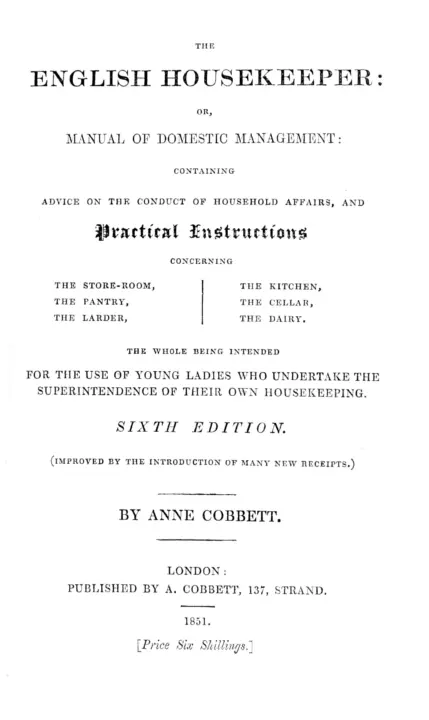
"The English Housekeeper: Or, Manual of Domestic Management" by Anne Cobbett is a practical guide to domestic management written in the mid-19th century. This work serves as a manual for young ladies entering housekeeping, providing instruction on various aspects of household management including cooking, organizing, and maintaining a household effectively. The author emphasizes the importance of practical knowledge in managing a home efficiently, particularly for women of moderate means. The opening of the book outlines the author's goals in providing helpful advice for young housekeepers, particularly in a time when the women of her era may be lacking in essential domestic skills. Cobbett discusses the significance of practical experience over academic learning, lamenting that many young women are ill-prepared for domestic responsibilities due to current educational practices. She emphasizes the value of homemaking skills, from managing finances to culinary practices, and criticizes the societal shift away from these practical arts, thereby setting the stage for the detailed guidance that follows in the subsequent chapters.
Introduction adapted from the source catalogue; source summaries may be automatically generated.
Free to read · English · 150,289 words · No account needed
MAKE TIME FOR A GOOD BOOK
On by default. Untick to stop anonymous reading totals. Each page counts after 10 seconds in view. How this works.
Anonymous counting is on unless you have switched it off.
Put them into lukewarm water to cover them, soap the feet well, and rub that part which is soiled, with smelt blue; lay them smooth in the water, strew some blue {379}between the folds, and let them lie all night; be careful in washing to rub them well, as the blue is hard to come out: the second lather must be of equal heat, but not quite so blue. Cut bear is used to tinge them pink.
To clean Floor Cloths.
Sweep, then rub the floor cloth with a damp flannel, then with milk or milk and water, and polish with a clean dry cloth. This is better than wax.
To clean Stone Stairs.
Boil in 2 quarts of water ½ pint of size, the same of stone blue, 2 table-spoonsful of whitening, and 2 cakes of pipe-maker's clay. Wet a flannel with this, wash the stones with it, and when dry, rub with a clean flannel and brush.
To take Oil from Stone or Boards.
To a strong ley of pearl-ashes, add some unslacked lime, let it settle, pour it off clear; lower it with water, and scour the grease spots; but it must be done quickly.
To get a Stopper out of a Decanter.
Drop a few drops of spirits of wine on it, and it will soon come out.
To take Rust from Steel.
Rub well with sweet oil, and two days after, rub with unslacked lime till
the rust disappears.
To clean Steel Stoves and Fire Irons.
Rub with a piece of flannel dipped in oil, then in emery powder; polish with a leather and rotten stone.
To clean Paint.
Put a very little pearl-ash or soda into the water, to soften it, then wash the paint with a flannel and soft soap; wash the soap off, and wipe dry with clean linen cloths.
{380}To clean Papered Walls.
The very best method is to rub with stale bread. Cut the crust off very thick, and wipe straight down from the top, then go to the top again, and so on.
To clean Tin Covers.
They should be wiped dry after being used, to prevent their becoming rusty. Mix a little fine whitening with sweet oil, and rub well, wipe this off clean, then polish with a leather and dry whitening.
To clean Copper Utensils.
If the kitchen be damp, or very hot, the coppers will turn black. Rub brick dust over, then a flannel dipped in oil; polish with leather and rotten stone.
Marking Ink.
Mix 5 scruples of silver caustic, 2 drachms of gum arabic, 1 scruple of sap gum, in 1 oz. distilled water, in a glass bottle. The wash to use previously; ½ oz. of soda subcarbonate in 2 oz. distilled water.
Ink.
Your reading position is saved on this browser. Take it to another device with a library code. Reading pages adapt to text, rather than matching a printed edition.
BEHIND THE BOOK
This eBook is for the use of anyone anywhere in the United States and most other parts of the world at no cost and with almost no restrictions whatsoever. You may copy it, give it away or re-use it under the terms of the Project Gutenberg License included with this eBook or online at www.gutenberg.org. If you are not located in the United States, you will have to check the laws of the country where you are located before using this eBook. Read the source licence.
The original source file, including credits and licence, is retained by this library. Request an original-format copy at no charge. Please include the book title and Project Gutenberg identifier #55314.
KEEP YOUR CURIOSITY GOING
Charles G. (Charles Griffith) Ross
Hannah Webster Foster

Emily Lawless
Edwin Hamlin Carr

Charles De Lano Hine
Andrew Ure